
A Basement Bathroom Below the Sewer Line: Questions Before You Buy
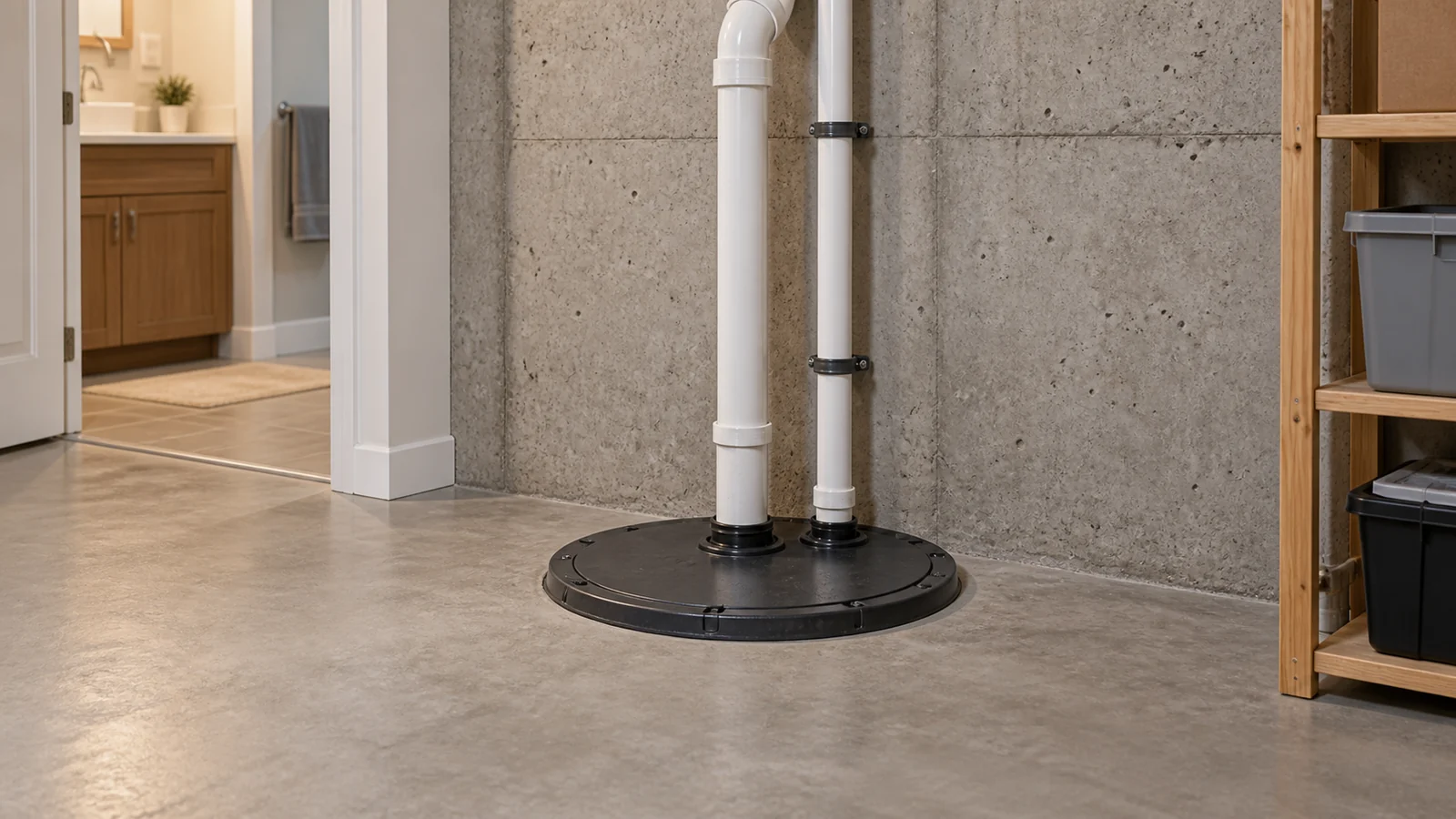
A basement bathroom can look entirely ordinary while depending on equipment hidden behind a service-room door. If wastewater cannot reach the receiving drain by gravity, a pumping arrangement may be part of what makes the bathroom usable. The buying question is not simply whether the toilet flushes today. It is which fixtures depend on the equipment, what happens when it stops, and what you will inherit in maintenance, access and repair obligations.
Start by asking the seller to identify the drainage arrangement and provide the equipment records. Then have a qualified plumber confirm the actual installation. A room being below street level does not, by itself, identify the sewer connection elevation or prove that a pump is necessary. Nor does the presence of a pump tell you whether it serves sewage, foundation drainage or something else.
The useful outcome is a small handover file tied to identifiable equipment, not a reassuring description of “a new sump.” That phrase can conceal two very different systems.
First establish what the pump actually handles
A foundation-drainage sump collects water around the foundation and pumps it away. The federal government's sump-pump guidance describes that purpose, including the relationship to weeping tile and the need for electricity. It is not a guide to handling toilet waste. Government of Canada sump-pump guidance
A sewage pumping system serves wastewater fixtures. Depending on the installation, it might involve a packaged sewage-ejector arrangement, a grinder system or another specified design. Those names are not interchangeable purchasing instructions. The equipment label and the plumber's findings matter more than the seller's shorthand.
Ask the plumber to identify which fixtures connect to the system and where the discharge goes. Does it serve just the downstairs toilet, the whole bathroom, laundry equipment or other rooms? Do upstairs fixtures have a separate gravity route? Can the dependent fixtures be clearly identified for a future occupant? These answers define the inconvenience and potential consequences of an outage.
Do not open a sealed basin or manipulate floats and electrical connections during a viewing. Manufacturer warnings address electrical hazards and sewage-related risks; inspection and testing need the appropriate qualified personnel. A buyer's useful role is to arrange access, collect evidence and ask what was actually tested. Liberty LE/LEH sewage-pump manual, safety and operation sections
One flush is a demonstration, not a condition report
A seller can truthfully say that the bathroom works while knowing little about the pump underneath it. A short demonstration does not establish the condition of controls, the warning arrangement, the discharge route or the installation's suitability for the connected fixtures.
Specify the inspection you need. Ask whether the plumber can identify the pump and controls, assess accessible connections and service access, observe an appropriate operating test, and report concerns or limits. If the system cannot be safely accessed, that limitation belongs in the report. “Not inspected behind finished wall” is different from “inspected with no concern identified.”
For one manufacturer example, Liberty's LE/LEH manual describes checking operation through multiple cycles and checking any alarm under its testing instructions. That illustrates why a system assessment is more informative than seeing a toilet empty once. It is not a prescription for testing every brand or a substitute for the manual for the installed system. Liberty manual, page 9
Ask about past symptoms without trying to diagnose them yourself: alarms, unusually frequent cycling, slow drainage, odours, power interruptions, pump replacement and any overflow or cleanup. Request the service invoice associated with each reported event. An invoice saying “pump replaced” does not necessarily mean that the basin, controls, valves, alarm or discharge piping were replaced too.
Put the whole system on one handover card
The following card can be copied into an inspection request and completed with the seller and plumber. Keep photographs of accessible labels with it. Unknown answers should stay marked unknown until supported; do not convert an approximate installation date into a warranty date.
| Handover entry | Evidence to attach or question to resolve |
|---|---|
| Fixtures served | Plumber-confirmed list and any rooms that must not be used during a fault |
| Pump identity | Manufacturer, model, serial number and readable label photograph |
| Other components | Basin/system model, control and alarm identifiers, and separate manuals where applicable |
| Installation history | Installation date if documented, contractor invoice, subsequent replacements and exact scope |
| Approval record | Relevant plumbing and any other required permits, inspection results and unresolved items |
| Operation and warning | Date and scope of professional test; how an occupant receives and responds to a warning |
| Service access | How the cover and equipment are reached without damaging finished construction; any access limitation |
| Power interruption | Which fixtures become unavailable; any documented, compatible backup arrangement and its limits |
| Maintenance handover | Applicable instructions, last service, recommended next service and service contact |
| Failure history | Reported incident, cause if established, repair and cleanup evidence, and any insurer requirements |
Treat the pump and its surrounding components as one service responsibility even if their manuals are separate. Liberty's packaged-system manual explicitly refers users to individual pump, control and alarm instructions for operation and maintenance. That is a useful reminder that a brochure for the basin is not necessarily the maintenance manual for everything inside it. Liberty Pro370/380/700 system manual, page 10
For example, suppose the seller supplies a recent pump invoice but no alarm record. The correct entry is “pump replacement documented; alarm identity and test unresolved,” not “system new.” That wording preserves what is known without overstating the gap.
A maintenance-free motor is not a maintenance-free bathroom
Ask for the maintenance requirements of the installed model and the installation, not a generic service interval found online. Liberty's LE/LEH instructions say the oil-filled motor does not require lubrication, while also describing checks involving the surrounding system and periodic maintenance. Those statements are compatible: a motor can need no oiling while its operating environment still needs attention. Liberty manual, maintenance sections on pages 9–10
Service access therefore has economic value. A pump behind a removable service panel presents a different future scope from equipment boxed into new cabinetry without practical access. Have the plumber identify access needs and have an appropriate contractor price any finish work. Do not assume that a pump replacement quote includes cutting, restoring and repainting surrounding construction.
Also ask who can service the equipment locally, whether the exact replacement or an appropriate substitute can be obtained, and whether a change would involve additional work. No universal replacement life follows from the age alone. Records, condition, usage and the manufacturer's requirements are more useful than an unsupported promise that it has “years left.”
Plan for loss of power and loss of pumping separately
The important household question is what must stop being used when this particular system cannot pump. Have the plumber provide clear instructions covering the connected fixtures. Do not assume that only the toilet matters if the shower or washing machine also drains into the same system.
An alarm and a backup power arrangement answer different questions. An alarm may warn of a condition; it does not itself move wastewater. Ask how the actual warning equipment is powered, where the warning can be noticed and whether remote notification is installed and working. A backup system needs documented compatibility and a realistic explanation of what it can support. A battery beside the basin is not evidence of unlimited bathroom use through an outage.
Do not infer sewage-system backup suitability from advice about foundation-water sump pumps. Ask a qualified contractor about the installed equipment and electrical arrangement. If the property will be rented or left empty for extended periods, include that use in the discussion: an audible warning in an unattended basement may not produce a timely response.
Separate approval, insurability and the repair budget
For Vancouver properties, the City identifies plumbing permits as relevant to installing, changing or upgrading plumbing, with specified exceptions for some minor work. Its process also includes inspections. Ask the City and contractor which records apply to this installation and any proposed alteration; a general permit number without the relevant scope or inspection result leaves an important question open. Other municipalities have their own processes. City of Vancouver plumbing permits
A permit record does not supply an insurance coverage decision. Give the insurance representative an accurate description, including any known previous overflow or unresolved defect, and ask separately about equipment failure, resulting water damage, sewer-backup coverage, deductibles and conditions. IBC identifies sewer backup as coverage that may need to be purchased separately; that does not establish whether a particular pump incident is covered by a particular policy. IBC's coverage overview
Build the purchase budget from defined scopes: inspection and investigation, any immediate work, access and finish restoration, ongoing service, and a reserve appropriate to the information obtained. Do not insert a generic pump price where the installation may require more than a pump.
If the inspection period ends with the drainage arrangement still unidentified, that is a decision point, not paperwork to finish after moving in. Discuss time, further access and any contractual protection with your real estate and legal advisers before removing conditions. For the wider purchase-record review, use our guide to unpermitted renovations and permit checks alongside the equipment handover card. A finished bathroom is easier to value when its hidden operating obligations are visible too.
For a property with an unclear basement drainage arrangement, JQ Properties can help organize equipment records and access requests before your purchase decision.
By Justin Qiao, Personal Real Estate Corporation, Justin Qiao Group | RE/MAX Crest Realty.
Sources checked September 9, 2026.

