
A Commercial Rent Increase vs Moving: Calculate the Break-Even Point
A renewal increase can make another space look cheaper before you have priced the move. The useful comparison is not today's rent against next year's rent. It is the cost of staying from now on against the cost of relocating from now on, over a period your business can realistically use.
Moving can be the better choice. It can also exchange a manageable monthly increase for a large one-time burden that the cheaper rent never recovers. A break-even calculation helps identify that trade-off without pretending that customer access, staffing or operating fit are only financial questions.
The model below uses invented Canadian-dollar inputs. They are replaceable planning figures, not Vancouver market rents or renovation quotations. It is a simple, undiscounted comparison before financing and tax effects.
Compare the two future monthly costs
Suppose your current occupancy cost is $8,000 per month. The renewal proposal would bring it to $9,000. A suitable alternative is estimated at $7,500, including the same categories of basic rent, additional rent and separately paid occupancy costs.
The prospective saving from moving is $1,500 per month: $9,000 minus $7,500. It is not the $1,000 renewal increase, and it is not the difference between the new space and the old rent that will no longer be available.
Check the comparison's scope before calculating. An apparently cheaper unit may have a different service arrangement, after-hours charge, usable area or maintenance obligation. Also check expected changes during the comparison period. If rents escalate differently, a single monthly saving is only a simplifying assumption.
BDC's relocation guidance advises budgeting beyond base rent, considering access for customers and suppliers, and allowing for disruption. Use those considerations to decide whether the alternative is genuinely usable before treating its rent as an available saving. BDC: moving a business
Build the one-time difference, including the cost of staying
The table assumes the business can secure both options and compares the period after the move is complete. The overlap row covers the transition before that steady-state period, so it is not charged again in the monthly comparison.
| One-time item | Moving | Staying |
|---|---|---|
| New fit-out: $45,000 less a confirmed $10,000 landlord allowance | $35,000 | — |
| Movers and equipment reconnection | $8,000 | — |
| Additional rent paid during overlap | $9,000 | — |
| Restoration of old premises required at this exit | $12,000 | — |
| Professional work, signs and address-change setup | $5,000 | — |
| Contribution lost during disruption | $8,000 | — |
| Contingency for the move | $8,000 | — |
| Required refresh if renewing | — | $10,000 |
| Total burden for each option | $85,000 | $10,000 |
The incremental one-time burden of moving is $75,000: $85,000 minus the $10,000 needed to stay. Using the full $85,000 as the difference would wrongly assume renewal requires no work.
Include only future costs that differ between the choices. The money already spent on the current fit-out is not recovered by deciding to stay; it is a past expenditure. However, the actual restoration obligation triggered by leaving now is a future cost and belongs in the comparison.
Check the landlord allowance's conditions and payment timing. BDC recommends documenting improvement funding and removable assets in the lease or addendum. An amount discussed in negotiations should not be deducted as certain money until the agreement and conditions support that treatment. BDC: leasehold improvements
Do not count lost sales as if every dollar were lost profit
In this example, assume $20,000 of sales would genuinely be lost, not merely delayed, during the move. The business avoids $12,000 of costs that vary with those sales. The lost contribution is therefore $8,000. Contribution means sales less associated variable costs; it is the amount available toward fixed expenses and profit. OpenStax: contribution margin
Use your own cost behaviour. Salaries that continue during closure are not automatically avoided variable costs. Equally, do not add the same continuing expense twice if it is already in both operating budgets or the overlap allowance. Ask your accountant to help reconcile the downtime estimate with the actual cash forecast.
If customers can be served from the old location during a staggered move, overlap rent may increase while lost contribution falls. Compare the combined effect. Minimizing one line does not necessarily minimize the move's total burden.
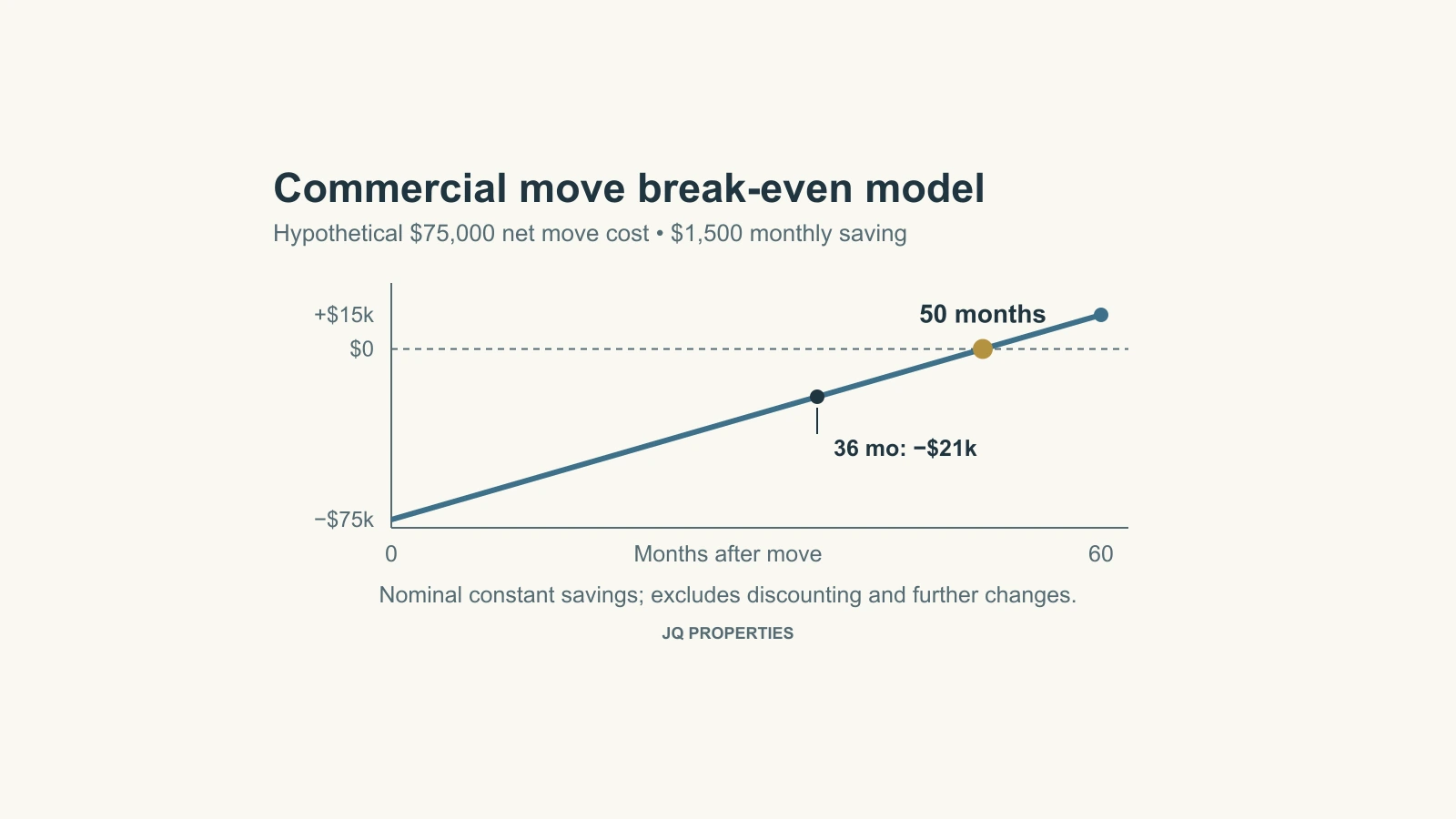
The base case takes 50 months to catch up
For constant monthly costs, the simple formula is:
Break-even months = incremental one-time moving burden ÷ monthly saving after moving.
Here, $75,000 ÷ $1,500 = 50 months. Before that point, the accumulated rent saving is smaller than the extra burden of moving. At 36 months, the saving is $54,000 and moving remains $21,000 behind. At 60 months, the saving is $90,000 and moving is $15,000 ahead on these inputs.
The result is not permission to assume five years of secure occupation. Compare 50 months with the usable term and any early-termination or relocation provisions in the actual alternatives. A potential renewal that is not assured should not silently become additional guaranteed recovery time.
If the new space is no cheaper each month, there is no positive savings-based payback for a positive moving burden. Moving may still improve capacity or customer access, but those benefits need their own evidence; they cannot be hidden in a rent-saving formula.
Test three scenarios, not one precise prediction
These scenarios deliberately change both the one-time burden and recurring saving. They are illustrations, not probability-weighted forecasts.
| Scenario | Incremental burden | Monthly saving | Simple break-even | Moving advantage after 60 months |
|---|---|---|---|---|
| Lower-cost move, stronger saving | $60,000 | $2,000 | 30 months | $60,000 |
| Base case | $75,000 | $1,500 | 50 months | $15,000 |
| Higher-cost move, weaker saving | $90,000 | $1,000 | 90 months | Negative $30,000 |
The final column equals 60 times the monthly saving, less the incremental burden. A positive number favours moving on the included economics; a negative number favours staying. Neither sign accounts for every business risk.
If the two rent schedules change over time, replace the division with a month-by-month cumulative comparison. Add each month's staying cost minus moving cost, and find the first month the total recovers the one-time difference. For a material commitment, consider discounting future savings and include financing, tax, future exit costs and other effects with professional help. The simple table does not calculate those items.
A favourable payback does not fund the move
The base-case burden includes $8,000 of lost contribution, which is not a contractor invoice. The moving-side direct costs and contingency total $77,000 after the assumed landlord allowance. That is a different number from the $75,000 incremental economic burden after subtracting the cost of staying.
If the $10,000 allowance is paid only after completion, the business could need to fund $87,000 of those direct costs and contingency first, before receiving it. Refundable deposits can require additional cash even though they are not automatically permanent costs. Timing matters alongside eventual payback.
Make the renewal decision before a notice deadline removes an option. Our guide to commercial lease renewals and rent resets covers that contractual review. When discussing a renewal or alternative space with JQ, bring both the tested cost comparison and the operational requirements. The right question is whether the move earns back its burden within a credible period while leaving the business enough cash and a space it can actually use.
By Justin Qiao, Personal Real Estate Corporation, Justin Qiao Group | RE/MAX Crest Realty.
General information checked September 8, 2026. Transaction-specific facts and subsequent rule changes can change the result.

