
BC Property Transfer Tax: Rates, Exemptions and Worked Examples
BC property transfer tax is a separate purchase cost, not part of your down payment and not the annual property-tax bill. Start with the tax before relief, then subtract only an exemption that fits the actual purchaser and property. A first-time buyer can qualify for a substantial exemption and still owe tax.
The rates and program thresholds below were checked on September 8, 2026. The worked examples assume an ordinary purchase of the entire fee-simple interest in one wholly residential property, with no additional foreign-buyer tax. Exemption examples also assume the whole transfer qualifies, the parcel is no larger than 0.5 hectares, and all other program conditions are met. Those assumptions make the arithmetic reproducible; they do not establish your eligibility.
Calculate from the right value
PTT generally uses fair market value at registration, including land and improvements. In an ordinary open-market sale, the price is usually the best evidence when registration follows within a few months. A material market or property change, a non-open-market transaction or a special valuation rule can require a different answer. An old assessment is not automatically the current tax value. Presold strata units have specific rules. BC's fair-market-value guidance
Write the value and its basis beside the intended registration date before calculating. “Mortgage amount” and “cash paid after deposit” are not interchangeable with the tax base. A larger down payment does not reduce the property's value for this calculation.
If only an interest is transferring, or the transaction includes multiple parcels, commercial use, a trust or a lease, stop using the full-transfer examples. The province has separate calculation examples for those facts. A whole-home tax result divided by a title percentage is not a universal partial-transfer formula. BC transaction examples
Apply the bands to successive portions
The current general rates apply to the value within each band, not one rate applied to the entire value:
| Portion of applicable value | General PTT rate |
|---|---|
| First $200,000 | 1% |
| Above $200,000 through $2 million | 2% |
| Above $2 million | 3% |
There is also a further 2% on residential value above $3 million. For a wholly residential full transfer, this is added to the general calculation on the excess above that threshold. Mixed-use property needs the appropriate residential allocation; the total price alone does not establish it. Property Transfer Tax Act, sections 3 and 3.01
For example, before exemptions, a hypothetical $650,000 full transfer produces $2,000 on the first band and $9,000 on the remaining $450,000: $11,000 total. Applying 2% to all $650,000 would overstate it by $2,000. Crossing a general rate threshold changes the rate on the next dollar; it does not reprice every earlier dollar.
These general and further rates are not the additional property transfer tax for foreign entities and taxable trustees. Where that separate tax may apply, use the international-buyer PTT guide after resolving classification and location. This article does not calculate that layer or determine federal purchase eligibility.
First-time buyer relief does not make an $835,000 home tax-free
The BC first-time home buyers' program requires Canadian citizenship or permanent residence at registration, plus the applicable BC residence or tax-return history. The buyer must not previously have held a registered interest in a principal residence anywhere in the world or obtained this program's exemption or refund. The ordinary full-property route also requires qualifying principal-residence use, parcel size and improvements. First-time home buyers' program
Under the current amounts, a wholly eligible transfer valued at $500,000 or less can have all general PTT exempted. Above $500,000 through $835,000, the exemption is $8,000. It decreases above $835,000 and reaches zero at $860,000. Thus, the eligibility threshold and the value sheltered from tax are different numbers. Current first-time buyer exemption amounts
The BC history test has two alternatives: maintaining your principal residence in BC for at least a year immediately before registration, or at least two BC-resident income-tax returns in the six immediately preceding taxation years. Do not replace that with “I have a Canadian bank account” or “this is my first purchase in Vancouver.” A previously owned overseas principal residence is relevant; an incomplete memory of old title arrangements should be resolved from records.
Ask for a clear answer about each condition, not a general statement that you are a first-time buyer. Other programs use that phrase differently. A mortgage incentive or federal savings-account rule does not decide this provincial exemption.
Worked resale example: a qualifying $850,000 purchase
Assume a buyer meets every first-time program requirement and buys the entire eligible resale property for an applicable value of $850,000.
The general tax is $2,000 + 2% × $650,000 = $15,000. Because the value lies inside the phase-out range, the exemption is:
$8,000 × ($860,000 − $850,000) ÷ $25,000 = $3,200.
The resulting general PTT payable is $15,000 − $3,200 = $11,800. This agrees with the province's current exemption table. There is no further residential tax at this value, and the example assumes no additional PTT. First-time buyer amounts and table
Three errors would materially change the budget. Subtracting the full $8,000 would understate tax by $4,800. Treating the whole home as exempt would omit $11,800. And subtracting $500,000 from the value before running the general bands is not the same as subtracting the applicable tax exemption.
Until eligibility is confirmed, keep both $15,000 before relief and the conditional $11,800 result in your planning notes. The $3,200 difference is the benefit at stake. It should not disappear into a single unexplained calculator total.
Newly built home relief is a different program
A qualifying newly built home can receive a full general-PTT exemption at a value of $1.1 million or less, with a partial range above that and below $1.15 million. At $1.15 million there is no exemption under that value phase-out. Unlike the first-time program, this route does not require that you have never owned a home. Newly built home exemption
Check the actual statutory category of newly built home, the first registration with a completed improvement, the purchaser's citizenship or permanent residence, qualifying principal-residence use and property size. A renovated resale marketed as “like new” is not established as eligible by that description. Nor does a builder's reference to GST prove the separate BC PTT result.
For the ordinary completed-home route, plan to move in within 92 days of registration and occupy it as your principal residence for the remainder of the first year. The first-time program has corresponding occupancy requirements for an existing home. Vacant-land construction, larger parcels, other improvements and later changes require their specific rules. Newly built home occupancy rules, first-time buyer occupancy rules
The two exemptions are not amounts to stack on the same purchase. If both appear relevant, identify the correct application route; the legislation restricts applying for both and provides specific switching procedures. Property Transfer Tax Act, sections 12.10–12.12
Worked new-home example: a qualifying $1,125,000 purchase
Assume the entire new-home transfer qualifies apart from its value being inside the partial range. The general tax before relief is $2,000 + 2% × $925,000 = $20,500.
The remaining proportion of the exemption is ($1,150,000 − $1,125,000) ÷ $50,000 = 50%. Multiply that proportion by the tax otherwise payable: $20,500 × 50% = $10,250 exempt. The payable amount is therefore $10,250. There is no further residential tax at this value, and no additional PTT is assumed. BC's newly built exemption calculation
Notice the different starting amount: this phase-out uses the applicable tax otherwise payable, not the first-time program's $8,000 maximum. Using the first-time formula on this new-home scenario would answer the wrong question.
A purchase's tax advantage also does not determine whether the home is the better buy. Compare the complete price, any separately applicable GST, adjustments and other closing costs. Do not describe an exemption as money the seller must credit or as a cash rebate that will arrive before you need closing funds.
Check the dollars beside a threshold
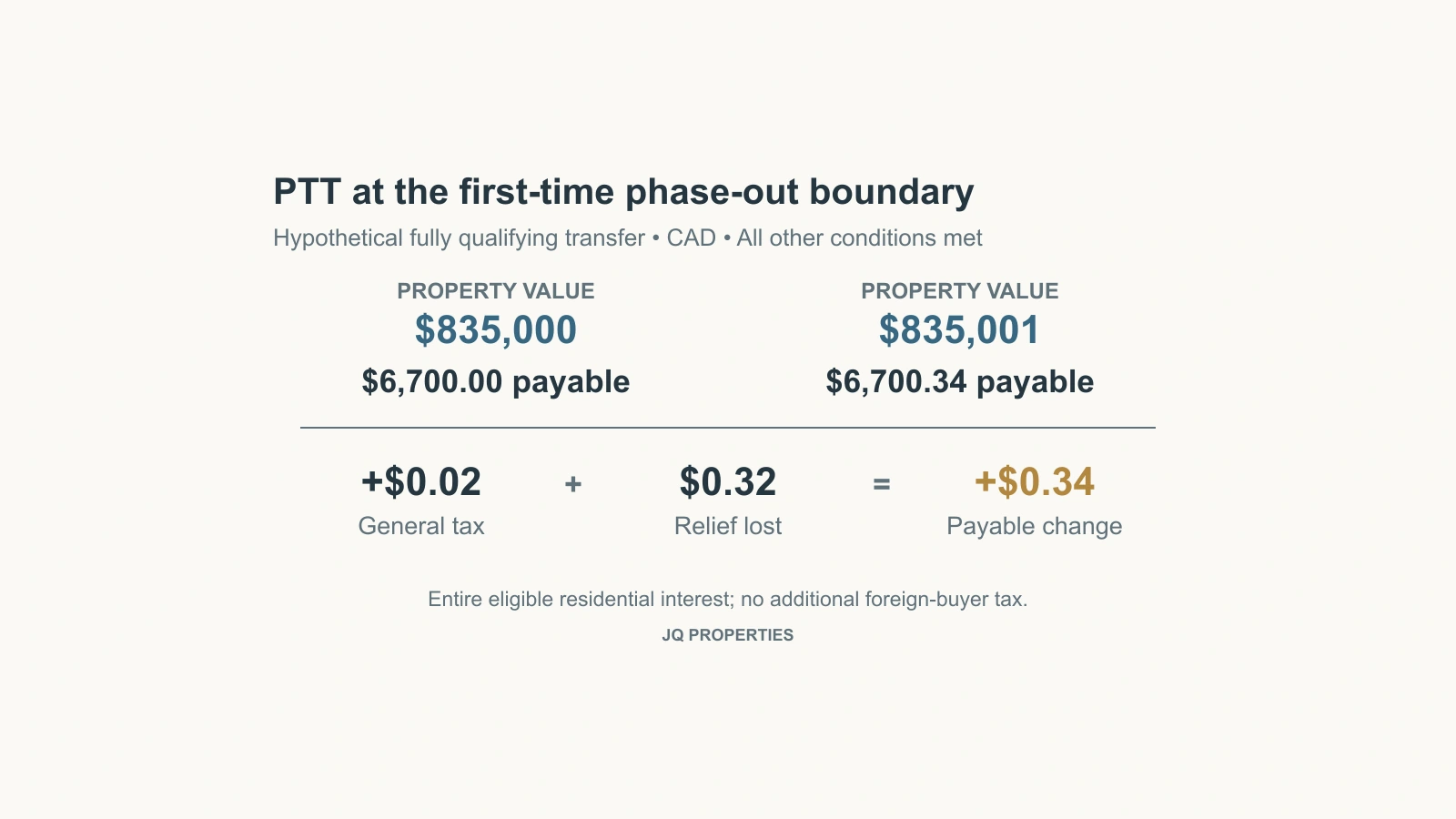
A headline threshold hides how the calculation changes on each side. With all the same first-time eligibility assumptions, the following amounts apply around $835,000:
| Applicable value | General PTT before relief | Exemption | General PTT payable |
|---|---|---|---|
| $834,999 | $14,699.98 | $8,000.00 | $6,699.98 |
| $835,000 | $14,700.00 | $8,000.00 | $6,700.00 |
| $835,001 | $14,700.02 | $7,999.68 | $6,700.34 |
The dollar above the threshold adds two cents of general tax and removes thirty-two cents of exemption. That is why simply adding the marginal general rate misses the actual change in payable tax. This is a calculated boundary illustration, not a suggestion to report an unsupported value.
Use the PTT rate-and-threshold worksheet for the formulas and additional one-dollar-below, at and one-dollar-above checks. It includes both exemption endpoints and the general rate thresholds. Print it or annotate a saved copy; it does not request identity documents or decide eligibility.
Turn a tax estimate into an actual cash reserve
Other relief, including qualifying related-individual and estate transfers, has its own conditions. A family gift is not automatically tax-free, and the two purchase programs above are not an exhaustive exemption list. BC's exemption categories
Keep the tax record short enough to reconcile: registration date, supported value, transaction scope, gross general and further tax, named exemption, confirmed exempt amount, and net amount requested for closing. Record any unresolved condition beside the number it could change.
Beside each tax component or exemption assumption, retain the official URL and section, the date checked, the rule used and the purchaser or property fact it depends on. Keep the relevant passage and the filing professional’s dated answer, including anything still unresolved. If a threshold, buyer fact or registration date changes, save a new calculation with an explanation of that change rather than replacing the earlier record. Compare the resulting components with the actual return and closing instruction; a current rate page does not establish the buyer’s eligibility.
Do that affordability check before offering, and revisit it before removing conditions if relief is still uncertain. Compare available closing cash with the tax before relief as well as the conditional result. If the purchase only works with the exemption, resolve the supporting facts before committing; a correct calculator total cannot fund the gap if the assumption fails.
For a taxable transaction, the Act requires a return on application for registration even where an exemption applies, alongside the applicable payment requirements. A zero estimate is not permission to omit the filing. Ask the filing professional to reconcile the estimate to the return and the funds request. Property Transfer Tax Act, section 2
Do not fund the current closing with a possible later refund. If the exemption was not claimed, investigate the relevant refund route and deadline promptly; do not assume the tax return can be corrected indefinitely. Keep the tax paid, possible recovery and expected receipt as separate entries until an actual result is known.
The same separation prevents double counting. PTT is not GST, annual property tax, legal fees or a mortgage charge. Those belong elsewhere in your purchase budget, even when one professional collects several amounts together. A builder's statement and a closing funds request may also use different layouts; reconcile the components instead of adding two grand totals.
If your date, value, intended occupancy or purchasers change, reopen the calculation and its assumptions. For different purchaser statuses or eligibility shares, use the mixed-status co-buyer guide. The useful outcome is a tax reserve tied to the transaction you will actually register, with enough explanation to see why it changes.
To connect the tax reserve to a property purchase, contact JQ Properties with the price, intended completion date and unresolved transaction questions.
By Justin Qiao, Personal Real Estate Corporation, Justin Qiao Group | RE/MAX Crest Realty.

