
A Daycare Is a Non-Conforming Use: What a Renovation or Expansion Could Change
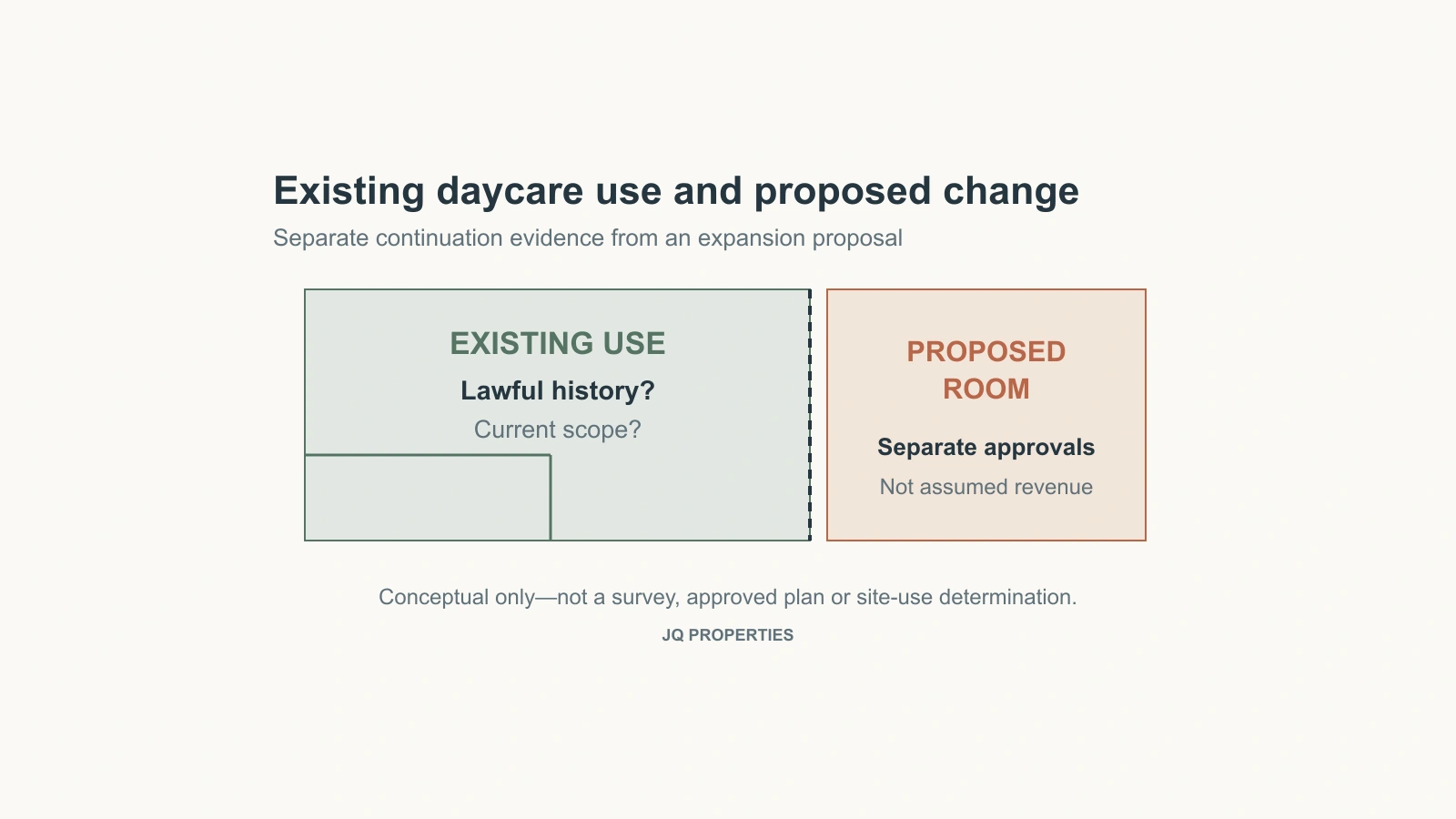
“The daycare is grandfathered” is not enough information to price an expansion. A lawful existing use may have protection when zoning changes, but that protection is not an unrestricted right to enlarge the building, change the operation or reopen after a lengthy closure. It also does not replace child care licensing approval.
For a buyer, the first task is to identify exactly what does not conform and why the existing use is lawful. Then describe the proposed changes separately. This article uses Burnaby's current process and a hypothetical group child care centre with more than eight children. Small facilities that qualify for the separate protections in section 20 of the Community Care and Assisted Living Act need their own analysis.
Check the current zoning, not the seller's old label
Burnaby's new Zoning Bylaw took effect on July 1, 2026, replacing its 1965 bylaw. The City's zoning page provides the current district map and bylaw parts; the old consolidation is now a reference copy. An old email describing a property under a former zone therefore needs to be connected to the current rules. It should not be discarded, because it may help establish the site's history. Burnaby Zoning Bylaw.
Ask which current district applies, which defined use describes the operation, and whether that use is permitted subject to conditions. Burnaby distinguishes a child care facility from a home-based child care facility located in the operator's personal residence. That distinction matters when someone proposes to stop living on site but keep operating there. Current bylaw definitions.
There may be no non-conforming use at all. The daycare use might be permitted, while the building has an older setback or parking arrangement. Or a site may operate under a particular approval with conditions that the buyer has not yet read. These are different starting points, not interchangeable versions of “grandfathered.”
Separate a non-conforming use from a non-conforming building
Section 528 of the Local Government Act permits continuation where a use was lawful when a land-use regulation bylaw was adopted and the use does not conform to that bylaw. A history of operating without the necessary authority is not the same factual basis.
Where use and density conform but specified building dimensions, siting or parking conditions do not, section 529 instead allows maintenance, extension or alteration subject to its conditions, including no further contravention. Where a non-conforming use continues in a building, section 531 generally prohibits structural alterations or additions, subject to statutory exceptions, including certain required work and permitted board-of-variance relief. These are not blanket bans on every repair, nor automatic renovation permissions. Local Government Act, sections 528–531.
The practical request to the City is specific: identify the non-conformity, its lawful basis, and how the submitted proposal changes it. Supply the approved plans, relevant historical permission and a dated description of actual operations. A licence displayed on the wall is useful evidence of licensing; by itself, it does not answer all those land-use questions.
If the file does not establish the history, leave the expansion unproven in the purchase model. Do not turn an unanswered question into either a promise that it is allowed or a conclusion that the business must close.
Describe the renovation in operational terms
“Minor renovation” might mean repainting. It might also mean cutting an opening in a structural wall, incorporating a neighbouring tenancy, adding an infant program and moving the outdoor play area. Those changes should not travel through the transaction under one vague label.
Use the existing-use and proposed-change sheet to record the current and proposed floor areas, licensed programs, maximum capacities, exterior work, yard locations and periods of closure. Mark what remains physically unchanged. Include a drawing that shows the boundary of the existing premises and the proposed additional area; do not rely on a floor-area total alone.
Outdoor changes deserve their own entry. Burnaby's current use-specific rules prohibit outdoor play areas in a required front yard in the commercial, employment and industrial districts where child care facilities are permitted. That does not prove a particular existing yard is unlawful, but it is a concrete reason to check the proposed relocation against the applicable district and history. Burnaby use-specific regulations, section 5.1.
The existing building's code requirements are another question. Burnaby's child care bulletin, revised July 1, 2026, explains that rehabilitating, changing the use of, or adding to an existing building requires consideration of Building Code compliance and necessary upgrades. Ask for the upgrade scope tied to your drawings, rather than assuming the current occupancy settles the proposed work. Burnaby child care building bulletin.
Keeping the use does not transfer the licence
A sale does not automatically erase non-conforming-use protection: section 534 says a change of owners, tenants or occupants does not, by that change alone, affect the use for this part of the Act. That does not make every ownership-change arrangement identical. Local Government Act, section 534.
Fraser Health separately states that a community care facility licence is not transferable and that a change of licensee or facility address requires a new licence application. Changes to maximum capacity or service type are among the matters handled through an amendment application for an existing licence. Identify the actual legal licensee before deciding which process applies. Fraser Health licence applications.
For the group-care setting discussed here, the Child Care Licensing Regulation also requires plans and written medical health officer approval before a structural change. Municipal permission does not substitute for that approval, or vice versa. The regulation has separate exceptions for specified school-ground and recreational programs, which are outside this example. Child Care Licensing Regulation, section 10.
A renovation closure can change the question again
Section 528 contains a six-continuous-month discontinuance rule; subsequent use then becomes subject to the land-use bylaw. The section includes qualifications for seasonal and agricultural uses. Do not assume a proposed daycare renovation automatically receives an exemption, or that retaining furniture and paying rent settles whether the use has been discontinued. Current continuation provisions.
Put actual operating and closure dates into the file, including any closure before the sale. If the plan depends on continuation protection, resolve the effect of the full interruption before committing to demolition or an extended shutdown. A contractor's optimistic completion date is not a legal answer to this issue.
There are additional restrictions for heavily damaged buildings under section 532. A fire-rebuild proposal therefore needs a different assessment from cosmetic improvements to a functioning centre. An insurer's willingness to pay for work is not, on its own, permission to rebuild for the same use.
Price the existing operation and the proposed expansion separately
Suppose a hypothetical centre's verified current operation supports your purchase analysis, while the seller describes an additional classroom as “easy upside.” Prepare one case using only the existing authorized operation, subject to the buyer's own required approvals, and a second case containing the proposed classroom.
Keep the additional enrolment and associated revenue out of the first case. In the second, include the specific approvals, construction and staffing costs, and a realistic opening assumption. If the purchase only works with the second classroom, the unanswered land-use question is fundamental to the offer; it is not something to bury in a small contingency allowance.
Burnaby offers development inquiries to identify required applications and submission materials. Depending on the actual issue, the path may involve rezoning or another applicable approval. A development variance permit cannot vary use or density, so “we will get a variance” is not a complete answer to an unpermitted use. Preliminary staff feedback is also not the final permission to proceed. Burnaby development planning.
For the broader purchase sequence, see our daycare licensing and zoning guide. When comparing a Burnaby daycare opportunity, contact JQ Properties with the existing approvals and a description of the changes your business plan requires. The useful purchase question is not whether the word “grandfathered” appears in the file, but whether the operation you intend to buy and run is the operation those records actually support.
Burnaby and provincial sources checked September 8, 2026. This is not a determination of any particular site's legal status and should not be applied as Vancouver's municipal process.
By Justin Qiao, Personal Real Estate Corporation, Justin Qiao Group | RE/MAX Crest Realty.

