
Buying a Commercial Unit With Deferred Maintenance: Separate Price From Cash Needs
A seller's price reduction can improve a commercial purchase without providing enough cash to complete the repairs. The distinction becomes important when the lender reduces its advance with the purchase price, renovation financing arrives only after work is paid for, or the repair delays occupancy and income.
Evaluate the transaction in two ways: whether the total economics justify the property, and whether the required money is available at each payment date. A favourable answer to the first question does not guarantee the second.
Turn “deferred maintenance” into timed scopes
Start with a building condition assessment suited to the property and the lender's requirements. Then obtain contractor pricing for the significant items. An assessor's planning estimate is useful for identifying exposure, but it is not automatically a fixed construction quote with access, taxes, permits and restoration included.
BDC describes building condition assessments as a way to identify immediate and longer-term work and associated estimated costs. Confirm the scope and limitations of the assessment commissioned for your unit; do not assume every inaccessible component or specialist issue has been resolved. BDC's building condition assessment guide
Have qualified advisers distinguish work needed before the space can be used or insured, work that can be planned within a defined period, and optional improvements. An aesthetic upgrade should not consume the cash needed for an urgent building-system problem. Also identify dependencies: equipment replacement may require electrical work or access arrangements, and roof work may affect an occupant below.
For a strata unit, establish who controls the component and the work. Your contractor's estimate is not necessarily the amount or timing that the strata corporation will approve or charge. For a leased property, check access and disruption obligations to tenants before assuming work can start immediately.
Recalculate the equity after negotiating the price
Consider a fictional purchase, with all amounts in Canadian dollars. The original price is $1,000,000. The parties agree to reduce it by $50,000 to $950,000 because of identified maintenance. In this example only, the acquisition lender advances 70% of the final purchase price and finances none of the repairs or closing costs. This is an assumed lending formula, not a market rule or an approval estimate.
At the original price, the advance would have been $700,000 and purchase equity $300,000. At the revised price, the advance is $665,000 and equity $285,000. The price reduction therefore releases $15,000 of the buyer's required equity—not $50,000 of repair money. The remaining $35,000 reduces borrowing.
If the lender instead keeps a fixed approved advance, the result could differ. The buyer needs the lender's revised written calculation, reflecting the amendment, appraisal and all conditions. Do not count a seller credit as extra cash while also subtracting it from the purchase price. The lawyer and lender must confirm how the actual concession is documented and treated.
Build a purchase-and-repair cash table
Here is the cash plan for that fictional revised purchase. The $30,000 closing-cost allowance is a modelling input, not a BC tax or fee calculation; replace it with transaction-specific advice. The $20,000 reserve is cash the buyer intends to retain for operations, not a repair bill.
| Cash requirement | Assumed amount | When it must be funded |
|---|---|---|
| Purchase equity: $950,000 less $665,000 advance | $285,000 | Deposits and completion, without counting deposits twice |
| Closing costs not funded by the acquisition loan | $30,000 | As required before or at completion |
| Defined repair project, including its assumed project charges | $80,000 | Contractor payment dates |
| Minimum operating cash retained | $20,000 | Available throughout transition |
| Total own funds required before any later reimbursement | $415,000 | Peak funding requirement under these assumptions |
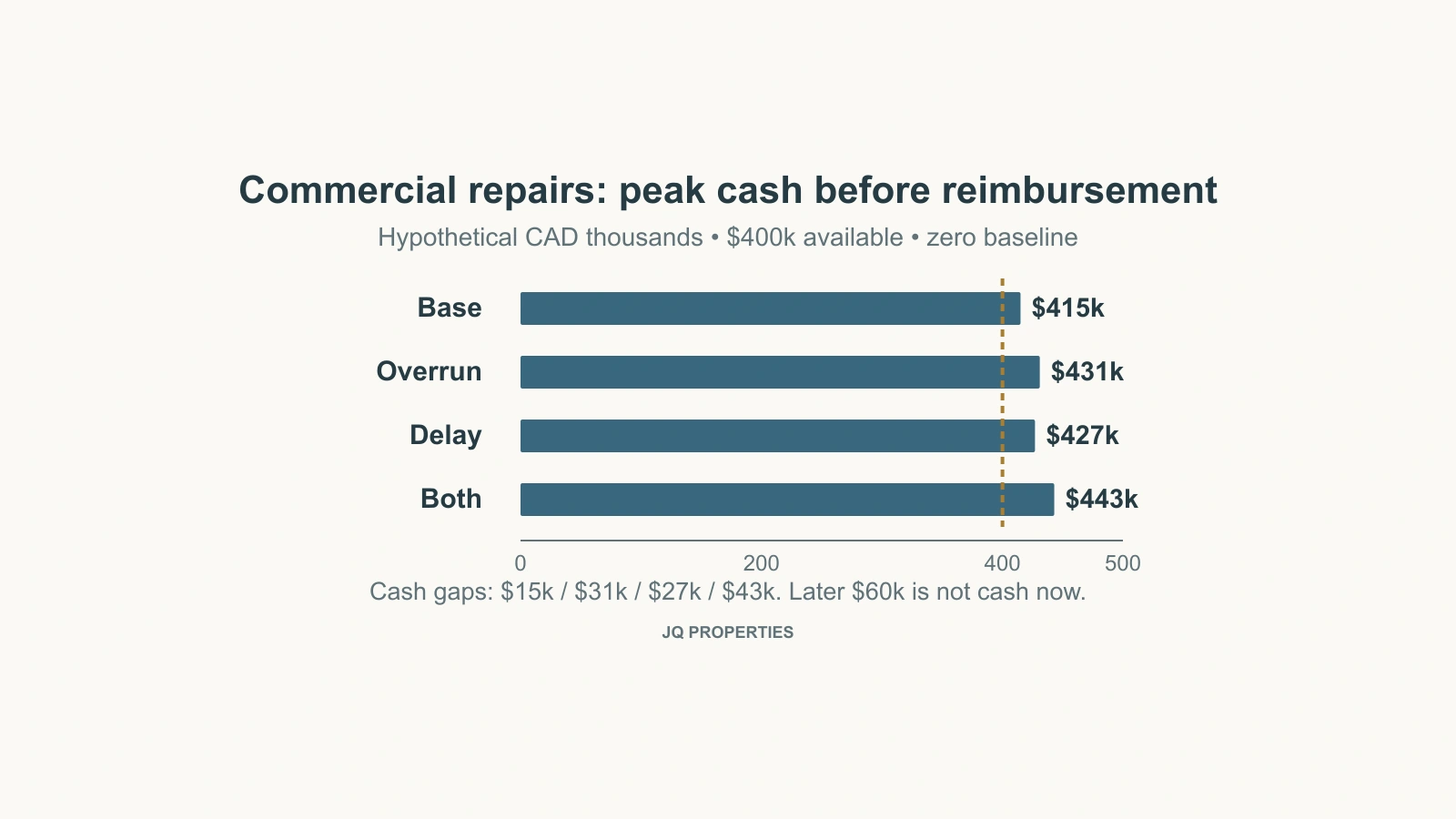
With $400,000 of available own funds, the plan has a $15,000 gap. Spending the $20,000 operating reserve would hide that gap by leaving the business below its chosen minimum. At the unreduced price, the same model required $430,000, so the negotiation helped—but did not fully fund the plan.
Now suppose a separate $60,000 renovation advance is approved, but its stated conditions require completed, paid work before reimbursement. The buyer still needs to bridge the $415,000 requirement before receiving it. Afterwards, net own funds committed or retained fall to $355,000, while debt increases by $60,000. Neither the approval nor the reimbursement makes the project $60,000 cheaper.
That reimbursement arrangement is fictional. Ask your lender for the actual release conditions, eligible invoices, equity contribution requirements, inspection process and any retained amounts. BDC's commercial real estate product can include acquisition and renovation purposes, but the offer is tailored and conditional on approval. A public product description is not an available balance in your bank account. BDC commercial real estate financing
Stress the gap, not just the repair estimate
Keep the same acquisition loan and eventual $60,000 renovation advance. Assume a 20% repair overrun adds $16,000. Separately, assume a two-month delay adds $6,000 a month of incremental carrying and temporary-occupancy costs, including any assumed bridge interest: $12,000. These are scenario inputs, not contractor forecasts.
| Scenario before renovation reimbursement | Peak own funds needed, including retained reserve | Gap against $400,000 available |
|---|---|---|
| Base case | $415,000 | $15,000 |
| Repair overrun only | $431,000 | $31,000 |
| Delay costs only | $427,000 | $27,000 |
| Overrun and delay together | $443,000 | $43,000 |
The eventual reimbursement reduces those peak amounts only when it is actually received. If the lender will not fund the overrun, it stays the buyer's responsibility. If a different release schedule requires payments before loan funds arrive, map those dates too. BDC's renovation-financing guidance specifically calls for project details, contractor quotes and cash-flow forecasts, and stresses a contingency for construction costs. BDC renovation financing guide
Do not treat a tenant recovery or tax deduction as cash on hand
Where a tenant occupies the property, read the actual repair obligations and operating-cost definitions with counsel. A “net lease” label does not establish that this capital project is recoverable, that the full bill can be charged immediately, or that the tenant will pay before your contractor. Identify exclusions, amortisation, caps, notice requirements and any dispute before inserting recovery into the funding column.
Keep tax classification separate as well. CRA's current-versus-capital guidance specifically addresses repairs to newly acquired used property to make it suitable for business use as capital, even where similar work could be current in other circumstances. Ask your accountant to classify the actual work; the invoice label “maintenance” does not decide the answer. This article does not calculate a tax deduction or assume one funds construction. CRA current and capital expense guidance
Before removing conditions, you should be able to point to a defined repair scope, a realistic delivery plan, revised lending terms and a funded downside case. If the numbers only work with an unapproved advance or immediate tenant repayment, the transaction still has a financing question. Use our commercial due-diligence checklist for the surrounding purchase review, and bring the cash table to the financing discussion. The discount matters; the ability to pay for the work on time matters separately.
JQ Properties can help connect the repair scope and property questions with your commercial purchase review; bring the cash table and the lender’s actual terms.
By Justin Qiao, Personal Real Estate Corporation, Justin Qiao Group | RE/MAX Crest Realty.
Sources checked September 9, 2026.

