
Buying a Home You May Sell in Three Years: Compare the Round-Trip Costs
By Justin Qiao, Personal Real Estate Corporation, Justin Qiao Group | RE/MAX Crest Realty.
Selling for the price you paid does not mean you have recovered the cost of buying, financing and owning a home. Over a short holding period, purchase taxes and selling expenses have fewer years over which to be spread. At the same time, part of each mortgage payment reduces debt rather than becoming an expense.
A useful three-year comparison separates those two facts. Track the cash you put in, the mortgage balance that will remain and the costs of getting out. Then test several sale prices without assuming the property will appreciate enough to cover the difference.
Decide what “break even” is supposed to mean
Recovering the original down payment is one test. Recovering every dollar paid into the purchase and ownership is a much higher test. Comparing ownership with renting is different again because both alternatives provide housing and have costs.
This article uses a cash-outlay recovery measure: net cash from sale compared with the down payment, purchase costs, mortgage payments and specified ownership expenses paid during 36 months. It excludes income taxes, investment opportunity cost and differences in everyday utilities. It is not an investment-return calculation or a conclusion that renting is better.
Use that definition consistently. Do not compare a sale-proceeds figure that includes your accumulated equity with a cost figure that ignores the mortgage payments used to build it.
Establish the purchase assumptions before doing arithmetic
Consider a hypothetical $800,000 resale condo bought for personal occupancy by a Canadian citizen. Assume the buyer does not qualify for a property transfer tax exemption, the $800,000 purchase price equals the relevant fair market value and no additional property transfer tax applies. Assume this particular used-home sale is GST-exempt and no mortgage insurance premium is charged on the conventional loan.
BC's general property transfer tax rates are 1% on the first $200,000 of fair market value and 2% on the portion above $200,000 through $2 million. In this example, the tax is $2,000 + $12,000 = $14,000. Eligibility and property classification must be established before using that figure for a real purchase. BC property transfer tax
CRA explains that used owner-occupied home sales are usually GST-exempt, with the particular circumstances controlling. A resale label alone should not substitute for tax review. This model is not for a taxable new home, assignment or substantial-renovation transaction. CRA owner-occupied home sales
Assume a $160,000 down payment and $640,000 mortgage. Add hypothetical tax-inclusive costs of $2,000 for purchase legal work and disbursements, $500 for inspection and $1,500 for moving in. Together with the $14,000 transfer tax, initial cash paid is $178,000. The deposit is part of the down payment, not another expense added on top.
These service amounts are planning assumptions, not local price quotes. Replace them with your own written estimates and include any additional transaction-specific expenses.
Separate principal repayment from interest
For the illustration, assume a five-year fixed term at 5% nominal annual interest compounded semi-annually, monthly payments and a 25-year amortization. The home is sold immediately after payment 36. There are no missed payments, extra payments or rate changes.
The model produces a monthly principal-and-interest payment of approximately $3,722.27. Across 36 payments, it uses $134,001.79 in total payments, comprising $41,936.49 of principal reduction and $92,065.30 of interest. The remaining mortgage balance is approximately $598,063.51.
Calculations retain full precision internally and round displayed amounts to cents; an actual lender schedule may differ with payment rounding, dates and contract conventions. The accompanying record includes the formula so the illustration can be reproduced.
The principal portion is important. It has moved cash into home equity by reducing the loan. Counting the full mortgage payment as an expense and then also deducting the remaining balance without reconciling sale proceeds can obscure where that equity went.
Add ownership and exit costs on their own terms
Assume monthly property taxes of $350, condo insurance of $100, strata fees of $400 and maintenance spending of $150. These invented amounts total $1,000 per month, or $36,000 over three years. They represent costs actually incurred, not a reserve balance still held in cash at sale. The period is assumed to cover the owner's full share without an additional duplicate tax or strata adjustment.
A major special levy, unusually large repair or period of vacancy would need its own line. A low routine-maintenance assumption cannot erase a known upcoming project.
For selling, assume a service charge equal to 3% of sale price, including applicable tax, solely for this model. This is not a standard commission or a quote. BCFSA says real estate remuneration is negotiable between the consumer and brokerage. Use the actual agreement and its tax treatment. BCFSA consumer guide to remuneration
Also assume $3,000 preparation, $2,000 sale legal/discharge costs, $1,500 moving out and a $5,000 mortgage prepayment charge: $11,500 of fixed exit costs. All service-cost assumptions include applicable taxes. The prepayment charge is an assumed lender quote, not a calculation from the 5% rate. Selling during a closed term can trigger a charge; obtain a date-specific payout estimate. FCAC breaking a mortgage contract
Test the sale proceeds against all cash paid
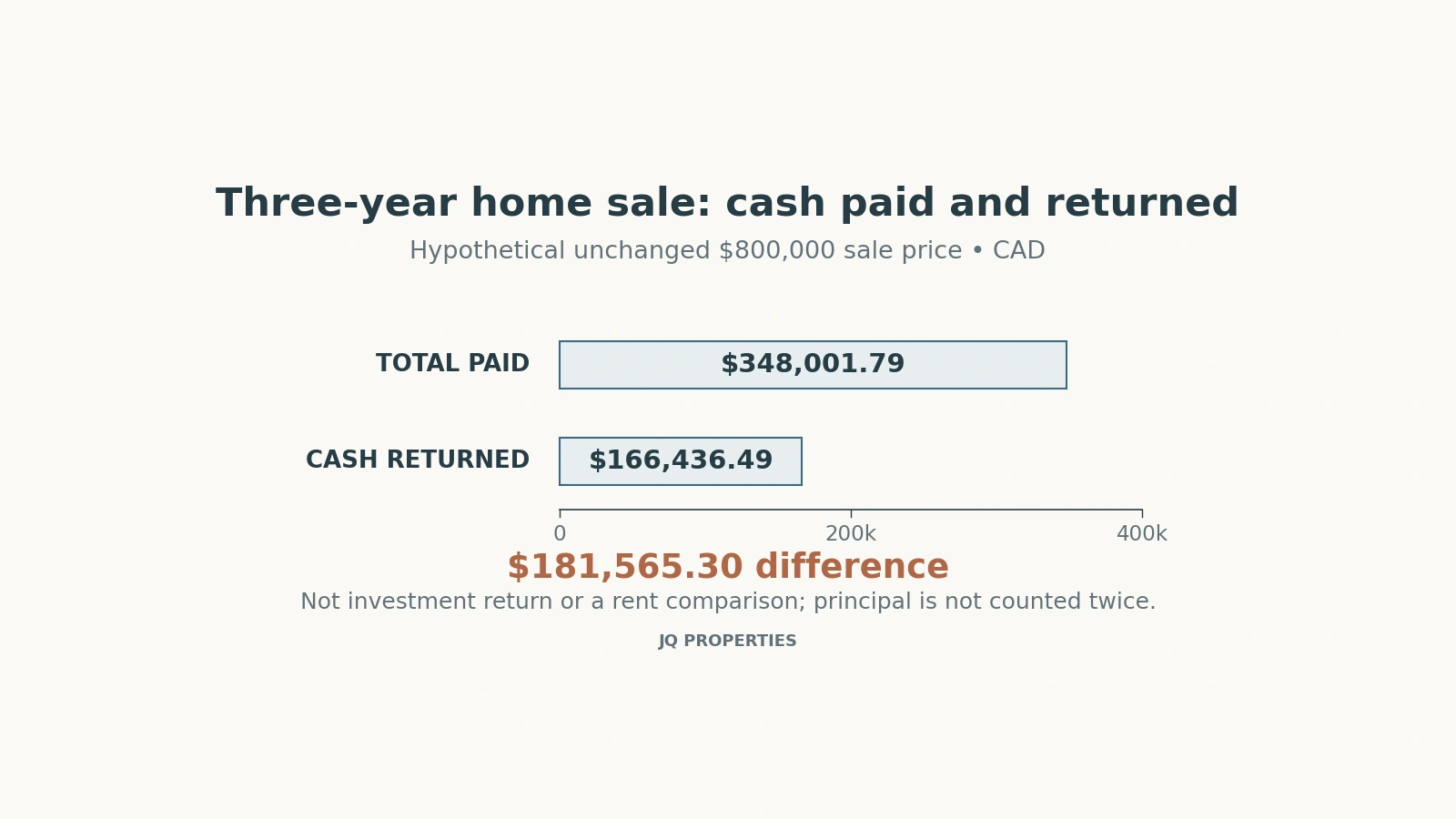
Cash paid through month 36 is $178,000 initially, plus $134,001.79 in mortgage payments, plus $36,000 ownership expenses: $348,001.79.
Net sale cash is the sale price minus the assumed 3% selling charge, $11,500 fixed exit costs and $598,063.51 remaining mortgage balance.
| Hypothetical sale price | Net cash after sale costs and mortgage | Less $348,001.79 paid in |
|---|---|---|
| $760,000 | $127,636.49 | −$220,365.30 |
| $800,000 | $166,436.49 | −$181,565.30 |
| $840,000 | $205,236.49 | −$142,765.30 |
At an unchanged $800,000 sale price, the owner receives more than the original $160,000 down payment back. Yet that does not mean ownership was cost-free: the cash-outlay difference is $181,565.30 under the stated assumptions.
The difference reconciles to $18,000 purchase costs, $92,065.30 interest, $36,000 ownership expenses, $24,000 percentage selling costs and $11,500 fixed exit costs. Principal repayment is not an additional expense in that reconciliation.
The recovery price is a result, not a forecast
With a percentage selling cost, the sale price needed to recover all modelled cash is not found by simply adding expenses to the original purchase price. The selling charge also rises with the sale price.
Using full-precision mortgage calculations, the cash-outlay recovery price is approximately:
($348,001.79 + $598,063.51 + $11,500) ÷ (1 − 0.03) = $987,180.72.
This is a mathematical threshold for this particular model, before income taxes and other excluded items. It is not a likely sale price, an appraisal, a target the market owes the owner or a recommendation to hold until it is reached.
The owner also received three years of housing. To compare with renting, build a separate, equivalent alternative including rent, moving, insurance, the treatment of invested cash and any relevant tax differences. A negative cash-outlay result alone cannot decide that comparison.
Tax reporting remains separate. CRA requires reporting a property sale even when it is a principal residence. Whether an exemption or other treatment applies depends on the actual facts; a three-year plan alone does not establish tax-free profit. CRA reporting real estate income
Use the model to judge flexibility
The three-year round-trip cost record (PDF) lets you replace the assumptions, preserve the principal-versus-interest distinction and test a repair overrun. If a realistic lower sale price would leave too little cash for the next move, that matters even when the mortgage is affordable today.
Our resale-value guide addresses the separate question of who might buy the property later. Justin Qiao Group can help connect that property-level evidence with your timeline and selling-cost assumptions. The purpose is to know what a short ownership period could demand, without needing a favourable forecast to make the numbers work.
This is general information, not individualized tax, mortgage, investment or legal advice. Sources were checked September 8, 2026. All transaction amounts, financing terms and sale prices are hypothetical.
Sources checked September 9, 2026.

