
Changing the Bank Account That Pays Your Mortgage: Confirm the First Withdrawal
By Justin Qiao, Personal Real Estate Corporation, Justin Qiao Group | RE/MAX Crest Realty.
Opening a new chequing account does not tell your mortgage lender to use it. If the mortgage is paid by pre-authorized debit, the lender needs the updated authorization and an effective date. Until that change is confirmed, money in the new account may not cover a withdrawal still scheduled against the old one.
This is an account-change problem, not necessarily a mortgage refinance. You can keep the same mortgage while changing where its regular payments come from. The goal is to identify the last withdrawal from the old account and the first from the new account, fund the correct account at the correct time and verify what actually happens.
First identify who initiates the payment
A pre-authorized debit, or PAD, lets the biller withdraw funds under an agreement. That differs from an automatic payment you arrange through your own bank to send money to a biller. FCAC distinguishes the two because changing one arrangement does not necessarily change the other. FCAC pre-authorized debits
Look at the mortgage agreement, payment confirmation and account history. Do not rely on the fact that the money moves “automatically.” Confirm with the lender how the payment is collected and what process applies to changing that collection account.
If you have both a lender-initiated debit and a separate recurring bank payment, have the lender explain how each is applied. One might be a voluntary extra payment. Cancelling or duplicating it without understanding the arrangement could change the repayment plan.
Obtain the effective date from the lender
Payments Canada advises contacting the organization with which you established the PAD agreement when changing bank information. Otherwise, it may continue drawing from the account on file. A new account shown in your banking app is not evidence that the lender has changed its payment instructions. Payments Canada consumer PAD guide
Use the lender's established secure channel to ask what authorization or supporting document is needed, who must approve the change, its processing cutoff and the first payment affected. Lenders can have their own process; RMG, for example, publishes a dedicated help entry for changing the account from which mortgage payments are withdrawn. Do not interpret that as a universal procedure or a guarantee of next-day processing. RMG account-change help
Keep the response identifying the effective date. “Request received” and “next payment will come from the new account” are different confirmations. If the request is incomplete, establish what remains outstanding and which account will be used in the meantime.
For a joint household, check who is authorized on the mortgage and payment account. Do not assume that a partner's new account can be substituted without review. Provide banking documents only through the lender's verified process, not in a general group email or through an unexpected message link.
Total household cash can be enough while the debit account is short
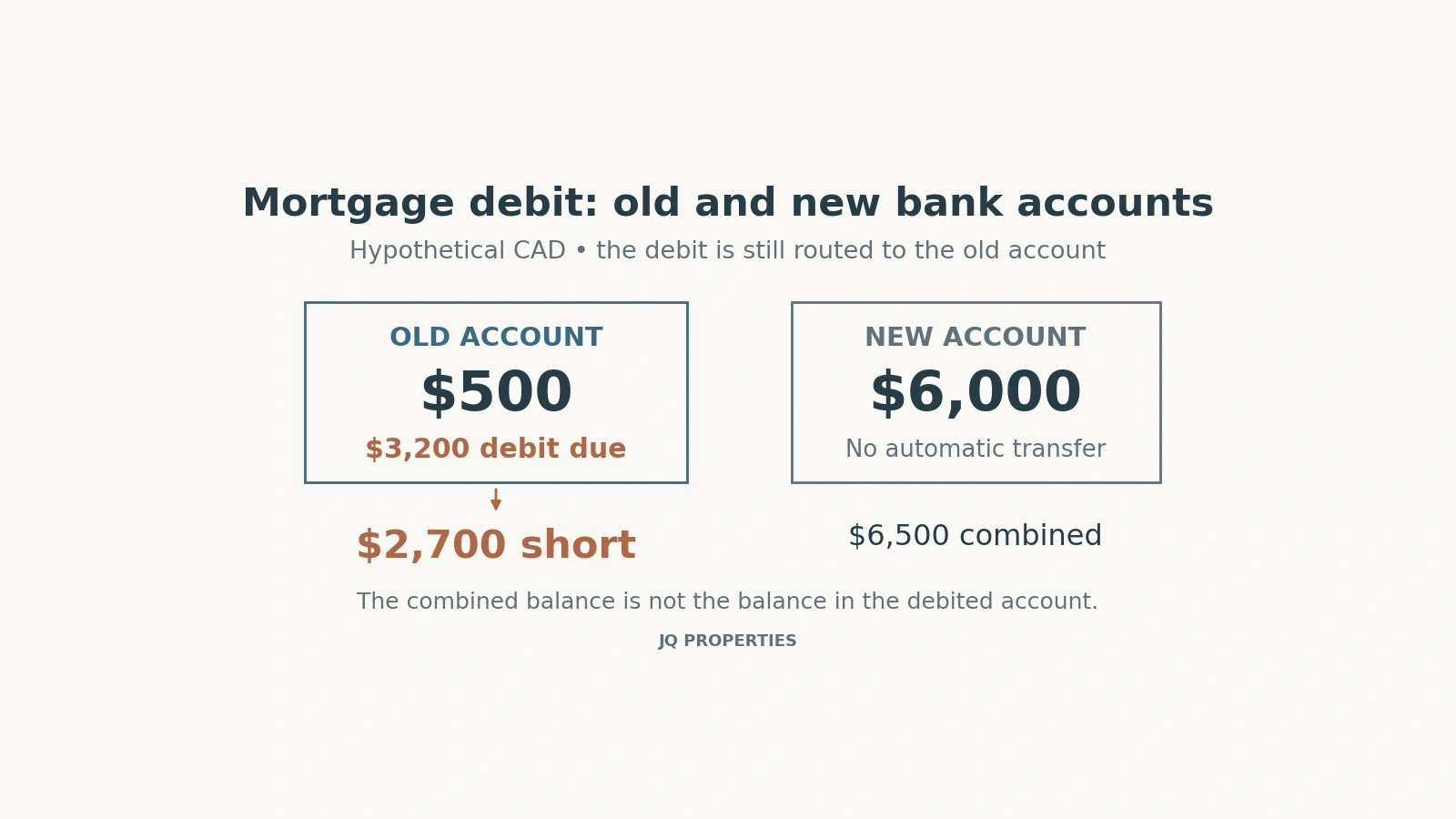
Consider a hypothetical monthly mortgage payment of $3,200. On November 2, the borrower requests an account change. The lender confirms that November 10 will still be collected from the old account, with the first new-account withdrawal on December 10. These dates and the lead time are assumptions, not a particular lender's policy.
The household has $500 available in the old account and $6,000 in the new account. Across both accounts, that is $6,500. But the old account is $2,700 short of the scheduled $3,200 mortgage debit. The surplus in the new account does not automatically protect a debit presented against the old account.
If another $400 authorized bill will leave the old account before November 10, only $100 remains for the mortgage, making the shortfall $3,100. The relevant balance is the amount available when the debit is processed after other expected transactions, not the balance displayed when the change request was submitted.
Resolve that account-specific gap with your financial institution and lender using their verified arrangements. Do not wait for a failed payment to show which account they used. FCAC notes that insufficient funds for a PAD can lead to NSF fees; the applicable terms need to be checked with your institution. FCAC PAD and insufficient-funds guidance
Do not close the old account before the handoff is complete
Review other payments and deposits attached to the old account as well. Salary arriving in the new account does not move every old-account debit, and a mortgage change does not update insurance, strata fees or utilities independently collected by other organizations.
FCAC's bank-switching guidance says to ensure you have access to the new account, update direct deposits and transfer or cancel PAD arrangements before closing the old account. It also emphasizes having funds available to cover payments. That is a sequence of confirmed changes, not simply an account-opening task. FCAC transferring financial services
You do not necessarily need to fund two mortgage payments for the same due date. You do need a clear answer about which account will be debited, plus a plan if the answer is still unresolved. Leaving both accounts open without checking their balances is not a complete safeguard either.
Watch the first successful withdrawal from the new account and confirm that the lender applied it to the mortgage as expected. Then check that an unintended old-account withdrawal did not also occur. Keep the change confirmation until the records agree.
Cancelling the debit does not cancel the mortgage payment
FCAC explains that cancelling a PAD agreement changes the payment method; it does not cancel the underlying contract or debt. Follow the agreement's cancellation process and arrange how amounts still owed will be paid. FCAC cancelling a PAD
For a mortgage, this means a stop payment or a closed account is not a lender-approved payment holiday. If a due date is close and the account change is not ready, contact the lender before taking action that could prevent collection. Ask it to confirm the temporary arrangement and whether an existing debit will still be attempted.
If a payment fails, ask about any planned retry before arranging another payment. Otherwise, an attempted correction and a re-presented debit might both draw cash. Establish how each transaction will be identified and applied rather than sending money twice on the assumption that a failed item cannot return.
Reconcile an unexpected withdrawal promptly
Suppose, in a separate hypothetical example, both accounts start with $3,400 and each is debited $3,200 for what appears to be the same mortgage instalment. Total cash falls from $6,800 to $400, rather than the $3,600 remaining after one intended debit. The unexplained extra cash movement is $3,200. That does not yet establish how the lender posted it or when money will be returned.
Contact the lender and the bank promptly with the dates, amounts and change confirmation. Ask whether the extra amount is pending, reversed, applied to the mortgage or scheduled for refund. Do not count an expected refund as available cash until its treatment and availability are established.
For personal PADs that are incorrect or unauthorized, Payments Canada describes a 90-day period from withdrawal to report the problem to the financial institution and seek reimbursement. This is not a reason to wait. Funds-transfer PADs have special recourse rules, and a legitimate payment is not refundable merely because the borrower would prefer a different account. Ask the institution to assess the actual transaction. Payments Canada recourse guidance
The mortgage payment account-change record (PDF) separates the request, effective date, account-specific cash and actual postings. Use account labels such as “old” and “new”; it does not require account numbers.
If this change happens around a purchase, our closing-cost coordination guide addresses the separate conveyancing arrangements. Justin Qiao Group can help organize the property timeline while your lender and bank confirm the payment instructions.
This is general information, not individualized banking, legal or mortgage advice. Sources were checked September 8, 2026. No payment, account change, cancellation or transfer is authorized by the examples here.
Sources checked September 9, 2026.

