
Commercial Strata Documents Before Condition Removal
Before removing purchase conditions on a commercial strata unit, establish whether the documents support the business you intend to operate and the ownership costs you can fund. A complete review connects the lot's legal rights, the strata's decisions and finances, and the building systems that serve the operation. Reading the Form B alone does not answer all three.
Commercial buyers use many of the same document types as residential buyers, but ask different practical questions: can customers arrive after hours, can a roof be penetrated for equipment, and which body pays to maintain a shared loading area? For an investment purchase, the tenant's lease adds another set of obligations; it does not replace the strata documents.
First identify the bodies and property you are buying into
Obtain the current title, registered strata plan and amendments, filed bylaws, rules and relevant registered agreements. Compare the legal lot number with the unit marketed for sale. Then identify any commercial section, shared-facility arrangement or neighbouring parcel on which the business depends. A manager's company name is not the name of the legal body responsible for every cost.
BC permits sections representing specified different interests, including residential and nonresidential owners. The strata corporation retains matters common to all owners; a section can have its own funds, budget, fees and levies for matters solely relating to it. Sections are formally established, not simply every group of storefronts in a mixed-use building. Strata Property Act, sections 191–194.
Where a section exists, request information from both it and the strata corporation. Record which body manages the roof, loading court, commercial corridor and mechanical equipment. Read any shared-cost agreement rather than assuming an expense belongs exclusively to the commercial owners because they use the area most often.
Get a current Form B and the documents behind it
Request the current Form B for the lot from the strata corporation and, where applicable, its section. Review fees, amounts owing, approved future levies, alteration-expense agreements, proceedings, outstanding work orders and parking or storage information. Ask for attachments, not merely the signed first pages.
The Province's current guidance includes the rules, current budget, most recent depreciation report if any, and copies of all electrical planning reports obtained. The insurance summary is also required information. Missing attachments should become specific requests, not assumptions that the underlying issue does not exist. BC Form B guidance.
“Current” is about changed facts, not an automatic shelf life. BCFSA warns that even a Form B less than 30 days old can be outdated after an AGM changes fees or another relevant event occurs. Obtain a new certificate or confirmation that the supplied one remains current; compare its date with subsequent meetings and notices. BCFSA Form B practice resource.
Arrange the seller's written authorization for broader records access where needed. Section 36 gives access to owners and specified authorized persons; its response periods are generally two weeks, or one week for bylaws and rules. A short purchase condition period does not make records appear sooner. Request them early and address an inadequate review period through the purchase contract. Act, sections 35–36.
Read restrictions through an ordinary business day
Describe the actual operation before interpreting the documents: opening hours, appointments or walk-in customers, staff, deliveries, noise, odour, waste, signage and equipment. Then find the wording affecting each activity. “Commercial use” is too broad to tell you whether an evening studio, repair shop or food operation fits.
Read the filed bylaws and applicable section bylaws alongside the rules. Under the Act, bylaws can govern strata lots and common property, while rules concern common property and common assets. Nonresidential bylaw-amendment procedures can differ from residential ones, so do not assume a residential voting summary tells you how a commercial restriction could be changed. Have any doubtful wording or proposed amendment examined in its actual statutory and bylaw context. Act, sections 119–128.
Municipal permission remains separate. Vancouver advises businesses to check the specific premises before buying or leasing because each space has an approved use and a change may need approval or permits. That municipal answer does not settle strata restrictions. Vancouver business-location guidance.
For an owner-user, test essential activities, not just whether the current seller operates without visible complaints. For a landlord, compare the tenant's promised use and access with the rights the owner can actually provide. A lease promise should not be treated as proof that the strata has granted the necessary right.
Follow business-critical rights outside the lot
Mark every area or service the operation requires: customer stalls, loading space, garbage enclosure, sign location, roof equipment, utility routes and after-hours entrances. For each, locate the title, plan designation, agreement or other instrument supporting its use. Distinguish ownership, limited common property, a contractual permission and an informal practice; a painted unit number is not the underlying right.
Ask whether access is shared, time-limited, subject to change or tied to an existing owner's arrangement. Confirm who maintains it and who can authorize alterations. Do not assume that permission to use a roof-mounted unit includes permission to enlarge it, reroute ducts or transfer an earlier alteration agreement unchanged.
A hypothetical clinic may fit inside the unit yet depend on patients using an entrance after the building's normal closing time. The useful follow-up is the actual access arrangement and change process, not a generic statement that the building has an entrance. If that right cannot be supported, revising the business hours or choosing another unit may matter more than negotiating a small price reduction.
Reconcile the two fee accounts before budgeting
Read current budgets, fee schedules and financial statements together. Identify whether a quoted monthly amount includes both the corporation and section, and whether reserve contributions are already included. Reconcile operating deficits, approved expenditures and relevant contracts; do not add every document's headline amount into one total.
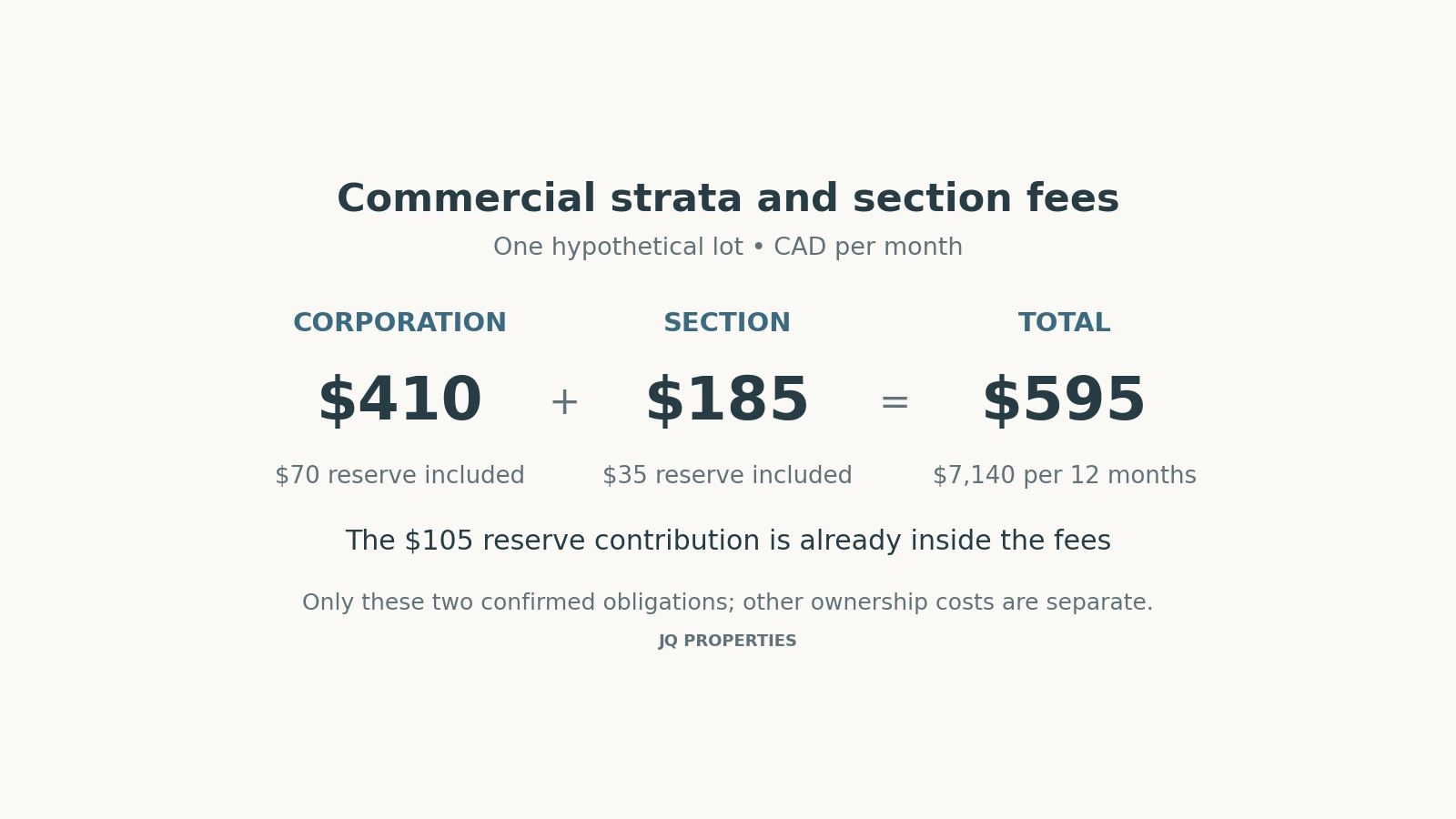
Consider a fictional commercial lot. Its corporation fee is $410 monthly, including a $70 reserve contribution. Its separate commercial-section fee is $185, including $35 for that section's reserve. If the documents confirm these are distinct obligations, the monthly total is $595 and the unchanged twelve-month run rate is $7,140.
A budget using only $410 omits $2,220 a year of section fees. But adding the combined $105 reserve contribution again would overstate the monthly total as $700: those contributions are already inside the two fees. Check for the opposite situation too—a manager may present a single consolidated payment already containing both components.
Suppose a September 1 certificate showed a $380 corporation fee, and a September 5 AGM subsequently raised it to $410 for the period being budgeted. The older combined figure of $565 is now $30 a month short. That is a $360 annualized difference, not a claim that the increase applies retroactively or for twelve months of the current fiscal year.
Keep approved levy obligations and payment dates separate from this recurring total. A discussion of a possible roof project is not an approved assessment, but neither is it proof that future capital cost is zero. If there is a tenant, commercial special-levy recovery requires a separate reading of the lease: identify the permitted charge, any exclusions, the allocation basis and the period of recovery before treating it as tenant income.
Connect the building reports with decisions made afterward
Read the depreciation report's inventory and responsibility assumptions against the systems serving the commercial unit. Ask whether shared HVAC, ventilation, doors, drainage and loading surfaces are included, and obtain referenced engineering or repair reports. Read minutes for what happened next: an inspection commissioned, a scope revised, work deferred, money approved or a repair completed.
BC's current requirements cover strata corporations with five or more lots, including commercial developments; four or fewer remain exempt. Annual votes can no longer defer the report requirement. The applicable initial or transitional deadline still depends on the corporation's establishment date, location and report history. A missing report therefore needs an explanation against those facts, not an old waiver resolution. BC depreciation-report requirements.
A forecast is not an approved project or a guarantee of equipment condition. Compare it with current quotations and resolutions before using a number in the purchase budget. Equally, a paid invoice does not establish that a recurring leak was resolved. Look for completion information and subsequent reports or minutes; leave the cause and remaining scope unresolved if the record does not answer them.
Review insurance and alterations as an operating package
Give a commercial insurance broker the strata and section insurance information, proposed operation, equipment, inventory and intended improvements. Review exclusions, deductibles, loss history where available, business interruption, liability and lender requirements together. A building insurance summary is not a quotation for the buyer's business coverage.
The Province distinguishes strata-corporation insurance from owners' and tenants' own insurance needs. Its examples often concern homes; commercial buyers should not substitute a household policy description for advice on their business exposures. BC strata-corporation insurance guidance.
For a planned buildout, gather previous alteration permissions, expense agreements, approved plans and relevant permits. Establish what the buyer must obtain anew and what ongoing repair or reinstatement obligations could remain. Strata approval, municipal permission and practical system capacity answer different questions; our industrial equipment-fit guide explains the technical side for machinery-dependent uses.
Turn unresolved documents into purchase decisions
Use the commercial owner-user document workpaper (PDF) to connect each essential business requirement with the supporting document, responsible body and remaining decision. It includes the fee reconciliation above and space for missing records, changed facts and unresolved costs.
Before removing conditions, distinguish a minor clarification from an unsupported operating right, unpriced material repair or financing dependency. Decide whether the evidence supports proceeding, whether a specifically documented change is needed, or whether the unit no longer fits. Have the contract consequences handled before its deadline; neither a records request nor a hoped-for approval automatically extends it.
BC sources checked September 8, 2026. Examples are hypothetical; the guide does not determine a particular bylaw's enforceability, insurance coverage or purchase-contract rights.
If you are comparing commercial strata units, JQ Properties can help connect the document requests with the business use, purchase conditions and unresolved costs. Start with the requirements that would make the unit unsuitable, not a count of documents received.
By Justin Qiao, Personal Real Estate Corporation, Justin Qiao Group | RE/MAX Crest Realty.
Sources checked September 10, 2026.