
Two Condos, Different Strata Fees: Compare the Total Monthly Cost
The condo with the lower strata fee is not necessarily the less expensive home to carry. One fee may include heat, hot water and a useful gym; the other may leave those bills to you. A fair comparison adds the costs outside each fee, counts the reserve contribution only once, and keeps uncertain future projects separate from today's recurring payments. You can then decide whether a higher monthly total buys services you actually value.
Start with the two homes you are considering, not a city-wide “normal fee.” The monthly comparison sheet below is designed for two actual candidates, with space to identify the source and billing period of each amount.
Put the fee beside the budget it belongs to
A listing's fee is a starting number. Check it against the current approved budget and the amount assigned to that specific strata lot. Note the fiscal year, effective date and whether another amount is payable to a section. A building-wide budget divided by the number of doors can produce the wrong answer where lots have different allocations.
BC's guidance explains that strata fees normally fund both the operating fund and the contingency reserve fund, and are generally calculated using unit entitlement. It also describes section budgets and other allocation arrangements. Use the actual lot schedule rather than assuming every owner pays an equal share. BC budgeting and strata-fee guidance.
Then read the expense lines for clues about inclusions. A building's “gas” line does not prove the unit has gas cooking, or that every form of heat is covered. It might serve the central hot-water system, common spaces or a pool. Match the budget to the home's equipment and the seller's bills. Ask a precise question: “Does the fee cover the energy used to heat this unit, or only the common-area system?”
The same principle applies to water, internet and parking. Something can be available in the building without being included in your particular fee. A parking space may have a separate charge, and a building internet arrangement may not cover the speed or service you want.
Compare the same household and the same period
Two owners' bills are not automatically comparable. One may live alone, keep the thermostat low and travel regularly. Another may have several occupants and work from home. Use a full year where available, note material differences and avoid treating a vacant unit's electricity bill as a family budget.
For a seasonal bill, total the year and divide by twelve. For an annual insurance premium or property-tax bill, do the same—but keep the actual due date in a separate cash calendar. A monthly average makes homes comparable; it does not change when you must pay.
If you lack a year's information, show a range instead of filling the blank with zero. For example, assume outside utilities could be $140–$220 a month and calculate both totals. This is not a forecast. It identifies whether the unresolved utility bill is large enough to change which condo fits your budget.
Use the same mortgage assumptions only if the two purchases truly require the same loan. If their prices differ, obtain financing figures for each property and down payment. A comparison that equalizes the mortgages may help isolate building costs, but it is not the household's final affordability calculation.
A worked comparison: the $210 gap nearly disappears
The following figures are invented teaching examples, not quotes, actual strata budgets or Metro Vancouver averages. Both examples assume the same household. Mortgage payments, property taxes and unit insurance are held equal solely to isolate the effect of fee inclusions.
| Monthly cash item | Condo A | Condo B |
|---|---|---|
| Strata fee, including reserve contribution | $460 | $670 |
| Heat, hot water and other unit electricity paid separately | $175 | $55 |
| Parking charge outside the strata fee | $65 | $0 |
| Gym membership the household would actually keep | $40 | $0 |
| Unit-owner insurance | $65 | $65 |
| Property taxes, annual amount divided by 12 | $250 | $250 |
| Mortgage payment | $2,900 | $2,900 |
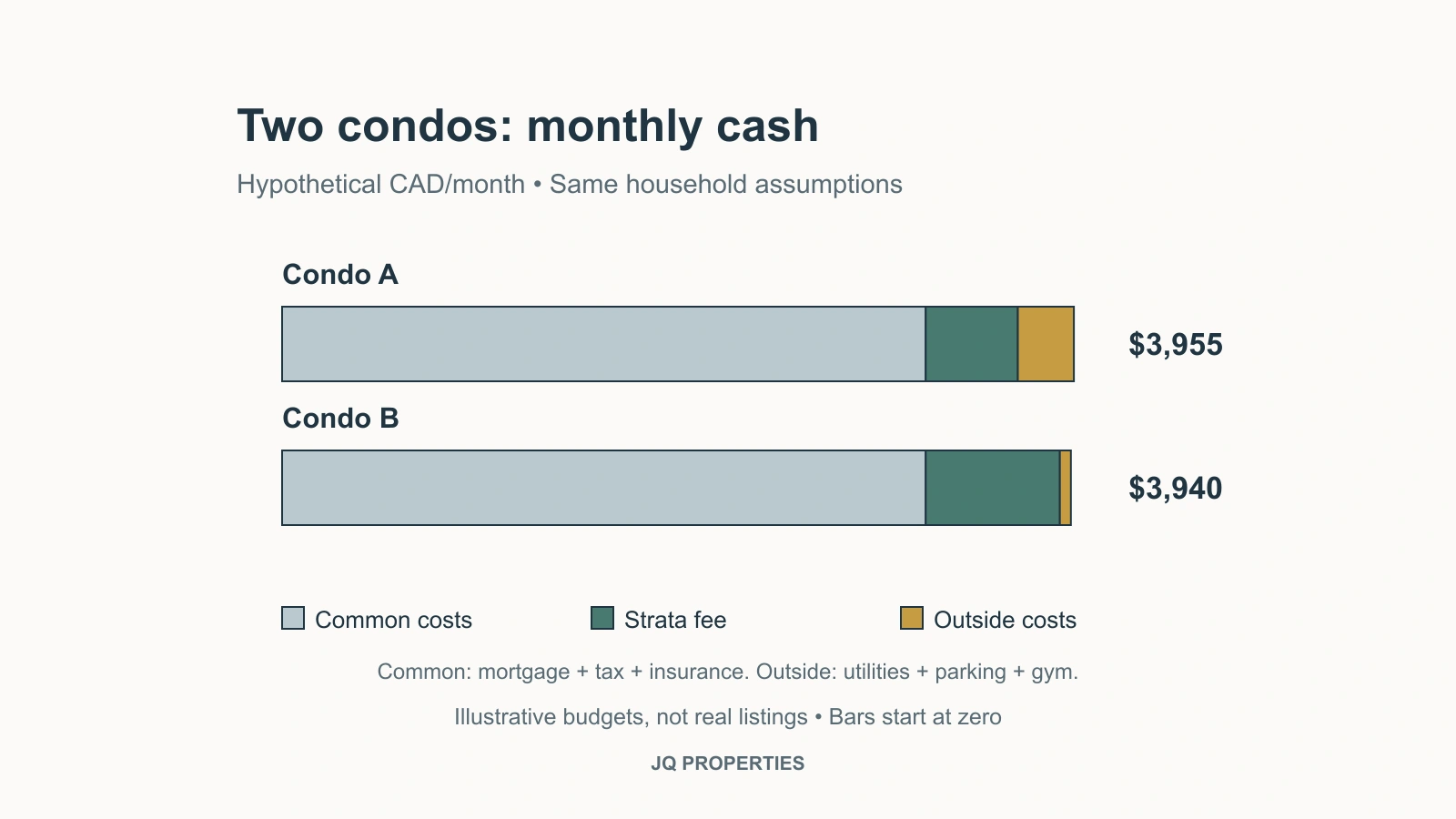
| Total monthly cash | $3,955 | $3,940 |
Condo B's strata fee is $210 higher. However, its assumed inclusions reduce separate utilities by $120, parking by $65 and a genuinely avoidable gym expense by $40. Those offsets total $225. The result is $15 less monthly cash for B, or $180 over twelve months, under these assumptions.
This is not an argument that amenities always save money. If you would not otherwise pay for a gym, remove the $40 from A. Its total becomes $3,915, making B $25 more expensive. If B's gym cannot replace your preferred membership, keep the membership cost in B too. A service you do not use still has a cost in the building budget, but you should not invent personal savings to justify it.
The comparison also shows why rounding every small difference away is unhelpful. A $15 monthly advantage is unlikely to outweigh a major difference in layout, location or household fit. Once inclusions are normalized, you may discover that the fee difference was not the deciding factor at all.
Do not subtract the reserve contribution from cash required
Suppose A's $460 fee contains a $70 monthly reserve contribution and B's $670 fee contains $145. You still pay the full $460 or $670. Subtracting the reserve amount would understate the cash leaving your bank account.
For understanding the budgets, it is useful to display those parts separately: A contributes $390 toward the other fee components and $70 toward the reserve, while B contributes $525 and $145. But the reserve is money retained by the strata for its purposes, not your personal account. It cannot be treated as a refundable deposit when you sell or as money you can withdraw to pay your next mortgage instalment.
Calling the entire contribution “wasted” is equally misleading. It contributes to funding the building's less-frequent expenses. Whether the amount is appropriate depends on the assets, condition, projected work and the rest of the funding plan; a larger contribution alone does not prove adequate funding. The Province distinguishes the operating fund from the fund for less-frequent common expenses. BC guidance on the contingency reserve fund.
Our broader article on why low strata fees are not always good covers that building-health question. Here, the task is narrower: ensure that money included in the monthly fee is not omitted or counted twice in the two-home calculation.
Keep future-project money in a separate view
A current monthly total is not a lifetime cost forecast. Record any approved special levy and its due dates separately. Keep proposed or report-forecast projects in a scenario section rather than turning them into a made-up monthly bill.
For example, a buyer may choose to set aside $300 monthly as a personal building-risk allowance. That is a savings choice, not proof the strata will levy $3,600 next year. If you include that allowance in an affordability test, use an explicit reason for each property rather than automatically giving every building the same number.
Insurance deserves similar care. A quoted unit policy is a recurring payment. Exposure to a strata deductible or a coverage gap is a different question. Adding the full deductible to every year's routine ownership expense would overstate recurring cost; ignoring the exposure because it is not billed monthly would conceal risk. Ask for the building insurance summary and a unit-policy quote, then assess those conditions separately.
Decide which missing number could change your choice
After completing the sheet, mark each amount as supported by a current document, estimated from partial information or still unknown. Concentrate your next request on the uncertainty that matters. If a $50 change in utilities reverses the result, get the bills. If the two homes are already hundreds of dollars apart after consistent financing, spend more effort understanding the larger drivers.
Before making an offer, your usable conclusion should be a sentence such as: “B requires about the same monthly cash under our current assumptions, includes parking we need, and has an unresolved insurance quote.” That is more informative than “B's strata fee is too high.”
Bring the two listing details, current budgets and available bills to JQ-Properties if you want help organizing a condo comparison. The best monthly figure is one you can trace to the actual home—and still understand when an input changes.
By Justin Qiao, Personal Real Estate Corporation, Justin Qiao Group | RE/MAX Crest Realty.
General BC ownership information checked September 8, 2026. Examples are hypothetical; this comparison does not predict future levies or property values.

