
Daycare Asset Sale vs Share Sale: Build the Approval Map
The phrase “buying the daycare” can describe two very different transactions. You might acquire selected business assets through your own company, or buy shares in the company already operating the centre. Before debating which structure is preferable, put the legal names beside the licence, lease and important contracts. The structure only helps if you understand which entity holds the things the business needs.
For a BC daycare acquisition, the central question is who will operate immediately after closing, at which premises, under which permissions. Keeping the trading name, children and furniture unchanged does not answer that question. Nor does choosing a share purchase automatically eliminate consent or notification requirements.
Start with identities, not the sign over the door
Collect the legal name of the current licensee, the tenant named in the lease, the employer, and the owner of significant equipment. Compare those with the seller named in the proposed agreement and, for a share purchase, the company whose shares are being sold. Differences may be explainable, but they should not disappear under one convenient business name.
A corporate registry search helps verify the entity rather than relying on a logo. BC's business-records service describes corporate summaries and certificates of status. Active corporate status is not a child-care licence, and a company summary is not a substitute for examining the corporate records needed to establish ownership of the shares being sold. BC business and organization records.
Use the daycare transaction identity and approval map to record the present holder, proposed holder and evidence for each relationship. Do not mark a row “unchanged” merely because the operating name stays the same.
Asset purchase: identify what must move to the buyer
In a straightforward asset purchase, the buyer acquires the specified assets rather than ownership of the seller's corporation. The purchase agreement must identify what is included, what is excluded and what obligations the buyer assumes. A list of toys, furnishings and goodwill does not itself create a right to occupy the premises or operate licensed care.
If the buyer's company becomes the new licensee, the licensing path must reflect that entity change. Fraser Health states that a change of licensee or facility address requires a new application, and includes changes in business structure within its new-applicant guidance. It does not describe a licence as an asset the parties can simply assign by signing their sale agreement. Fraser Health licence applications.
The premises relationship must also work for the applicant. Section 9.1 of the Child Care Licensing Regulation addresses ownership, a qualifying lease, or written authorization from the premises owner. An assignment or new lease should therefore name the intended entity and allow the proposed care use. A buyer's access for inspections is not necessarily permission to operate the centre. Child Care Licensing Regulation, section 9.1.
For equipment and service contracts, distinguish ownership from assignment of an agreement. A photocopier sitting in the office could belong to a leasing company. The asset schedule cannot make the seller owner of something it does not own. Identify any required release, consent or replacement contract before treating the item as freely available to the buyer.
Share purchase: the company can remain, while its obligations remain too
In a share purchase, the shareholder changes but the corporation is a separate legal entity. Assets held by that company are not individually transferred to the shareholder merely because the shares change hands. CRA's business-purchase guidance explains the distinction between buying assets and acquiring shares. This is an identity point, not a recommendation about the tax outcome of your deal. CRA: Buying a business.
If the target company is already the licensee and remains the operator at the same address, do not describe the transaction as an automatic licence transfer. Equally, do not conclude that licensing has nothing to review. Present the actual shareholder, director, manager and operating changes to the licensing office and obtain the requirements for that fact pattern.
The regulation imposes an immediate duty to notify changes to information supplied with the licence application. Fraser Health also identifies updates such as a designated director or licensee contact in its amendment guidance. A corporate filing alone does not update the health authority's records. Regulation, section 10, Fraser Health amendment guidance.
Read the lease for the actual transaction. A provision addressing a change of control may matter even if the named tenant remains the same company. Check the defined trigger, any exceptions, the notice or consent requirement, and the proposed guarantor arrangements. Do not label a share purchase “no landlord consent needed” without reading that wording.
The company's history also stays relevant. BDC warns that buying shares involves the business's assets and liabilities, including liabilities not recorded in the accounts. A share acquisition is not a way to preserve useful agreements while automatically discarding old exposures. BDC acquisition due diligence.
Test the map with a mismatch
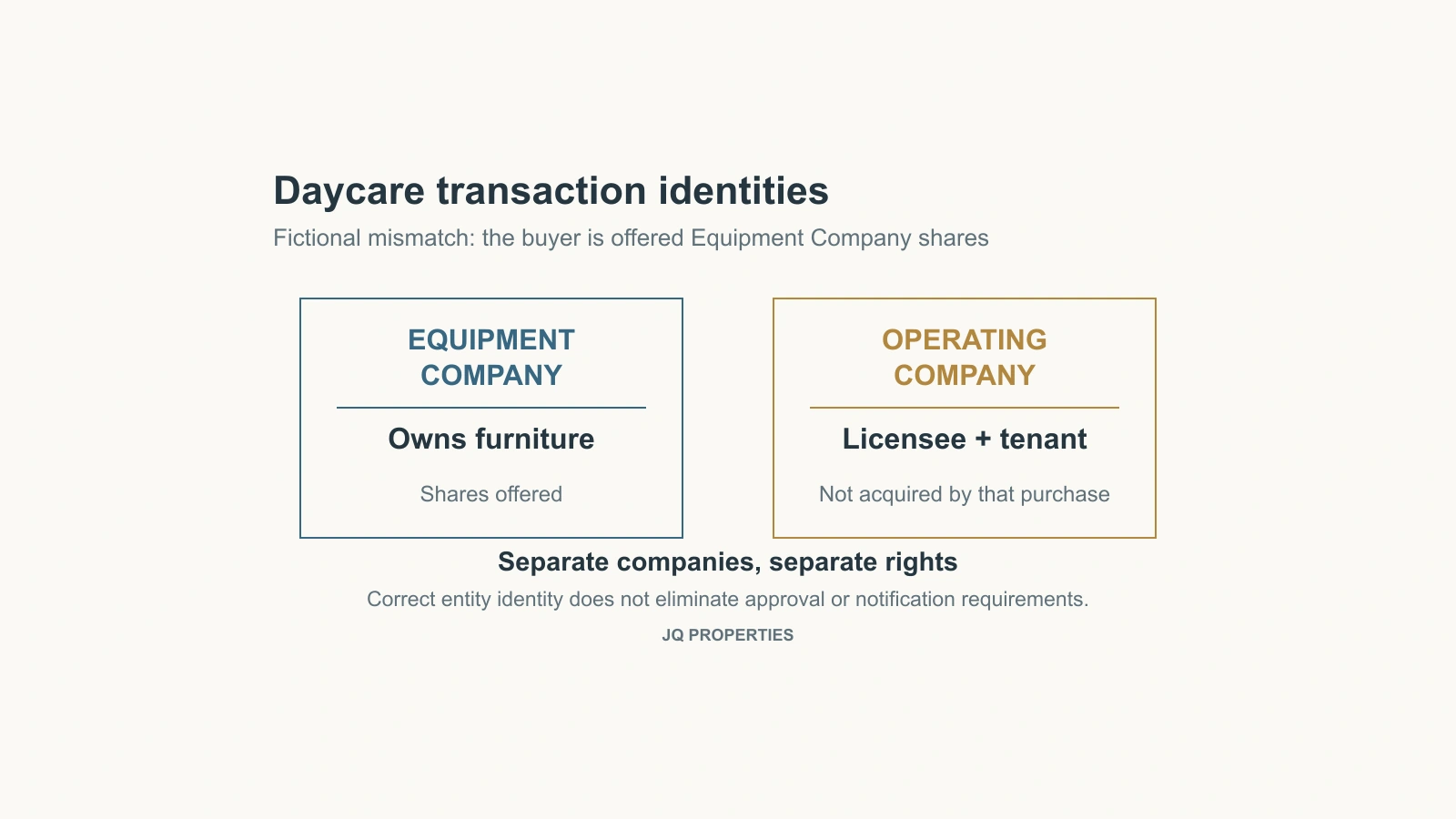
Consider fictional placeholders: Operating Company is the named licensee and tenant, while Equipment Company owns the furniture. A buyer is offered all the shares of Equipment Company. Buying those shares changes control of the furniture owner, but it does not acquire Operating Company or establish rights under Operating Company's licence and lease.
The same problem can be less obvious when the companies have similar names or the same individual owner. Ask for evidence of each entity's role. If the seller later proposes transferring operations into the target company before closing, redraw the map: that preliminary step may itself change the licensee, tenant or contracting party. Do not review only the final share transfer while overlooking the restructuring needed to get there.
Now assume Operating Company itself is the target. The identity mismatch is resolved, but the approval rows are not automatically complete. Licensing notifications, lease change-of-control provisions, financing conditions and insurance arrangements still need their own evidence. “Correct company” and “all necessary steps completed” are different conclusions.
An asset sale is not a blanket escape from past obligations
Avoid the opposite shortcut: assuming an asset purchase means the buyer can ignore every earlier employee entitlement. BC's Employment Standards guidance explains continuity of employment when a business is disposed of and the Act applies to continuing employees. It also addresses obligations such as accrued vacation pay. The parties' purchase-price adjustment or indemnity does not, by itself, remove statutory employee rights. BC Employment Standards, section 97 guidance.
Review employee records and relevant liabilities under either structure. Keep government funding agreements, parent contracts and payment arrangements on the map as separate relationships; a licensing answer is not a funding or banking answer. The map does not calculate a tax preference, guarantee financing or establish that all contracts continue.
Our guide to daycare lease consent and licensing timing addresses coordinating the transaction once those paths are identified. Here, the useful output is a precise list: which entity changes, which permission is triggered, what evidence is still missing, and whether it must be resolved before the intended operator starts care. Contact JQ Properties with the proposed structure and the current licence and lease names so the acquisition review starts with the business you would actually own.
By Justin Qiao, Personal Real Estate Corporation, Justin Qiao Group | RE/MAX Crest Realty.
Sources checked September 8, 2026.

