
Daycare Food Preparation: Does the Space Match the Service You Plan?
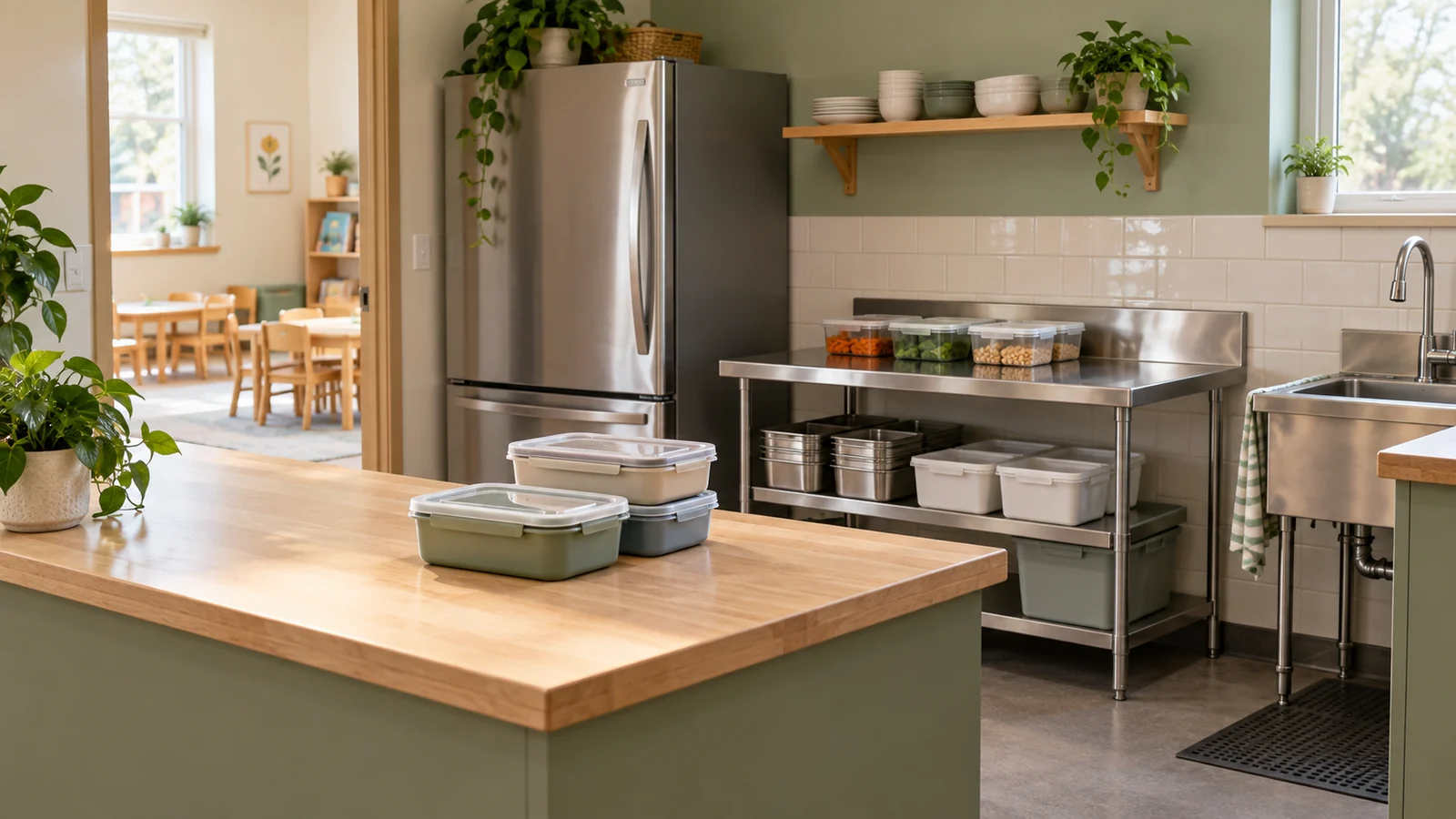
A daycare kitchen that works for parent-packed lunches may not work for a buyer who wants to cook meals on site. Even two catered-food arrangements can need different facilities: receiving a hot lunch just before service is different from storing several days of chilled meals and reheating them. Before valuing the kitchen or promising an expanded meal program, describe exactly what food will arrive, what staff will do to it, and where every stage will happen.
There is no single kitchen package that fits every BC child care licence. HealthLink BC's current guidance says the need for a food-service permit depends on the number of children and the food served. Start with the licensing officer for the actual facility, with environmental health involvement as required. HealthLink BC: food safety in child care facilities.
“Meals included” is not a kitchen specification
Take one ordinary week's menu and translate it into work. For each item, describe its condition on arrival: packaged and ready to eat, raw, frozen, chilled and cooked, or hot. Then describe any washing, cutting, thawing, cooking, reheating, portioning, holding or leftover handling at the daycare.
That description often exposes the real difference between the seller's operation and the buyer's plan. “We use a caterer” could mean individually packed lunches delivered for immediate service. It could also mean bulk trays delivered the previous afternoon, stored overnight, reheated in batches and served from reusable dishes. The second arrangement adds tasks that the first kitchen may never have performed.
Include substitute meals and allergy-related arrangements in the description. Do not hand an authority a simple menu while relying on an unmentioned process for several children. Staff need to be able to identify the correct meal and avoid cross-contact within the actual layout and care instructions.
Child care requirements remain relevant even where a separate kitchen permit is not required. The Child Care Licensing Regulation addresses appropriate food and drink, individual food instructions, drinking water and supervision while children eat. It also prohibits using a food preparation, storage or eating surface for diaper changing. Child Care Licensing Regulation, sections 46 and 48.
Compare the functions, not the number of appliances
Use the food-service and facility-fit worksheet to compare four common arrangements. These are planning descriptions, not official permit categories:
| Proposed arrangement | The facility question that is easy to miss |
|---|---|
| Parent-packed lunches with centre-provided snacks | Where are lunches kept appropriately cold, and where are snacks prepared and dishes cleaned? |
| Hot catered food for the same meal service | Where is delivery received and safely held if it arrives early or service is delayed? |
| Chilled catered meals reheated on site | Can the space store the actual delivery quantity and support the required reheating, portioning and cleaning sequence? |
| Meals cooked from raw ingredients | How are raw and ready-to-eat foods separated, and what cooking, ventilation and sanitation facilities does the process require? |
A refrigerator door that closes is not a capacity test. Use the actual container dimensions, delivery frequency and other stored food when assessing space. The equipment also needs to maintain the required conditions under the proposed load; fitting containers inside does not establish that performance. For food premises governed by the Food Premises Regulation, potentially hazardous food must be stored or displayed at no more than 4°C or no less than 60°C, and refrigeration and hot-holding equipment must be suitable and adequate for the premises. Those holding limits are not cooking or reheating instructions. Food Premises Regulation, sections 14 and 19.
Walk the dirty-dish return as well as the food's outward journey. Where do used containers wait? Can someone wash hands without moving dirty trays? Is there enough clean space to portion lunches without occupying the next meal's preparation area? A domestic-looking dishwasher is not proof of a suitable sanitation process; identify its actual functions and the accepted procedure.
Changing the menu can change the building work
A small electric appliance is still part of a cooking process. Do not assume “no gas” means no ventilation or fire-protection question. Identify the appliance, the foods cooked, the cooking method and the expected volume before deciding what the existing room can accommodate.
Vancouver's current commercial-kitchen guidance specifically warns that an existing kitchen may have been approved only for cooking that does not create greasy fumes. A changed menu or equipment can require ventilation and fire-protection upgrades, with permits and inspections for the work. That is a Vancouver example, not a finding that every daycare snack counter needs a restaurant hood. City of Vancouver: kitchen ventilation and fire protection.
For a Burnaby premises, use Burnaby's current building-permit process rather than applying Vancouver's application requirements. In either city, an exhaust route can affect more than the kitchen: a wall penetration, roof outlet or equipment location may require landlord or strata permission. Confirm that the proposed installation is possible before pricing only the appliance.
Separate the resulting costs into equipment, installation work and operational changes. A quote for an oven does not include every possible electrical, ventilation, plumbing or fire-protection cost. Conversely, do not assume a full commercial-kitchen conversion is necessary until the proposed food service has been assessed. Burnaby's current building information.
Test lunch service as an operating sequence
Consider a hypothetical centre serving 24 children. Its proposed supplier offers two delivery choices: 24 individual chilled meals each morning, or 48 meals every second morning. The latter doubles the incoming meal-container count before that day's service. It may reduce delivery charges while creating a storage problem. Neither count proves what refrigerator is adequate.
Now add the staff sequence. Someone must receive the food, put it away, prepare service, respond to individual meal instructions and clean afterward. If one employee is doing those tasks, the staffing plan must still meet the actual supervision and qualification requirements for the children present. Do not count the same person's time as both uninterrupted kitchen work and uninterrupted room coverage without testing how the work will happen.
Try the sequence on a drawing or in an empty room with clean, empty containers. Note the occupied surfaces, door swings, handling stages and return path. This is a layout rehearsal, not permission to prepare or serve food before required approvals. A useful result is specific: “The proposed two-day delivery does not have assigned cold-storage space,” or “Dirty trays would return across the lunch-portioning area.”
Make the approval question answerable
Give the licensing officer the menu, child numbers, delivery and preparation description, floor plan, equipment list and proposed change from the existing program. Ask which food-service permit or approval path applies, what plans are required, and what must happen before that service begins. For food businesses within its jurisdiction, Fraser Health distinguishes operating permits from health approvals and provides the floor-plan, food-safety and sanitation application materials. An existing operator's permit or approval should not simply be assumed to transfer to a different owner. Fraser Health: requirements for new food businesses.
Keep that answer alongside the premises' municipal requirements and the transaction's timing. The broader daycare licensing and zoning guide explains why those paths need to fit the purchase schedule.
If full meal preparation does not fit the current space, the useful alternatives are concrete: a different acceptable delivery model, a narrower menu, or a costed and approvable renovation. Compare those choices before promising parents a service that the building and staffing plan cannot yet support.
General BC premises and business-planning information, checked September 8, 2026. The worksheet does not replace the facility's required approvals or approved food-safety procedures.
When comparing daycare premises, JQ Properties can help organize the property questions around your menu, equipment and intended opening sequence.
By Justin Qiao, Personal Real Estate Corporation, Justin Qiao Group | RE/MAX Crest Realty.

