Daycare Lease Review: Space, Term, Consent and Cost
A daycare lease is useful to a buyer only if it supports the operation being purchased. A long term does little good if the outdoor yard is excluded, the permitted use does not fit the program, or the tenant must pay for a major building system the earnings model ignores.
Review the lease against a description of an ordinary operating day: who opens the premises, which rooms and outdoor areas children use, how families arrive, what happens during maintenance, and who pays the bills. The result should be a short list of supported rights, unresolved restrictions and costs to carry into the purchase decision.
This review concerns the business's right to occupy and use the site. It does not replace the separate health-authority licensing process, municipal requirements or the buyer's financial review.
Assemble the agreement that actually governs the site
Obtain the signed lease, every amendment, extension, assignment, landlord consent and incorporated schedule. Request current rent statements, additional-rent reconciliations, deposit records, relevant notices and outstanding repair correspondence. An unsigned draft or a broker's summary may omit the provision that changes the answer.
Check the tenant's legal name against the seller and the proposed transaction. Identify the landlord and any party whose consent is required under the documents. If the seller leases only part of a larger property, check whether the yard, parking, storage and access routes are part of the leased premises, shared facilities, or separate permissions.
A schedule that was meant to show the outdoor area but is missing cannot be replaced by a photograph of a fence. Ask for the executed plan and any later changes. If records conflict, state the conflict; do not pick whichever version makes the business easier to sell.
Create a dated operating description beside those documents. Include the care programs, planned hours, food preparation, proposed alterations and any change in operator. This gives the landlord and licensing authority the same factual proposal without pretending that one party can approve everything.
Match permitted use to what the buyer intends to run
Read the actual use language. Does it describe childcare generally, specified programs, an identified operator or additional public-service obligations? Check restrictions on hours, noise, food preparation, signs, alterations and use by other groups. A broad permitted-use phrase does not necessarily override a narrower schedule.
Also identify what an exclusivity clause protects, if there is one. It may restrict particular competing uses within a defined property; it does not establish demand or prevent competition elsewhere. Do not price protection that is absent from the signed agreement.
B.C.'s Child Care Licensing Regulation separately addresses premises authorization. Section 9.1 requires an applicant to own the premises, lease them without a prohibition on the intended care use, or have written authorization from the owner. A lease can help establish that element without proving the entire licensing application will succeed. Child Care Licensing Regulation, section 9.1
If the buyer proposes a different age group, larger capacity or structural work, separate the existing operation from the change. Section 10 addresses changes to application information and, subject to its specified exceptions, prior written approval for structural changes. “The seller has operated here for years” is not evidence that a new wall opening or additional room has already been approved. For a non-conforming-use renovation, establish the lawful existing use and the rules that apply to the proposed change before relying on additional space.
Confirm the whole route, not just the classroom
Trace the space children, staff and families must use: entrance, corridors, washrooms, storage, yard and lawful parking or drop-off areas. For each location, identify the document granting access, permitted hours, other users and any power to relocate or withdraw the arrangement.
The City of Vancouver's 2021 Oakridge general childcare lease precedent illustrates why the definitions and schedules matter. Its definition of “Play Yard” ties exclusive outdoor use to the leased premises and a labelled plan. That is a dated public precedent with blanks, not proof that any private daycare has equivalent rights. City childcare lease precedent, definition 1.1(aa)
For a shared route, ask who controls locks, delivery access and maintenance closures. A yard agreement is not enough if the only path crosses another tenancy without a continuing access right. For the detailed yard and access comparison, see outdoor play space due diligence. Likewise, a parking allocation does not prove that family arrivals work at the same time as neighbouring businesses. A shared-building arrival test should compare family drop-off and pickup times with the neighbouring business’s actual access and parking demands.
If a right is informal, keep it outside the supported operating case until it is documented. The practical response may be a written amendment, an alternative arrangement with the required permissions, or a decision that the site does not fit. Do not assume continued neighbour goodwill is a transferable business asset.
Distinguish consent to the deal from permission to provide care
Locate assignment, subletting and change-of-control language, including definitions elsewhere in the agreement. The sale structure alone does not answer whether consent is needed. Identify the proposed tenant, guarantor, security, effective date and any conditions attached to consent.
The Oakridge precedent's Article 13.1 expressly requires prior written City consent for assignment and contains its own discretion and covenant provisions. It is a useful counterexample to the idea that every lease must be freely assignable. It is not a statement of the rules governing every landlord or private transaction.
Fraser Health separately states that a community care facility licence is not transferable and requires a new application when the licensee or facility address changes. Confirm the applicable process with the responsible authority using the actual legal entities and site. Landlord consent does not transfer a licence, and a licensing application does not grant a lease assignment. Fraser Health licence applications
Obtain the complete consent document, not simply an email saying the landlord is generally supportive. Check whether it changes rent, options, repairs or security, and whether the outgoing tenant or guarantor is released. Release should not be inferred merely because a new operator is accepted.
Match the lease's insurance requirements to the buyer's proposed coverage, effective date and required evidence. Ask the insurance representative to identify any unmet requirement before possession, rather than assuming the seller's certificate covers the new tenant. Keep that confirmation separate from the landlord's consent.
Put term and interruption rights into the operating plan
Record the current term end, renewal rights, notice mechanics and rent-setting provisions. Separate an enforceable right supported by the documents from an extension the parties hope to negotiate. There is no universal number of lease years that makes a daycare purchase safe.
Compare the supported period with the business plan's investment and financing needs. A lender's repayment term does not extend the lease. Where the purchase depends on an approaching renewal deadline, compare the supported lease-option horizon with the price and investment that depend on it.
Read beyond the expiry date. Demolition, relocation, casualty, default and access provisions can affect continuity during the term. Identify notice, cure rights, restoration obligations and any rent treatment when space becomes unusable. Do not assume every closure suspends rent or that the landlord must pay for lost enrolment.
For alterations, ask who approves the work, who owns improvements after installation, who maintains them and what must be removed at the end. A tenant improvement allowance may have payment conditions; do not treat an unapproved reimbursement as cash already available.
Calculate occupancy cost without turning deposits into expenses
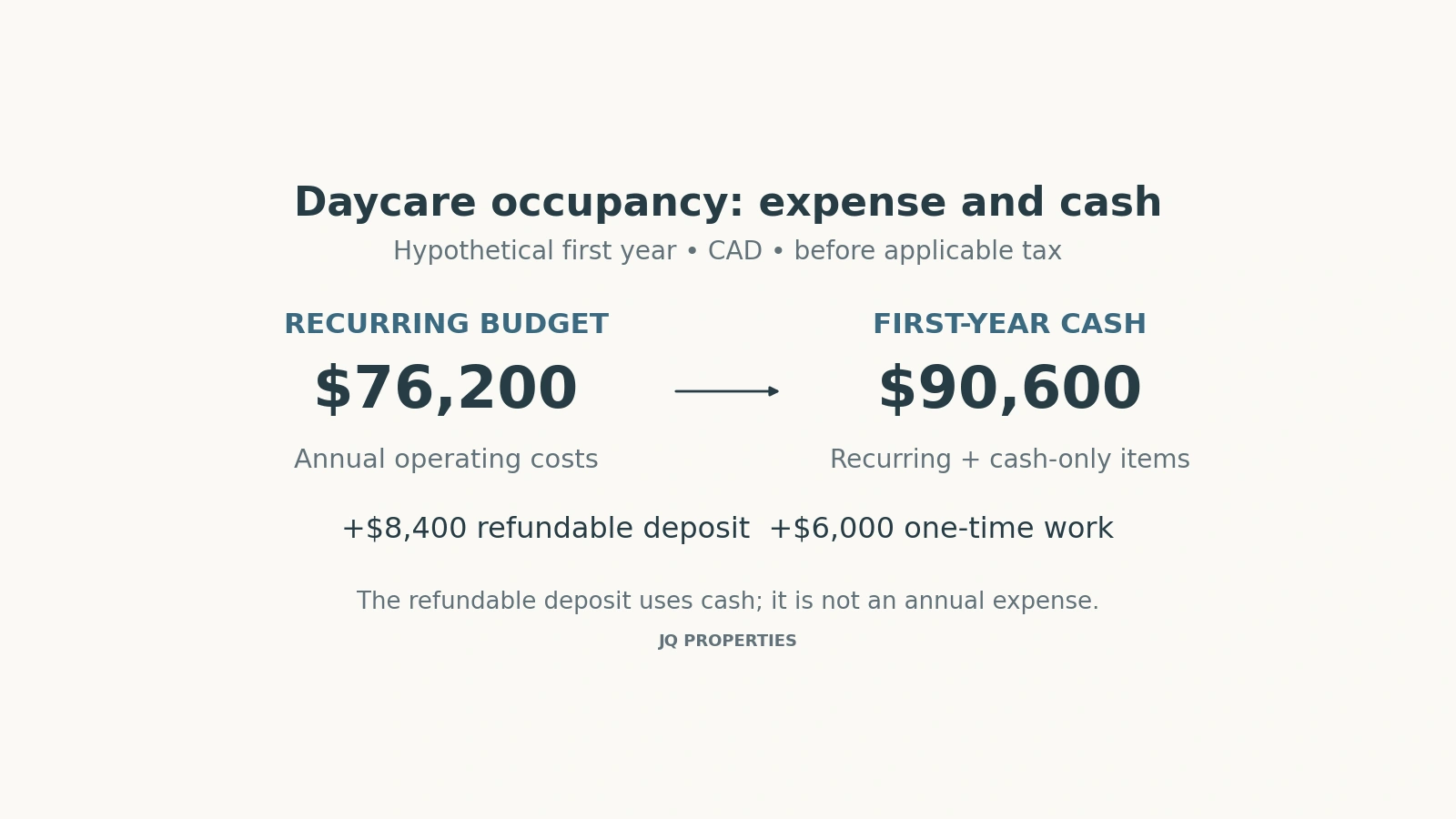
The lease-to-operation worksheet (PDF) includes a fictional cost example. Base rent of $4,200 per month is $50,400 annually. Add $14,400 of estimated additional rent, $6,000 of separately billed utilities, $1,800 of waste service and $3,600 of tenant insurance. The annual recurring occupancy budget is $76,200, before applicable taxes.
This example assumes none of the separately listed costs is already included in additional rent. Check that assumption against the actual definitions and bills. If additional rent is a monthly estimate subject to reconciliation, it is not a guaranteed annual ceiling. At $1,500 instead of $1,200 per month, the example rises by $3,600 to $79,800 annually.
A refundable $8,400 security deposit is a cash requirement, not another annual operating expense. Adding that deposit and $6,000 of one-time buyer-funded premises work produces a first-year occupancy cash requirement of $90,600 in the base case. The calculation assumes the buyer must supply the full deposit; an existing deposit transferred or adjusted at closing needs different treatment. It excludes purchase price, payroll, financing and other business costs.
BDC's leasing-budget guidance recommends examining incidentals and past bills as well as rent increases. The useful question is what this lease actually passes through, not whether its heading says “net” or “gross.” BDC occupancy-budget guidance
Ask both who performs repairs and who pays
Make separate entries for routine service, repairs, replacement and tenant-caused damage. The party arranging a contractor may not be the party ultimately charged. Ask whether a building-wide cost can also appear in additional rent and whether the proposed one-time work is already included elsewhere in the budget.
The Oakridge precedent's Schedule D makes this distinction explicit through separate columns for performing and paying for work. Its play-area entries also distinguish general outdoor items from perimeter-fence damage. Use that structure as a reading aid, not as the repair allocation for the property you are buying.
An unresolved $12,000 replacement estimate would raise the example's base first-year cash requirement to $102,600 if the buyer must fund it separately. That arithmetic does not establish who owes the money or whether the work is sufficient for approval. Obtain the scope, contractual allocation and timing before accepting a price credit as the entire solution.
Conclude with specific decisions: the yard right needs documenting; the repair responsibility changes the budget; the proposed use needs confirmation; or a consent condition changes the purchase timetable. Some uncertainties can be priced, while an essential missing operating right may make the premises unsuitable regardless of a discount. A daycare lease review succeeds when it makes that distinction clear before the buyer commits.
For help organizing a daycare premises comparison, contact JQ Properties with the signed lease, proposed use and the operating right or cost that remains unclear.
By Justin Qiao, Personal Real Estate Corporation, Justin Qiao Group | RE/MAX Crest Realty.
Sources checked September 9, 2026.