
Daycare Payroll Normalization: Include the Work the Owner Does
A daycare owner’s unpaid work is still an operating requirement. If the seller supervises a room, manages staff, speaks with parents, and completes administration, the buyer needs a realistic way to cover those duties after closing. Start with the work and when it happens, then price the people and relief needed to perform it.
The amount the owner withdraws from the business is not the answer. Draws, dividends, salary, and expense reimbursements can have different accounting treatment. Reconcile the financial statements before making an adjustment, and keep payment for your own labour separate from the return on the money you invest.
Reconstruct an ordinary week—and an inconvenient one
Ask for an anonymized schedule showing the owner’s actual duties. Include opening and closing, time counted in a care group, parent meetings, staff supervision, purchasing, recordkeeping, payroll coordination, and work done after children leave. A job title such as “director” does not tell you how many of these tasks the owner performs.
Record tasks that happen at the same time carefully. An owner supervising a room while answering a brief administrative question has not supplied two hours of labour in one hour. But an hour of concentrated billing work cannot automatically be assumed to occur while that person is responsible for active child supervision. Identify a feasible replacement schedule, not just a total that looks affordable.
Then examine a week with an absence, training session, or late collection. The seller may routinely fill gaps without recording additional payroll. If your replacement employee is away, someone still needs to cover the required work. The broader staff continuity guide explains why retention matters; this calculation identifies the labour cost hidden by owner coverage.
Match qualifications to the work being replaced
Ownership does not substitute for an educator qualification. Nor can every person described as an assistant replace an educator in every scheduled role. The current Child Care Licensing Regulation sets manager and employee requirements, certificate verification, supervision, and program-specific staffing rules. In particular, section 19(4) requires the licensee to verify educator or assistant certification through the Registry’s system.
If the seller is the person whose qualification supports a particular group, record that function separately from general business administration. A buyer intending to do the paperwork personally may still need qualified coverage in the room. Conversely, an appropriately qualified person hired for room coverage may not have enough paid time to take over all the seller’s management work.
Use qualification summaries during early diligence; arrange authorized verification and staff discussions at the appropriate transaction stage. Do not contact employees directly without an agreed communication plan or circulate unnecessary personal employment records.
Use wage evidence as a reference, not a staffing quote
When checked on September 8, 2026, Job Bank’s Vancouver-area wage page showed a $23.50 hourly median for the Lower Mainland–Southwest region, with $20.00 low and $29.75 high figures. The wage update was November 19, 2025, and its reference period was 2023–2024. These are regional occupational statistics, not a September 2026 offer from an available replacement employee.
Use that information to challenge an implausible assumption, then compare the actual role, qualifications, hours, benefits, and current recruitment evidence. An educator-manager package with administrative duties should not be priced simply by multiplying every owner hour by a regional median. Confirm how any wage-enhancement funding is treated in the seller’s payroll and your proposal; do not silently subtract an assumed subsidy from gross employment costs.
A replacement plan with the leave coverage included
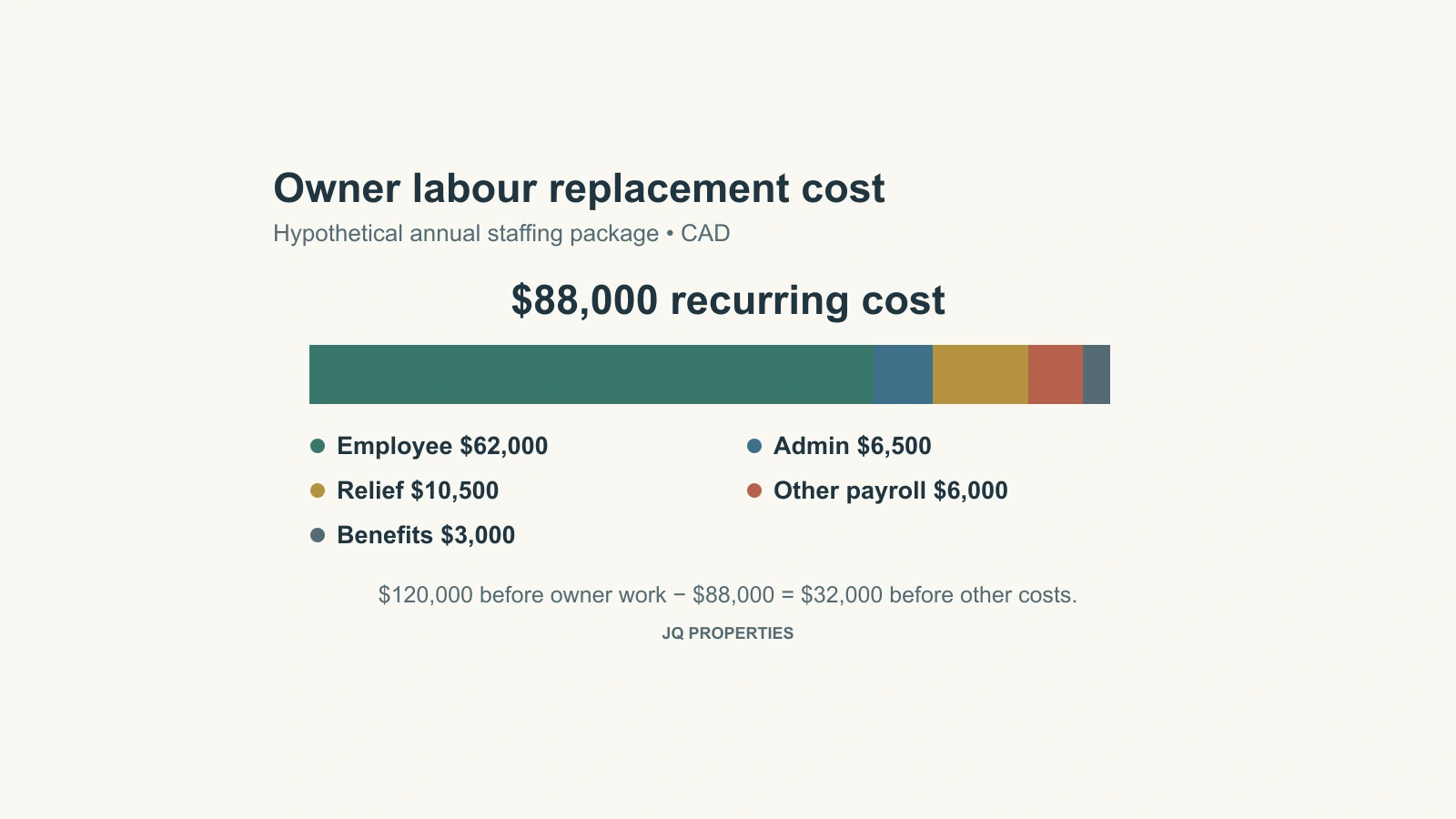
Consider a hypothetical owner working 45 hours per week: 32 hours in scheduled care, eight hours of management, and five additional hours of administration. Assume the buyer can replace the first 40 hours with one appropriately qualified employee on a workable five-day schedule, and purchase the remaining administrative coverage separately. That scheduling assumption must be tested; it is not permission to combine incompatible duties.
The hypothetical annual package is:
| Replacement requirement | Annual assumption |
|---|---|
| Qualified employee, 40-hour role, salary including the stated paid-leave arrangement | $62,000 |
| Additional administration, five hours weekly at an assumed $25 wage for 52 weeks | $6,500 |
| Relief and overlap, 300 hours at an assumed $35 per hour | $10,500 |
| Employer payroll contributions and assessments, separate planning allowance | $6,000 |
| Health and other benefits, separate planning allowance | $3,000 |
| Recurring replacement cost | $88,000 |
The 300 relief hours are an explicit budget: 160 for four weeks of vacation coverage, 40 for illness-related absence, 40 for training coverage, and 60 for planned overlap and other coverage needs. The administration line is a paid-hours budget including its own paid-leave provision, not 52 guaranteed productive weeks; necessary absence coverage for that role is assumed within the 60-hour allowance. These are staffing assumptions, not a prediction of sick leave or a complete legal entitlement calculation. The $35 relief rate is assumed to include the relief provider’s paid-leave cost; employer charges are covered in the separate allowance. Check actual arrangements rather than copying that convention.
BC’s annual vacation guidance distinguishes vacation time and vacation pay. Its illness and injury leave guidance explains eligible employees’ paid and unpaid leave after 90 consecutive days, including the average-day’s-pay calculation. Paying the employee during leave and paying someone to cover their duties are different costs.
In this example, the main salary already includes the assumed paid vacation and paid illness leave. Adding the same leave pay again would double count it; omitting relief would leave a service gap. The separate employer-cost allowance is not a statutory percentage or payroll calculation. Replace it with amounts based on actual earnings, applicable CPP/EI rules, WorkSafeBC assessments, benefits, and the employment arrangements. Likewise, a salary label does not by itself resolve overtime obligations.
The owner-work replacement sheet keeps the duties, schedule, pay basis, and leave treatment together so you can see what each amount includes.
Apply the adjustment to the right starting number
Suppose the business produces $120,000 of annual operating cash before compensation for this owner’s work. Assume the seller’s $40,000 of withdrawals were distributions, not an expense deducted in arriving at that figure. Subtracting the $88,000 recurring replacement cost leaves $32,000 before financing, income tax, capital spending, and other adjustments outside this example.
Do not add the $40,000 back: it was never deducted. If the seller instead had a genuine salary expense already included in the starting figure, the reconciliation would be different. Identify the entry, remove only what is being replaced, and then include the replacement package once.
Assume a further $2,500 of one-time recruitment and initial onboarding costs. The first-year amount becomes $29,500 on the same basis. Keep that one-time cost separate from recurring payroll so it does not disappear from closing cash or become a permanent annual charge without explanation.
If you intend to do the work yourself, show two views: actual cash under your personal working plan and performance after a reasonable labour charge. The second helps distinguish a business that pays for a job from one that also earns a return on invested capital. Neither view should assume you can replace qualifications or hours you do not have.
Before changing the offer, identify the largest unsupported input: the owner’s schedule, a qualification gap, the replacement wage, or relief availability. Resolving that item is more useful than debating a valuation multiple built on incomplete payroll. Contact JQ Properties with the anonymized duty schedule and the financial starting point if you want to organize that work for a daycare purchase.
By Justin Qiao, Personal Real Estate Corporation, Justin Qiao Group | RE/MAX Crest Realty.

