
After a Home Inspection: Which Findings Need a Specialist?
The next step after a home inspection is not to obtain a quote for every sentence in the report. It is to identify the unanswered questions that could change your purchase decision, then choose the person or record capable of answering each one.
A missing installation date may be resolved with a matching invoice. An unexplained pattern of movement may need engineering advice. A repair estimate can help budget work, but it does not necessarily diagnose the cause or establish that the proposed repair is sufficient. Treating these as the same assignment wastes time precisely when a buyer’s condition period may be short.
This guide is for BC buyers who already have an inspection report. The aim is to turn its findings into a manageable decision record: what has been established, what remains outside the inspection, and what must be understood before proceeding.
Read the scope before ranking the findings
Read the full report alongside the inspection contract, including inaccessible areas and recommendations for expert advice. A reassuring summary does not erase an attic that could not be entered or a system that was not tested. Ask the inspector to clarify ambiguous wording and distinguish an observed defect from a possibility requiring investigation.
BC’s Home Inspector Licensing Regulation requires the contract to specify coverage, address mould and asbestos inspection, and describe whether the inspection is non-invasive or which invasive procedures will be used. The written report must give opinions on the agreed items, identify recommendations for expert advice and say what was not covered. It is not reasonable to treat silence about a concealed component as a favourable finding. Home Inspector Licensing Regulation, sections 12–13
Consumer Protection BC describes an inspection as a way to reduce, not eliminate, risk. Its guidance also directs consumers to independent contractors for repair quotes and says the inspector should not supply those estimates or refer the consumer to a contractor. Keep the inspection opinion and the proposed repair sale distinct. Consumer Protection BC’s inspection guidance
For each material finding, write a plain-language question. “Foundation concern” is too broad. “What explains the reported movement, is it ongoing, and what further investigation or remedial design is needed?” gives the next professional a useful assignment.
Some follow-up ends with a document, not another site visit
Suppose a hypothetical report records the roof installation date as unknown, but does not identify a defect requiring specialist review. The seller then provides a roof invoice for this address, identifying the main-house roof and a completion date. Check that it documents completed installation on the main house—not cleaning, work on a garage, or a deposit for work not yet completed.
If the document answers the date question, that question can be closed in the buyer’s record. It does not establish today’s roof condition, an exact remaining life or that every roof section was replaced. Any separate condition concern remains open. This is a useful, limited resolution—not a reason to order a roofer simply to repeat the date, and not permission to ignore a reported leak.
Likewise, a missing service record may be obtained without commissioning a whole new inspection. Ask what the record actually proves. A recent furnace service invoice does not mean every defect was repaired; a permit number does not describe all work in the house. The unpermitted-renovation guide covers the separate task of reconciling work and approval records.
Match the technical question to the scope
For structural movement, a modified support or an uncertain load path, ask a structural engineer with relevant residential experience what assessment is needed. A general contractor may be able to price a specified repair, but a price alone cannot establish the structural diagnosis or design. Verify the professional’s registration and practice area; Engineers and Geoscientists BC’s directory provides status, practice restrictions and other registration information. EGBC registrant directory
For an electrical concern, retain a licensed electrical contractor for the relevant assessment. Ask them to distinguish an observed connection issue, circuit condition, service capacity and any proposed remedial work. A proposal to replace a panel is not automatically a whole-house wiring assessment. Technical Safety BC’s contractor guide explains how to check the licence type and authorized scope. Also confirm the responsible permit authority: some municipalities administer electrical permits themselves. TSBC contractor guide, electrical permit jurisdictions
Water findings need a more precise route than “call someone about dampness.” A suspected supply-pipe leak may call for a plumber. A roofing defect calls for relevant roofing expertise. A below-grade drainage concern may require drainage investigation; uncertainty about movement or the building enclosure may require an engineer with that competence. Tell the first professional what was observed and ask whether the suspected cause lies within their scope. More than one discipline may be needed, but not every damp mark requires every discipline.
Do not turn mould-like staining, suspected asbestos or an oil-tank clue into a confirmed diagnosis. Ask for appropriately qualified investigation and the necessary access or testing permissions. A tank scan and an environmental assessment answer different questions. A surveyor handles boundary location, not structural adequacy; a fireplace or gas-appliance concern needs expertise in that system, not a generic assurance from an unrelated trade.
These examples are routing questions, not remote diagnoses. If a report identifies an immediate hazard, follow the professional’s safety directions promptly. Do not open panels, disturb suspect materials or use a potentially unsafe system to test the concern yourself.
Commission an answer, not just an appointment
When contacting a specialist, supply the relevant report pages, photographs, property address, access restrictions and decision deadline. Ask permission before forwarding a report you are not entitled to share. Explain the question and request a written scope, fee and delivery time.
A useful response identifies what was examined, the observations and conclusions, remaining uncertainty, recommended action and any need for further work. Ask whether the engagement includes a site visit, testing, a written opinion, a repair specification or merely a quotation. Arrange seller permission for access and any invasive investigation; booking the appointment alone does not provide that permission.
Consider two hypothetical responses to a crawlspace finding. One offers a visual visit and short letter; another offers opening-up, sampling and a remedial design. They are not equivalent bids. Before comparing price, establish whether the second scope is required, what permissions it needs and whether the first professional can answer the buyer’s immediate question without it.
Nor does an assessment fee buy the repair. Keep investigation costs, estimated remedial costs and future maintenance separate. A quote with exclusions for concealed damage is not a fixed ceiling on all consequences of the finding.
Track answers without giving the house a misleading score
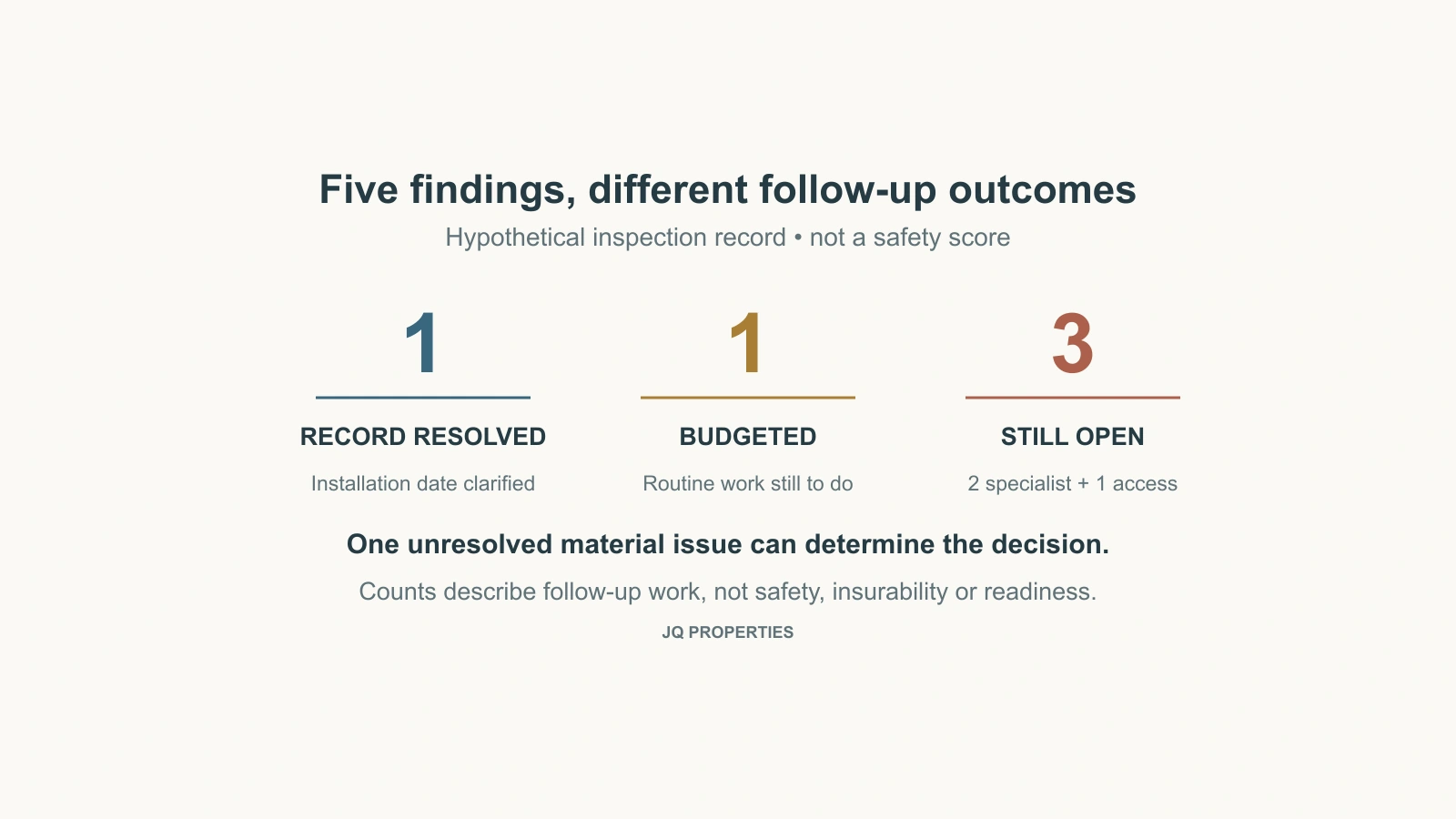
The inspection finding-to-scope workpaper provides a routing table and a written-brief prompt. It is a manual note sheet, not software that diagnoses defects. Its example deliberately has different outcomes: one record question closed, one routine maintenance item budgeted, two specialist questions open and one access limitation still unresolved.
In that example, the date question is resolved and the maintenance item is budgeted; the other three follow-ups remain open. That is a workload count, not a claim that the house is 40% safe or that two routine answers outweigh one unresolved structural concern. An appointment booked is still an open question until the relevant response arrives and is understood.
Use the sheet to name the person obtaining each answer and the time required. Keep “no estimate yet” distinct from a zero-dollar repair. If several findings depend on the same cause, cross-reference them so that one problem is not counted as three independent repair budgets.
Connect the result to financing, insurance and the contract
Where a finding may affect coverage or a lender’s property requirements, provide the requested facts and obtain the response before relying on the original financing plan. Do not assume a contractor’s letter binds an insurer or that a mortgage pre-approval has already accepted this property. The older-home materials and insurance guide separates material identification, condition, extent and underwriting.
If essential information cannot arrive before the condition deadline, speak promptly with the professionals handling the purchase. An extension requires agreement; an unanswered request or a booked specialist does not itself change the contract. The appropriate next step depends on the wording and timing of the buyer’s conditions, not a universal right to cancel after an unfavourable inspection.
Once the material questions are answered, decide what they mean for this buyer. Routine maintenance may fit the budget without negotiation. A defined repair may support a specific request, subject to the seller’s agreement. Unresolved cause, essential-use restrictions or unmanageable disruption may lead to a different decision even when somebody has supplied a low estimate.
If repairs are negotiated, address scope, who performs them, permissions, timing and evidence of completion with the relevant advisers. “Fix everything in the report” can conceal substantial disagreement about what was promised. A later walkthrough can check agreed visible items and changed condition, but cannot replace technical follow-up that was needed before the buyer committed.
JQ Properties can help organize the report questions, document requests and purchase timing. The inspection and specialist conclusions belong to the qualified professionals engaged for that work. A useful follow-up process ends with an informed decision about the remaining uncertainty—not simply a longer folder of reports.
By Justin Qiao, Personal Real Estate Corporation, Justin Qiao Group | RE/MAX Crest Realty.
Sources checked September 9, 2026.