
Can You Buy a Home in BC? Check Federal and Provincial Rules Separately
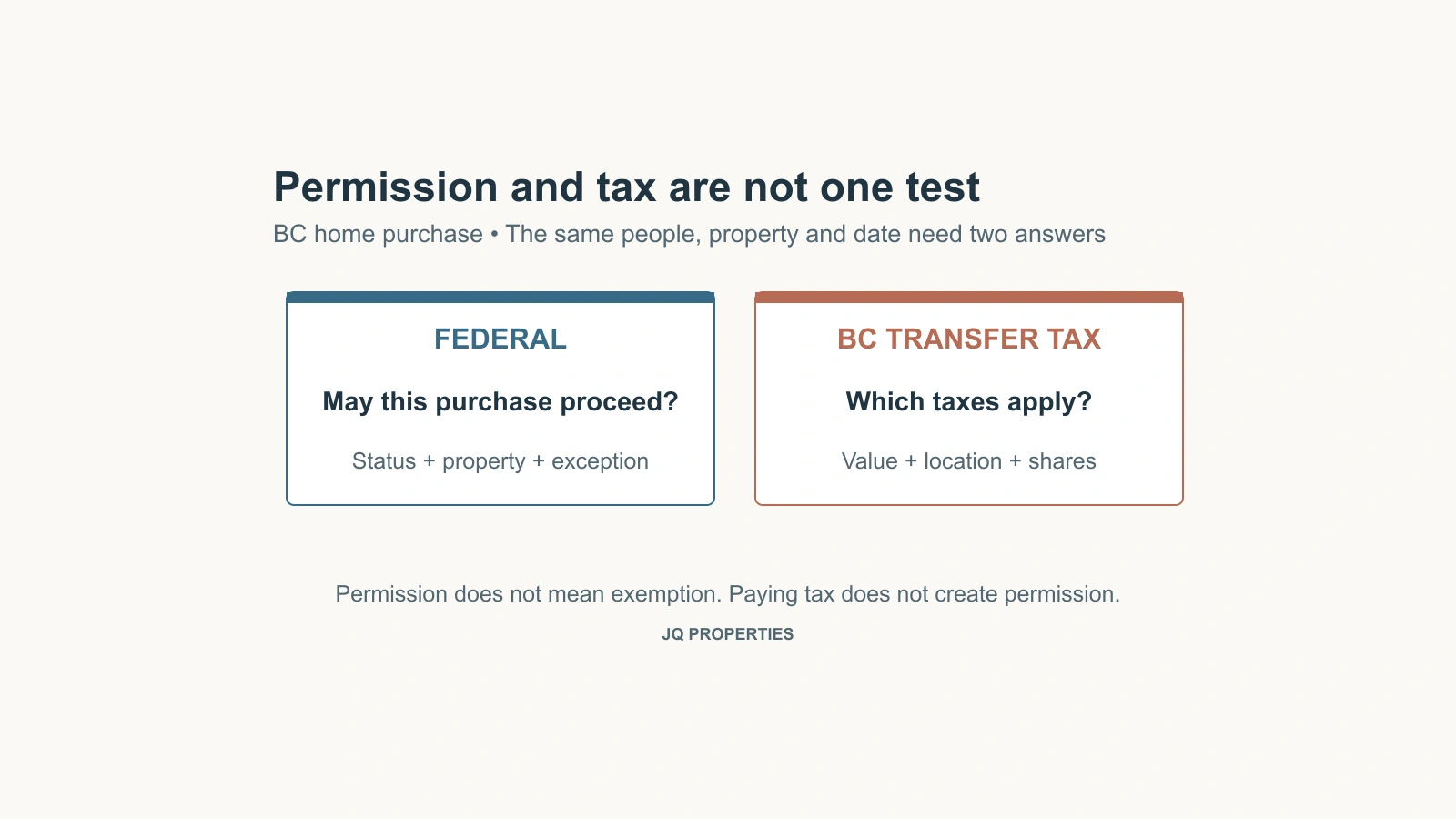
A buyer can be permitted to purchase a British Columbia home under federal law and still owe BC’s additional property transfer tax. The reverse matters too: having enough money for the tax does not give a prohibited purchaser permission to buy.
Keep two separate answers on the same page: does the federal prohibition apply to this purchase, and what provincial transfer tax is payable? A work permit, Canadian spouse, local bank account or Canadian company name cannot answer both questions by itself.
This guide reflects official material checked September 8, 2026. The current federal legislation schedules repeal of the purchase prohibition for January 1, 2027; that date is not a promise that rules cannot change before a future transaction. Have the applicable law checked for the actual purchase. Budget Implementation Act, 2022, No. 1, sections 236–237.
Start with the actual purchasers, not the word “international”
For individuals, the federal Act’s definition of non-Canadian excludes Canadian citizens, permanent residents and people registered under the Indian Act. It also addresses corporations and prescribed entities. The prohibition concerns direct and indirect purchases, so the legal review must reflect the real ownership arrangement. Federal Act, sections 2 and 4.
Write down everyone who will acquire an interest, the capacity in which they are buying, and any company or trust involved. Tell the lawyer about arrangements behind the proposed title, including someone contributing money in exchange for an ownership benefit. Do not let a short list of names on an offer conceal facts needed for the advice.
Keep immigration status separate from income-tax residence. CRA’s newcomer guidance explains that tax residence depends on relevant residential ties and is not determined simply by an immigration label. A conclusion reached for an income-tax return is not automatically a conclusion under purchasing legislation. CRA’s newcomer tax guidance.
The federal property boundary is not a neighbourhood description
A residential condominium unit can be covered even in a large tower. Do not read the Act’s treatment of detached houses with up to three dwelling units as an exemption for every unit in a building containing four or more homes. The Act separately includes residential condominium units and comparable separately owned premises. Federal definition of residential property.
The Regulations exclude property outside both a census metropolitan area and a census agglomeration, using Statistics Canada’s 2021 classification. “Rural,” “recreational” or “outside Vancouver” is not the test. Check the precise address with the official geography and retain the result for the parcel being considered. CMHC provides an address-based map from its federal prohibition information page.
Also establish what is being acquired. The regulatory definition of purchase includes acquiring a legal or equitable interest with or without conditions. Separate exclusions address particular acquisitions, including development. A vague intention to renovate should not be promoted into an assumed development exclusion. Ask counsel to identify the provision and the facts that support using it. Regulations, sections 3–4.
That is a reason to seek advice before signing, not merely before removing subjects. Do not assume a financing condition postpones every legal consequence of the purchase.
Temporary residents need more than a valid status document
For the federal worker route, the Regulations require qualifying work authorization with at least 183 days of validity remaining on the purchase date, together with the residential-purchase limit. CMHC describes that limit as not having previously purchased a residential property in Canada while the prohibition is in effect. Ask counsel to check the actual authorization, relevant date and purchase history. Regulations, section 5; CMHC’s exception guidance.
The student route is different. It requires authorized study at a designated learning institution, all required income-tax returns for the five preceding taxation years, at least 244 days of physical presence in each of the five preceding calendar years, a purchase price no higher than $500,000, and the residential-purchase limit. A study permit alone is not that full set of facts. Regulations, section 5(a).
Other exceptions exist. For example, the Act provides for a non-Canadian buying with a qualifying spouse or common-law partner, and for protected persons. These are defined routes, not a general exemption for any relative, friend or co-buyer who is Canadian. Federal Act, section 4(2).
Consider a hypothetical worker whose reviewed authorization has 200 days remaining at the legally relevant purchase date and who has no earlier purchase during the prohibition. Those facts support checking the worker route. Change the remaining validity to 170 days and that route’s day-count condition is not met. A hoped-for extension is not the same evidence as an authorization already in effect. Another exception may require separate analysis; the change does not produce an automatic answer about every possible purchase.
A Canadian company can require a foreign-control review
For relevant non-public Canadian corporations and entities, federal control can include direct or indirect ownership representing at least 10% of equity value or voting rights, or control in fact. Incorporation in Canada therefore does not finish the inquiry. CMHC’s control explanation.
In a hypothetical private company with a non-Canadian shareholder holding 12% of the relevant voting rights, the lawyer cannot dismiss the federal control question merely because the shareholder lacks a majority. Conversely, a figure below 10% should not be treated as automatic clearance without considering indirect interests and control in fact.
BC has its own foreign-corporation and taxable-trustee definitions. Its corporation definition refers to a different control framework, and a trust may require examination of beneficiaries even where the trustee is Canadian. Do not copy the federal 10% result into the provincial tax answer. BC Property Transfer Tax Act, section 2.01.
Then calculate the provincial tax on its own facts
BC’s additional property transfer tax is currently 20% of the relevant proportionate residential fair market value for foreign entities and taxable trustees in specified areas, subject to applicable relief. Those areas are Metro Vancouver, Capital, Fraser Valley, Central Okanagan and Nanaimo regional districts. The province states that the additional tax does not apply on Tsawwassen First Nation treaty lands. BC’s additional property transfer tax guidance.
Federal census geography and BC tax geography are different maps. A federal property exclusion does not itself establish a provincial tax exemption. Likewise, accepting a federal temporary-resident exception does not settle the additional-tax classification.
General property transfer tax remains a separate calculation. BC’s general rates are 1% on the first $200,000 of fair market value, 2% on the portion above $200,000 through $2 million, and 3% above $2 million. A further 2% applies to residential value above $3 million. Applicable exemptions must be checked separately. BC property transfer tax rates.
A spouse exception can coexist with a substantial tax bill
Assume a hypothetical Canadian citizen and their non-Canadian spouse buy an entirely residential resale condo in Metro Vancouver. Counsel confirms that the joint purchase satisfies the federal spouse exception. The spouse acquiring 40% is also classified as a foreign national for BC tax purposes, and the other purchaser takes 60%. Assume no trust arrangement and no transfer-tax exemption. The fair market value of the whole property is $1.2 million.
| Calculation | Amount |
|---|---|
| General PTT: $200,000 × 1% + $1,000,000 × 2% | $22,000 |
| Residential value attributable to the foreign purchaser’s 40% share | $480,000 |
| Additional PTT: $480,000 × 20% | $96,000 |
| Total of those two transfer-tax amounts | $118,000 |
The Canadian spouse does not make the other share disappear from the calculation. Nor does this share-based calculation limit the government’s collection rights: section 2.02(7) makes each transferee jointly and severally liable for the total additional tax owing on the transaction. Have the legal adviser explain that responsibility before agreeing how the household will fund it. BC Property Transfer Tax Act, section 2.02.
For a simple, entirely residential transaction without relief, the additional-tax calculation is residential fair market value × total taxable proportionate share × 20%. Do not use that simplified formula to decide whether a trust is taxable, to classify a mixed-use property or to validate an ownership arrangement. The example also excludes legal fees, adjustments and other closing costs.
An exemption today and a possible refund later are different budgets
A BC Provincial Nominee route may provide relief for a qualifying individual’s share. The current regulation requires qualifying nominee status and principal-residence intention at registration, an existing permanently affixed dwelling improvement, ownership outside a taxable-trustee capacity, no previous use of the specified nominee relief, and an exemption application. Check the full provisions and supporting nomination documents; a work permit is not the same thing as a nomination. Property Transfer Tax Regulation, sections 17.1 and 19.
A later change to permanent residence or citizenship can support a refund only when the refund requirements are met. They include status, occupation and application timing; receiving an approval letter is not a guarantee that every requirement will be satisfied. The province specifically warns against relying on an expected immigration outcome to secure a refund. BC’s additional-tax refund guidance.
For planning, show tax payable at registration before separately showing any hoped-for later recovery. A future refund is not cash available to complete the purchase. If the household cannot close without receiving relief, resolve the relief analysis before making a commitment that depends on it.
Use this two-answer map for the actual home
The following is a preparation tool for a legal and tax discussion, not a self-certifying eligibility test. Copy the prompts and keep the relevant documents with the answers.
| Question | If established | If not established | Starting authority |
|---|---|---|---|
| Who is acquiring what interest, including indirect interests and entity control? | Record the identified purchasers and capacities | Ask counsel to resolve ownership before assuming a status result | Federal Act s.2; Regulations ss.1–2 |
| Does the exact property and acquisition fall within the federal prohibition’s scope? | If covered, examine a specific exception; if excluded, record why | Check parcel, interest and official census geography | Federal Act s.2; Regulations ss.3–4 |
| If an exception is needed, are all its facts met at the relevant time? | Record the relied-on provision and evidence | Do not treat an incomplete exception as permission | Federal Act s.4; Regulations ss.5–6 |
| Independently, does BC additional PTT apply to this transfer? | Identify residential value, taxable shares and any substantiated relief | Resolve provincial classification and area separately | BC Act ss.2.01–2.03; Regulation Part 4 |
| What amount must actually be funded at registration? | Add applicable general and additional PTT to the closing budget | Separate missing estimates and possible later refunds | BC’s tax and refund guidance above |
The useful conclusion is specific: “Federal analysis relies on this provision for these purchasers and this property; BC tax is this amount on these assumptions.” If the purchaser, ownership arrangement, property or legally relevant date changes, ask which part of that conclusion needs to be redone.
Keep a short dated note beside each answer: the official URL and section, the purchaser or property fact it addresses, the publisher’s “current to” and last-amended dates, and the day you opened it. For the federal answer, check the Act, the relevant Regulations and any enacted amendment or commencement provision—not just a news summary. Opening an older consolidation today does not extend its stated coverage to today. Justice Canada explains these separate dates and amendment links in its guide to using federal legislation.
Attach the passage relied on and keep the adviser’s dated answer with the documents considered, its scope and any open question. If the law or transaction facts change, retain that earlier note, identify what needs reconsideration, and record the revised answer before the affected offer, condition or registration decision. This record helps you ask a precise follow-up; it does not turn an unconfirmed exception or tax saving into an established result.
For identification, proof of funds and signing arrangements, use the overseas purchase document guide rather than repeating the eligibility analysis. Ask the receiving professional which secure delivery channel to use, and share only the records needed for that request. Keep a dated index of what you sent, who received it and which version replaces an earlier document; the index should describe the records without copying passport or account numbers into another shared file.
Once those answers are in place, move to newcomer household and funding preparation or the decisions before a first offer. JQ can help organize property and timing questions; individual legal and tax conclusions belong with the advisers reviewing your actual documents.
General information, not legal, immigration or tax advice. Rules and source consolidations should be rechecked for the transaction date.
By Justin Qiao, Personal Real Estate Corporation, Justin Qiao Group | RE/MAX Crest Realty.

