
New Home Warranty Gaps: What to Check on a Nearly New BC Home
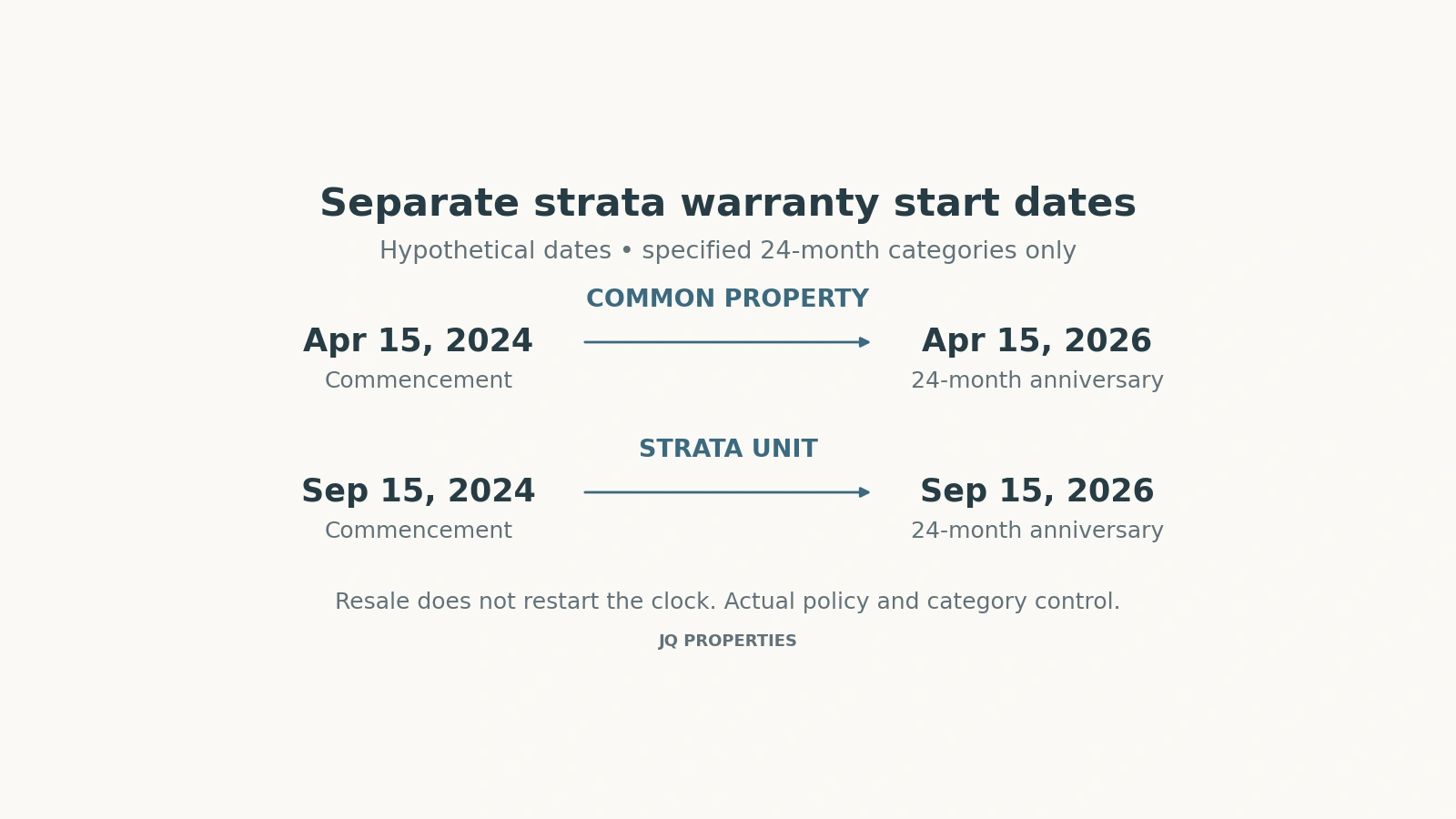
A nearly new home does not come with a fresh warranty clock when it changes owners. A buyer needs the actual policy, its commencement date, the coverage category for each concern and the history of claims and repairs. In a strata building, the unit and common property can have different dates. An attractive “balance of 2-5-10 warranty” description is therefore the beginning of the enquiry, not a complete answer.
Focus on what remains useful at the intended purchase date. A home can still have structural coverage while an ordinary materials-and-labour period has ended. A repair may also have its own warranty period. None of those facts, by itself, confirms that a particular symptom will be accepted as an insured defect.
Establish which insurance actually exists
Ask for the warranty certificate and policy, the provider's identity, commencement records and written expiry information. BC Housing explains that remaining warranty stays with a home on resale and that strata homes have separate unit and common-property policies. It also recommends obtaining the claims history through the owner when considering a purchase. BC Housing's resale-home guidance.
Start with the New Homes Registry if the provider is unclear, then reconcile the result with the policy documents. An entry is not a substitute for reading limits, exclusions and the present claim position. Make sure the address, unit and building correspond to the home being purchased; a large development's marketing name alone is not sufficient identification.
Do not assume an owner-built home has the same third-party policy. BC Housing distinguishes authorized owner builders, who need not arrange that insurance, from insured homes built by licensed residential builders. Statutory owner-builder obligations are a different route, not a warranty insurer waiting to pay a claim. Establish which situation applies before using the calendar below. Owner-built home explanation.
If you are still comparing the purchase categories themselves, our new-build versus resale guide addresses timing and broader trade-offs. This article concerns the protection left on a specific nearly new home.
The numbers describe different kinds of protection
BC Housing's summary distinguishes the first 12 months for materials-and-labour defects in detached homes and strata units from 15 months for common property. The 24-month coverage concerns specified categories, including building systems; it is not another year covering every finish. Five-year protection concerns building-envelope defects, while ten-year protection concerns structural defects. Policies may exceed minimum requirements. BC Housing's coverage overview.
The regulation is more precise about the 24-month categories: electrical, plumbing, heating, ventilation and air-conditioning delivery/distribution systems; certain exterior-component defects that may cause detachment or material damage; defects making the home unfit to live in; and qualifying Building Code violations. A code issue must meet the regulation's health/safety or material-damage test. Homeowner Protection Act Regulation, Schedule 3.
That matters when evaluating a reported problem. “Window issue” might describe a damaged handle, a construction defect around an opening or water penetration through an exterior assembly. Those are not interchangeable descriptions. Record the symptom and location, and ask the insurer to identify the relevant coverage rather than choosing a period solely because the word “window” appears in a list.
Likewise, a crack is not automatically a structural defect because it is visible on a wall. The ten-year heading should not turn every cosmetic observation into an assumed claim—or lead a buyer to ignore a serious concern because someone called it cosmetic without investigation.
Use the correct clock for each building and policy
For a strata unit, the regulation starts coverage at the earlier of actual occupancy and title transfer. Common-property coverage begins with the first unit commencement in each separate multi-unit building of the strata plan. For a custom home built on the owner's land, the test also includes when it is completed and ready for occupancy—not just when the owner moves in. Regulation, Schedule 3, sections 4–6.
This is why “built in 2024” cannot supply an expiry date. Nor should a buyer use their own proposed completion as the starting date. Obtain the dates already recorded for the insured home and ask the provider to resolve any discrepancy with occupancy or title records.
Here is a hypothetical calendar using a common-property commencement of April 15, 2024 and a unit commencement of September 15, 2024. These are assumed dates, not information about a real development. The reference date is September 8, 2026.
| Coverage category to investigate | Clock used | Calendar anniversary to confirm against the policy | Position at the example reference date |
|---|---|---|---|
| General unit materials/labour | Unit: 12 months | September 15, 2025 | Anniversary passed |
| General common-property materials/labour | Common: 15 months | July 15, 2025 | Anniversary passed |
| Specified 24-month unit categories | Unit: 24 months | September 15, 2026 | Seven calendar days away |
| Specified 24-month common-property categories | Common: 24 months | April 15, 2026 | Anniversary passed |
| Building envelope, where covered under common policy | Common: 5 years | April 15, 2029 | Later anniversary |
| Structural defects under unit policy | Unit: 10 years | September 15, 2034 | Later anniversary |
| Structural defects under common policy | Common: 10 years | April 15, 2034 | Later anniversary |
The table is a planning aid, not a determination of the final lawful notice time or coverage allocation. Copy the exact expiry date from the relevant policy and confirm uncertainties with the provider. Do not wait until an anniversary to report a potential defect. A passed anniversary also does not tell you whether an earlier, properly notified claim remains unresolved.
For your own calendar, keep separate rows for unit and common-property coverage, then add the issue, policy number, stated expiry, date notice was delivered, insurer acknowledgement and next outstanding action. Use calendar months and years, not “two years equals 730 days,” which can mis-handle a leap year. For a leap-day or other ambiguous date, obtain the insurer's written expiry rather than improvising a legal deadline.
A builder visit is not the same as a recorded claim
BC Housing directs owners to give written notice to both the warranty provider and licensed builder as soon as possible and before coverage expires. It warns that a builder's offered repair, without written notice to the provider, is not a formal claim. Common-property defects are reported by the strata corporation; owners report defects in their units. BC Housing's claims guidance.
Ask for the submitted notice and insurer acknowledgement, not merely a message saying “the builder knows.” The distinction matters if the first repair did not resolve the symptom. A date-stamped photo can help describe the problem but does not prove that the required recipient received notice.
For example, Travelers asks claimants to identify each item's location and provide supporting photos and documents. For common property in a multi-building complex, it asks for submissions under each affected building's policy with the relevant items identified. Follow the actual provider's current instructions, not another insurer's form by habit. Travelers' claim instructions.
A useful handover separates each item's stage: reported, being assessed, accepted, denied, repaired or awaiting follow-up. “Warranty work ongoing” can conceal very different obligations. Read the insurer's position and any reasons for denial before assuming an allowance in your purchase budget will be reimbursed.
Carry repair records forward, not just the original certificate
Repairs made under home warranty insurance have materials-and-labour protection until the later of one year after completion or the end of the applicable original coverage. That does not restart the entire home's 2-5-10 coverage. Repair warranty rule, Schedule 3, section 8.
For illustration, if an applicable original period ends September 15, 2026 and an insured repair finishes August 20, 2026, the later date is August 20, 2027. If that repair instead finishes February 20, 2025, its first anniversary comes before the original September 15, 2026 expiry, so the original expiry is later. These comparisons assume the work was performed under the warranty, not an unrelated private renovation.
Request the repair specifications, completion letter and any subsequent inspection or complaint. Match them to the location you are viewing. Repainted drywall may indicate completed finishing, but it does not tell you whether the underlying cause was addressed or whether a new symptom is the same claimed defect.
Maintenance and damage prevention still matter. BC Housing notes that owners must take reasonable measures to prevent a problem worsening and should coordinate repairs with the provider because outside work can affect a claim. Keep maintenance records and urgent-response documentation; do not let an insurance discussion delay appropriate action to prevent further damage. Claims and damage-prevention guidance.
Before committing to the purchase, identify the next expiring category and the most significant unresolved issue. Establish who is pursuing it, what the insurer has actually said and what access or work may continue after completion. A nearly new home is easier to evaluate when its remaining protection is a documented calendar and claim history, rather than a comforting phrase in the listing.
BC information checked September 8, 2026. Examples are hypothetical and do not determine coverage, liability or a claim deadline for any home.
If a warranty deadline or unresolved repair could change your home purchase, JQ Properties can help organize the property-record requests and transaction timetable while the provider confirms the actual coverage position.
By Justin Qiao, Personal Real Estate Corporation, Justin Qiao Group | RE/MAX Crest Realty.
Sources checked September 9, 2026.

