
NOI vs Cash Flow in Commercial Real Estate: A Worked Comparison
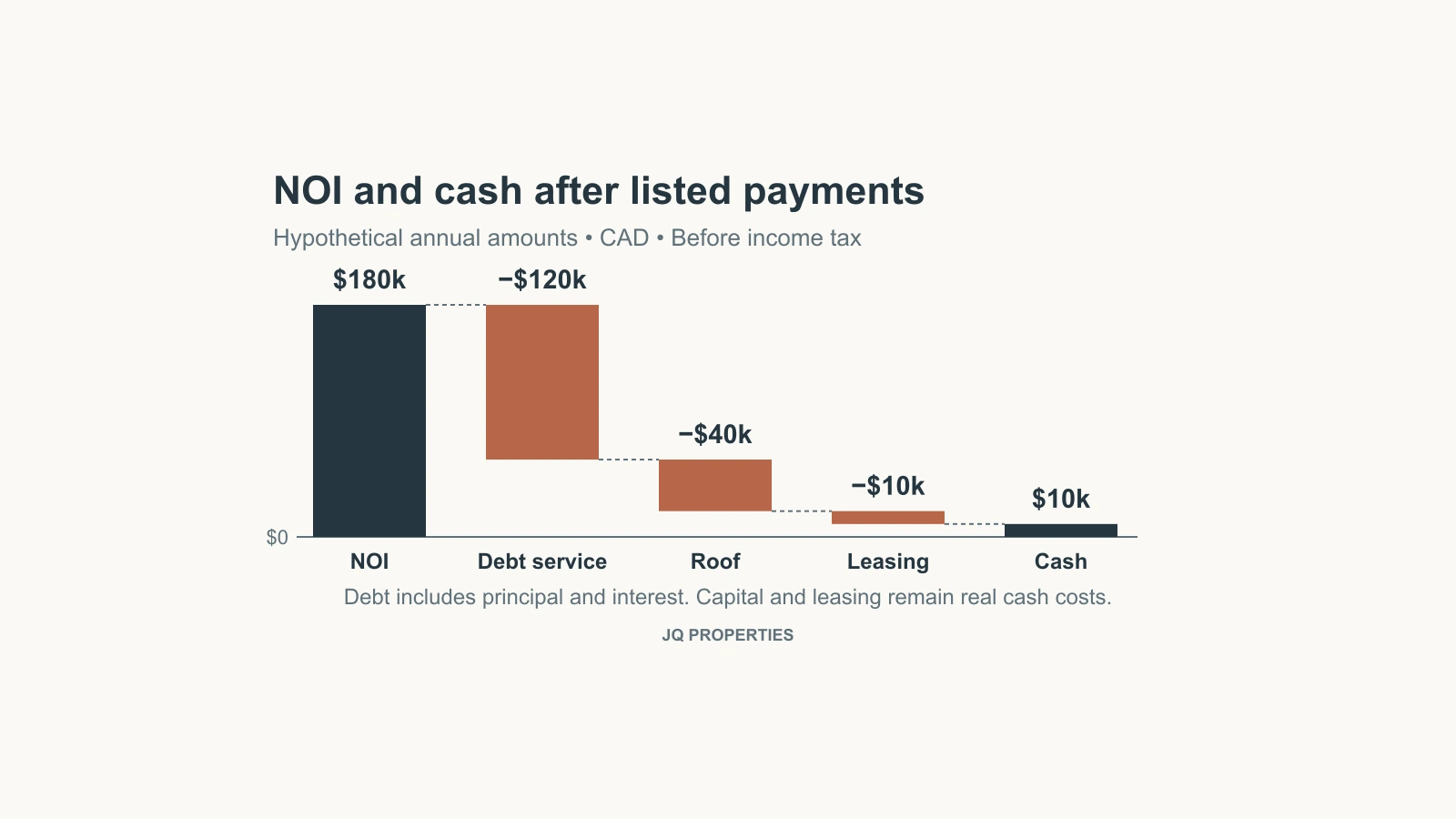
A commercial property can generate positive net operating income and still require the owner to contribute cash. NOI measures the property's income after operating expenses, before financing and other excluded costs. Your cash result also depends on when money is collected, principal and interest payments, capital work, leasing expenditures and any funds you retain rather than distribute.
Neither number replaces the other. NOI helps you compare the underlying property and understand an income-based valuation. A dated cash forecast tells you whether your ownership plan can pay its bills. The safest way to use a seller's income package is to bridge between those views explicitly, rather than treating the advertised NOI as money available to spend.
Define the measure before comparing the numbers
BC Assessment's income-approach explanation starts with potential income, makes allowances for vacancy and collection loss, then deducts operating expenses to reach NOI. It distinguishes mortgage interest from property operating costs. This is an appraisal framework, not a promise that every seller's spreadsheet follows the same convention. BC Assessment's valuation methods.
Ask whether the stated number is actual income for a completed period, a current annualized run rate, or stabilized income based on future assumptions. Annualizing a recently signed rent is different from showing a year's collections. A stabilized figure can be useful, but it should say what occupancy, rents and expenses must change before it becomes achievable.
“Operating cash flow” also needs context. Some property explanations use it informally for NOI. A cash forecast based on bank movements is different, especially when receivables or unpaid bills change. Request the formula, period and included costs rather than debating the label alone. This article uses a clearly defined property NOI and then a separate pre-income-tax cash calculation; it is not a financial-statement or tax-return template.
Build one property's annual NOI
Consider a hypothetical small commercial building over one 12-month forecast period. All amounts are Canadian dollars. The purchase itself, sales-tax remittances or credits, owner income taxes, debt and capital payments are outside the first calculation. There are no straight-line-rent or other non-cash income adjustments. All expected income and operating expenses in this base case are assumed collected or paid within the period.
| Annual property income | Amount |
|---|---|
| Potential base rent | $240,000 |
| Less vacancy and collection-loss allowance | −$12,000 |
| Expected base rent after that allowance | $228,000 |
| Lease-supported expense recoveries | +$60,000 |
| Other property income, such as parking | +$6,000 |
| Effective gross income | $294,000 |
The $12,000 reduction is 5% of potential base rent only. It is an invented input, not a recommended vacancy allowance. The separate recovery forecast is already assumed to reflect the occupancy and recovery terms in this example. In a real forecast, test the recovery loss caused by vacancy rather than deducting a percentage from whichever total is easiest to find.
Operating expenses are property taxes of $50,000, insurance of $12,000, utilities of $18,000, routine repairs of $14,000, management of $12,000 and other recurring services of $8,000. They total $114,000. The resulting NOI is $294,000 − $114,000 = $180,000.
Recoveries do not justify omitting the related expenses. If the property incurs the $114,000 and receives $60,000 back from tenants, both belong in this presentation. Recording the recovery as income while subtracting only the already-netted $54,000 expense would overstate NOI by $60,000. Conversely, a presentation using base and other income less net unrecovered expenses can reconcile to the same answer when its definitions are consistent.
Move from $180,000 NOI to the buyer's cash result
Now add the hypothetical buyer's obligations for that same year. The loan schedule requires $75,000 of interest and $45,000 of principal, or $120,000 in total debt service. A distinct roof replacement costs $40,000 and a separate leasing payment costs $10,000. Neither is included in the $114,000 operating-expense total.
| Bridge from property NOI | Amount remaining |
|---|---|
| NOI | $180,000 |
| After $75,000 interest | $105,000 |
| After $45,000 principal | $60,000 |
| After $40,000 roof replacement | $20,000 |
| After $10,000 separate leasing payment | $10,000 |
The last line is cash generated after these stated obligations, before owner income tax and any additional exclusions. It is not $180,000 of spendable income, and it is not automatically after-tax profit. A depreciation entry is not another cash payment to subtract from this bridge; a real capital invoice is.
J.P. Morgan's commercial-term-lending explanation similarly separates major capital expenditures, debt service and owner income taxes from NOI. Its discussion is about US multifamily property, so the conceptual distinction is useful here without importing US tax treatment or prescribing an accounting policy for a BC building. NOI and cash-flow explanation.
If the buyer elects to retain $6,000 of the $10,000 for later needs, only $4,000 is available for distribution under that plan. The retained $6,000 is still the owner's cash, not a new payment to a contractor. Label that line “cash retained,” not another operating expense. Do not deduct both a reserve allocation and a payment funded from that same allocation without showing the release or funding source. A long-term reserve plan is a separate exercise; this bridge simply identifies what the annual result includes.
Principal repayment matters even though it is not an operating expense
Ignoring the $45,000 principal payment would overstate the example's cash result by exactly $45,000. Principal reduces the debt balance under the assumed loan schedule, but the money still leaves the account. It cannot simultaneously pay the lender and the roof contractor.
Obtain the repayment schedule for the actual loan, including any scheduled balloon payment, interest-only period or fees outside the normal instalment. BDC recommends checking loan schedules when identifying principal and interest and asking the financial institution which coverage measures it will assess. Its business DSCR guidance uses a business-earnings numerator; that should not be silently substituted for a property lender's own NOI definition. BDC on debt-service calculations.
For an explicitly simplified property coverage calculation, $180,000 NOI divided by $120,000 annual debt service is 1.50 times. That ratio does not include the roof or leasing payment in its denominator and does not show the $10,000 cash outcome. It is not a statement that the property qualifies for a loan. Lenders can adjust the income measure, expenses, reserves and required coverage.
Imagine another buyer has annual debt service of $156,000 on the same property. NOI remains $180,000, but cash before the roof and leasing payment is only $24,000. After those $50,000 outflows, the result is negative $26,000 before income tax. Different financing changed the owner's cash, not the building's operating income.
Check collection timing before calling NOI cash
The base example assumed collections and payments occurred within the year. Now change only two timing facts. Suppose $12,000 of income already included in the $294,000 remains receivable at year-end, with no opening receivable. It is expected to be collected later and is not the same amount as the earlier vacancy and collection-loss allowance. Also suppose $5,000 of operating expenses is unpaid at year-end, with no opening payable. All other assumptions remain unchanged.
Cash from operations is then $180,000 − $12,000 + $5,000 = $173,000. After $120,000 debt service, $40,000 capital work and $10,000 leasing expenditure, only $3,000 remains before income tax. The unpaid $5,000 has not vanished: it is an obligation that will require cash when paid.
This small example shows why an accrual or normalized statement should not be labelled a bank forecast without adjustments. BDC's cash-flow guidance emphasizes the timing of actual inflows and outflows, including loan repayments and significant purchases. BDC on managing cash flow.
Do not deduct an uncollected amount twice if the income measure already excludes it. Nor should a permanently uncollectible debt be described merely as a timing delay. Identify the specific amount, its treatment in the starting income number and the expected collection date. A ledger entry by itself does not establish that the cash will arrive.
Use the bridge to challenge the seller's presentation
The NOI-to-cash-flow workpaper includes the full example, both financing outcomes and a blank bridge. Enter one consistent annual period, document the starting income convention, then show each adjustment once. It is usable with an ordinary calculator and does not calculate loan payments, tax deductions or market value for you.
For operating costs, compare invoices and contracts with the seller's statements. An owner who self-manages may report no management payment, while your plan requires a manager. Keep that difference visible rather than assuming the seller's cash expense is your sustainable expense. Read the lease before accepting a recovery, and use the CAM reconciliation guide if the numbers do not reconcile.
Separate routine repairs from the identified capital project and document any ambiguous classification. If a roof cost is already in the starting expenses, remove it from that starting measure only when appropriate to your stated NOI convention, then show its cash payment once below. Reclassification must not make the cost disappear. Likewise, a tenant allowance or rent concession needs its own contractual treatment; the bridge should not invent an allowance from a rent-roll label.
Finally, use NOI—not financing-after-cash—as the numerator when calculating the conventional property cap rate. At a hypothetical $3 million price, $180,000 NOI implies 6%. Dividing the $10,000 cash result by that price answers a different question and should not be advertised as the cap rate.
Before making a purchase decision, ask for the bridge behind the headline: what the property earns, what this buyer must pay, when those payments occur and what remains unverified. A positive annual result still needs a month-by-month timing check if a large invoice comes before the rent that will fund it. The point is to understand both the investment's operating strength and the cash commitment required to own it.
By Justin Qiao, Personal Real Estate Corporation, Justin Qiao Group | RE/MAX Crest Realty. General commercial-property analysis checked September 8, 2026. All figures are hypothetical; the article does not determine taxable income, accounting treatment, lending approval or investment suitability.