
Regular vs Accelerated Biweekly Mortgage Payments: Count the Year’s Cash
By Justin Qiao, Personal Real Estate Corporation, Justin Qiao Group | RE/MAX Crest Realty.
Regular biweekly and accelerated biweekly mortgage payments can leave your account on the same dates but take different amounts. Under FCAC's standard comparison, regular biweekly divides twelve monthly payments across 26 payments. Accelerated biweekly takes half the monthly payment every two weeks, adding up to thirteen monthly payments over 26 withdrawals.
The extra annual contribution is the central difference. Before choosing it, compare the full year's cash requirement and the months with three withdrawals. A smaller-looking individual payment is not necessarily a cheaper or more comfortable mortgage schedule.
“Every two weeks” is not “twice a month”
Semi-monthly means two payments each month: 24 over a year. Biweekly means every two weeks, conventionally compared using 26 payments over 52 weeks. Those schedules do not stay aligned with the same dates of each month.
FCAC describes a regular biweekly payment as the monthly amount multiplied by 12 and divided by 26. Its accelerated biweekly amount is the monthly payment divided by two. Semi-monthly also divides the monthly payment by two, but collects it only twice each month. FCAC: Mortgage payment frequency
That means the words following “biweekly” matter. Do not approve a change based only on a representative saying “we will split the payment.” Ask for the dollar amount, the first debit date and the schedule's exact name. Then multiply the amount by the relevant payment count.
Lenders may use different labels. TD currently lists both Bi-Weekly and Rapid Bi-Weekly among its choices, for example. Treat that as a reason to ask how the quoted option works, not as a reason to infer all its terms from another lender's terminology. TD: Mortgage payment options
Follow a $2,600 monthly payment through the year
Consider a hypothetical principal-and-interest payment of $2,600 a month. Hold that base payment constant and assume a full comparison period containing 12 monthly, 24 semi-monthly or 26 biweekly payments. Exclude property taxes, optional insurance, fees and any additional lump sums.
| Schedule | Calculation of each payment | Each payment | Total for the stated comparison period |
|---|---|---|---|
| Monthly | Given monthly amount | $2,600 | $31,200 |
| Semi-monthly | $2,600 ÷ 2 | $1,300 | $31,200 |
| Regular biweekly | $2,600 × 12 ÷ 26 | $1,200 | $31,200 |
| Accelerated biweekly | $2,600 ÷ 2 | $1,300 | $33,800 |
The accelerated amount is $100 more at each of the 26 biweekly payments. Multiplying $100 by 26 gives the $2,600 extra annual contribution. Relative to the ordinary $31,200 annual total, that is about 8.33% more cash, not a discount obtained by dividing the bill.
Notice the other comparison: semi-monthly and accelerated biweekly both show a $1,300 debit, yet one totals $31,200 and the other $33,800. Looking only at the amount on one bank statement cannot tell you which schedule you have.
This example is a cash-contribution comparison, not a mortgage quote or amortization forecast. It deliberately starts with an assumed monthly payment rather than inventing a loan balance and interest rate that your lender has not offered.
Why extra payments can reduce interest
For an amortizing mortgage, paying down principal sooner reduces the balance on which future interest is calculated. FCAC explains that accelerated payments put more money toward the mortgage than a monthly schedule and can reduce interest charges. FCAC: Paying off your mortgage faster
There are two ideas to keep separate: changing when money reaches the loan, and increasing how much money reaches it. Regular biweekly changes timing while roughly preserving the annual payment total under the formula above. Accelerated biweekly also increases that total. Do not credit the entire accelerated benefit to more frequent processing alone.
Nor should the $2,600 extra contribution be described as $2,600 of interest saved. The effect on interest depends on the balance, rate, payment application and how long the lower balance remains outstanding. RBC's published comparison illustrates different schedules, but its lifetime-interest figures explicitly assume a constant interest rate throughout amortization. Your future renewals may not follow that assumption. RBC: Accelerating your mortgage payment schedule
For a useful lender illustration, request the same starting balance, rate assumptions and comparison date for both options. Compare total payments, interest and principal remaining. That will show what the extra cash accomplished without presenting a fixed number of years saved as a universal promise.
The three-payment month needs its own budget
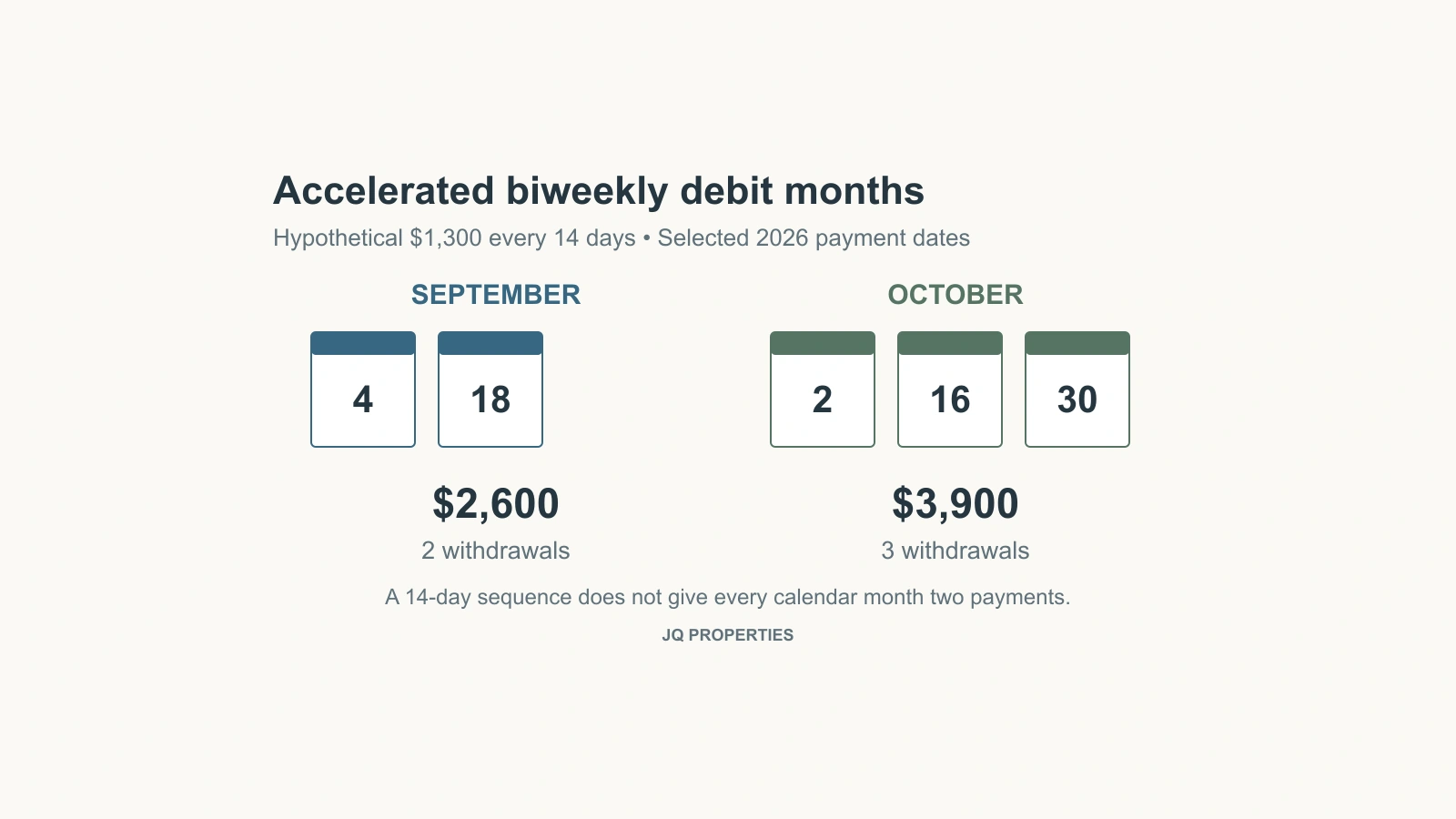
Suppose a hypothetical biweekly schedule starts on September 4, 2026. Its next dates are September 18; October 2, 16 and 30; and November 13 and 27. October contains three payments, even though September and November contain two. These are illustrative scheduled dates; your lender's actual debit and holiday arrangements control.
At the example's accelerated $1,300 payment, October requires $3,900. At regular biweekly's $1,200, it requires $3,600. Neither is captured by simply putting “two mortgage payments” into every monthly budget.
Now imagine a household has $2,900 available each month for principal-and-interest payments after its other planned spending. Accelerated biweekly averages $2,816.67 a month across the assumed 26-payment year, so it appears to fit. But in that October, $3,900 exceeds the month's $2,900 allocation by $1,000.
The annual arithmetic and the monthly cash problem can both be true. A two-payment accelerated month leaves $300 from that allocation. The household would have to accumulate enough of those unspent amounts in advance, or have another funded buffer, to cover a three-payment month. A reserve that is already committed to a strata levy or moving bill is not available a second time.
The payment-frequency cash calendar lets you compare the standard annual totals and then enter actual withdrawal dates beside income dates. It also explains why a partial first year or a calendar with a different actual payment count must be summed from the schedule, not forced to match a 26-payment illustration.
Match the schedule to the paycheque you actually receive
Being paid biweekly may make a biweekly mortgage convenient, particularly if the debit follows cleared income. Being paid twice monthly is different: a three-mortgage-payment month does not automatically bring a third paycheque.
Even two biweekly schedules can be out of phase. If the mortgage is due on Friday and your payroll arrives the following Friday, the shared frequency does not fund the earlier debit. Put both schedules on the same calendar and check the lowest projected account balance, not just the monthly total.
Ask the lender how weekends, holidays and a frequency change affect the first withdrawals. Do not assume that selecting a new schedule cancels a debit already due. Wait for the confirmed effective date and revised amount before changing the transfers that fund the mortgage account.
Also separate principal and interest from bundled charges. If your lender collects property taxes or optional insurance with the payment, applying the mortgage-frequency formula to the entire bank debit may give the wrong comparison. Obtain the components and their actual collection schedules rather than assuming each one accelerates in the same way.
Check how much flexibility remains after the change
A frequency choice and a voluntary increase in the payment amount are not necessarily the same contractual action. RBC's public frequency page says its payment frequency can be changed without cost during the term. FCAC separately cautions that increases in payment amounts can be subject to contractual limits and normally cannot simply be reduced again until term-end. Ask which rule applies to the change you are requesting; do not import RBC's statement into every mortgage. RBC: Payment frequency, FCAC: Increasing mortgage payments
If income is uneven, ask whether an ordinary schedule plus permitted occasional extra payments better matches when cash becomes available. Check the contract's amounts and dates before doing so. That is an option to compare, not a recommendation to use emergency savings for faster repayment.
The right question is not “Which label sounds fastest?” It is “What will leave my account, on which dates, and can I sustain that while meeting my other obligations?” For the broader purchase decision, the guide to buying now or waiting puts payment comfort alongside financing, property fit and reserves.
Justin Qiao Group can help you carry a realistic ownership budget into your property search. Your lender should confirm the mortgage schedule and any change to it. This article provides general information, not an individual mortgage recommendation.
General information checked September 8, 2026. Transaction-specific facts and subsequent rule changes can change the result.

