
Strata Minutes Red Flags: Look for Decisions, Not Scary Words
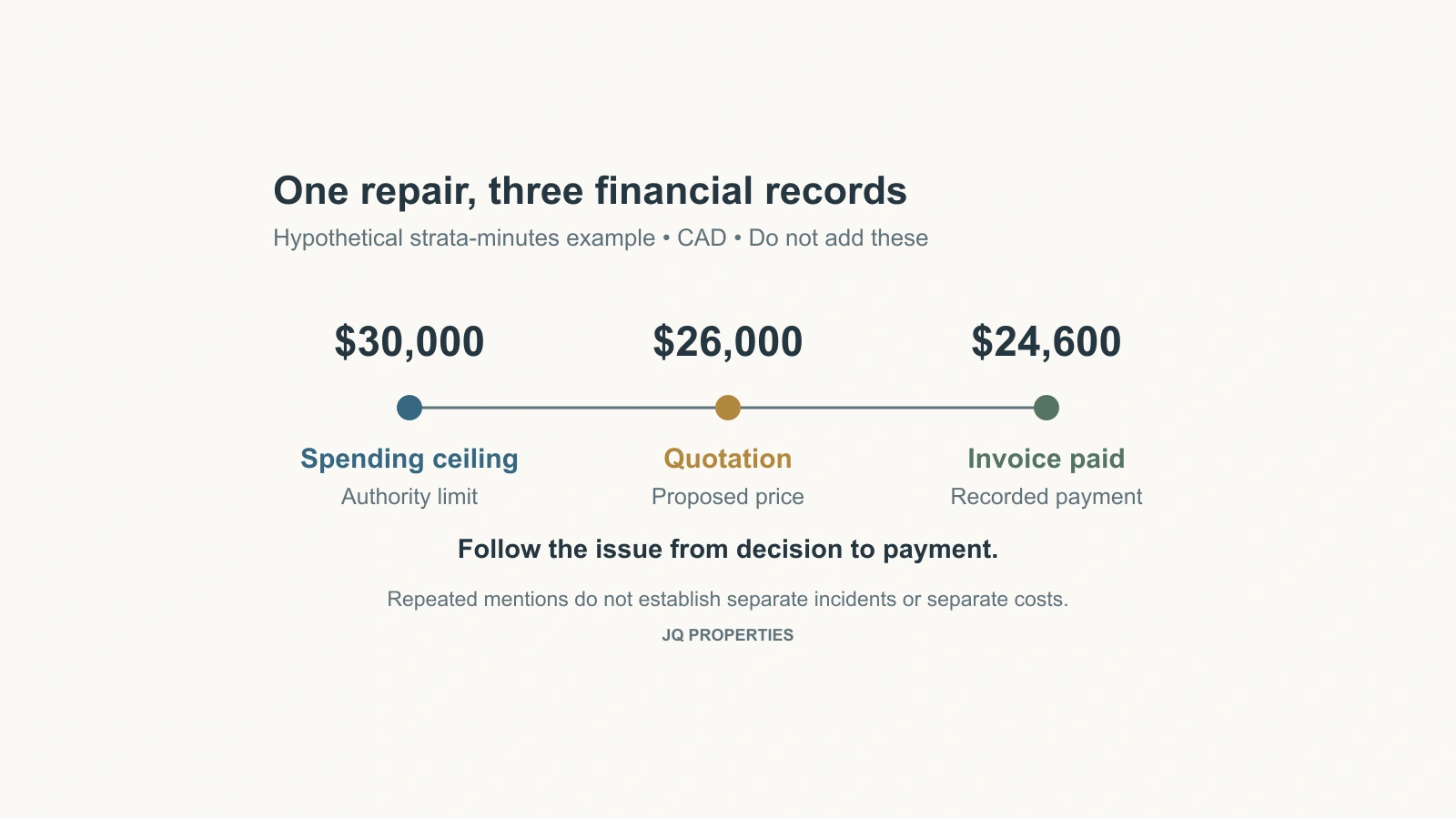
A word such as “leak,” “lawyer” or “deferral” is a starting point, not a verdict on a condo building. Read strata minutes as a sequence: what happened, what was decided, what changed and what remains unresolved. Three mentions of one incident do not establish three incidents, and silence after a repair discussion does not establish that the repair worked.
For a buyer, the most useful red flag is a material question that the available records cannot answer. That might be a second failure after an attempted repair, an approved project without an identifiable funding decision, or a claim described differently in the minutes and the current Form B. Each calls for a specific follow-up, rather than a blanket rejection or reassurance.
Build a chronology before counting problems
Sort council, annual general meeting and special general meeting records by meeting date. Add section meeting records if the property belongs to a section. Keep the meeting notice and attachments where a decision matters, because the minutes may refer to a motion without repeating its full wording.
An AGM record may contain an approved budget or owner-level decision that explains months of council discussion. A council note may report investigation and contractor progress. The meeting label alone does not establish that every listed expenditure was validly authorized; the relevant resolution and governing rules still matter.
BC requires minutes of AGM, SGM and council meetings, including voting results. It also requires financial and other records that can explain the shorthand in those minutes. Strata Property Act, section 35.
Make a simple list of meetings supplied and meetings referred to elsewhere. If March minutes approve February's minutes but February is missing, you have an identifiable gap. If there is no August file, first ask whether a meeting occurred. Do not manufacture twelve expected monthly meetings or assume that every missing month proves a missing record.
Read three entries as one developing story
The following excerpts are entirely fictional. They illustrate interpretation, not an actual strata, a model for legally sufficient minutes or a finding that a particular spending authority exists.
February 10: “Water staining reported in the west corridor after the January 28 storm. A contractor has been asked to investigate the entry point. No repair scope has been selected.”
At this stage, the record identifies one reported event and an investigation. It does not identify the failed component, the full extent of damage or a replacement budget. The useful request is the investigation result, not an estimate of every owner's future levy.
March 10: “Follow-up on the January 28 west-corridor event. The inspection identifies a localized failed joint. No additional water entry has been reported. Under the spending authority previously approved for this work, repair expenditure up to $30,000 is authorized; the accepted quotation is $26,000.”
This is still the same event. The new information is a reported cause, a defined response and two different financial amounts: an authorization ceiling and an accepted quote. Obtain the referenced inspection, quotation and approval. The excerpt alone cannot establish the legal sufficiency of that authority.
April 14: “The west-corridor repair was completed March 26. Final invoice of $24,600 has been paid. The contractor's completion note has been received. Performance during heavy rain remains to be checked; a follow-up inspection is scheduled for April 30.”
Now there is reported completion and payment, but the weather-performance check remains outstanding. Calling the building's water problem “unfixed” would ignore completed work. Calling it “permanently solved” would outrun the stated evidence. Ask for the April 30 result and any later report of water entry.
The minutes context worksheet places these entries side by side and provides blank space for a real sequence. It keeps incident count, financial status and repair status separate, so a repeated agenda heading cannot silently become another loss.
Do not add every dollar mentioned in the minutes
In the fictional sequence, $30,000 is the authorized ceiling, $26,000 is the accepted quote and $24,600 is the amount finally paid. Adding them produces $80,600, which is not supported as project spending.
The paid amount is $1,400 below the accepted quote and $5,400 below the authorization ceiling. Those differences do not automatically become cash available for another project. Other commitments, the approval's terms and the financial accounts determine what remains usable.
When minutes mention several amounts, label each one before calculating: estimate, authorization, contract, change order, invoice, payment or refund. A change order may be additional to the contract or included in a revised total; ask which. An invoice outstanding in one meeting may be the same invoice recorded as paid in the next.
For an actual levy, use the approved special levy guide and its allocation schedule. For long-term assumptions, use the depreciation report guide. Minutes help find those decisions; they do not substitute for their amounts and conditions.
Look for changes in the problem, not changes in wording
Recurrence deserves attention when the evidence describes a new event, another location, a failed repair or a broader diagnosis. “Water issue carried forward” is not enough to identify which of those occurred.
Compare the event date, location, described cause and contractor reference. If two records use different names for the same corridor, do not force a match merely to keep the incident count low. Mark the relationship uncertain and request clarification. A possible duplicate is not a confirmed duplicate.
Deferral also needs context. Delaying cosmetic work while an engineering investigation determines the correct scope differs from repeatedly postponing necessary repairs without an interim plan. Ask what is being delayed, why, what conditions are being monitored and which decision will restart the work.
A reported insurance claim raises another set of distinctions. The date of loss, claim status, deductible and physical repair can move on different schedules. A settled insurance payment does not necessarily establish that construction is complete. Conversely, work can be complete while the account remains under discussion. The condo insurance guide explains the separate policy questions.
Quiet minutes can still leave important information out
A historical regulatory decision provides a concrete example. In the August 27, 2020 O'Donnell consent order, the supplied minutes referred to possible invoice duplication but did not disclose that the strata was party to litigation. A Form B also failed to disclose the litigation. The regulator found professional misconduct in issuing that certificate. The agreed facts expressly noted no evidence that the buyers suffered financial harm from a later approximately $15,000 payment. This was a specific disciplinary matter, not a finding that every invoice dispute conceals litigation or causes buyer loss. Official consent order, attached proposal paragraphs 18–29.
The practical lesson is to compare records that answer different questions. “Invoice disputed” should prompt a request for the current status: still a billing discussion, a filed proceeding, settled, withdrawn or otherwise resolved? If Form B and the minutes conflict, ask for an explanation of their dates and facts rather than choosing whichever answer is more comfortable.
Not every underlying document is freely distributable. Legal privilege and privacy can limit disclosure. A buyer can request an appropriate non-privileged status explanation without assuming access to confidential legal advice or residents' personal details.
Similarly, complaints about noise, pets or alterations are allegations and management issues, not reliable biographies of neighbours. Read the applicable current bylaws and relevant outcome. Do not identify or contact residents to investigate personal accusations from a document package, or publish the minutes in an open forum.
How much history is enough, and how do you obtain it?
BCFSA's current sample strata-document condition includes two years of meeting minutes, along with other records. That is sample contract wording, not a legal declaration that older history is irrelevant or that every buyer automatically receives those files. A long-running repair may require the earlier report or approval that started it. BCFSA strata documentation clause.
The strata must retain minutes for at least six years. Retention and a buyer's review period are different questions. The records access route also matters: section 36 covers owners, specified tenants and people authorized in writing by them. Arrange appropriate seller authorization for the broader records request rather than assuming a prospective buyer has the same access to everything. For a valid section 36 request, the usual statutory response period is two weeks, shortened to one week for bylaws and rules. BC records guidance, Strata Property Act, section 36.
Ask for the newest available records and identify whether they are draft or approved. Under Standard Bylaw 19, owners must be informed of council minutes within two weeks of the meeting whether or not approved; check whether the strata has amended that bylaw. A blanket “not approved yet” explanation is therefore something to examine, not a universal reason that minutes cannot be supplied. BC Standard Bylaws, item 19.
Privacy does not justify inventing the missing story. If a requested attachment cannot be supplied, identify the reason and what factual status information is available. The Province's records guidance addresses both strata record duties and privacy obligations.
End with a question someone can actually answer
Instead of “Are there any red flags?”, send a dated, narrow request: “The April 14 minutes say the repair was completed and a rain-performance check was scheduled for April 30. Please provide the available follow-up result and identify any subsequent reports concerning that location.”
For a financial issue, ask whether the $26,000 quotation was replaced by the $24,600 final invoice or whether other invoices remain. For a gap, name the missing meeting or referenced report. These requests are easier to answer and more useful to your decision than a generic demand for reassurance.
If an important uncertainty remains near your contractual deadline, consider its significance and the options your actual agreement provides. Missing records do not automatically extend the deadline or allow cancellation. JQ Properties can help connect the minutes with the property questions that matter to your purchase, while technical conclusions and legal outcomes remain separate.
By Justin Qiao, Personal Real Estate Corporation, Justin Qiao Group | RE/MAX Crest Realty. BC sources checked September 8, 2026. Meeting excerpts are invented; the regulatory example is historical and is not a JQ client case.