
Tenant Estoppel Certificates: Compare Them With the Lease and Rent Roll
A tenant estoppel certificate is useful because it asks the tenant to confirm the position under its lease, including exceptions the seller's summary may not reveal. For a commercial buyer, the job is not finished when a signature arrives. Compare the certificate with the signed lease and amendments, the rent roll and the supporting payment records, using the same dates and definitions.
A mismatch can be a clerical error, a legitimate change or a substantive dispute. Those require different responses. Resolve what the statement actually means before changing the income forecast, accepting a purchase adjustment or treating an estoppel delivery condition as satisfied.
Start with the request the lease actually permits
Ask the seller for the lease's estoppel provision, any prescribed form, notice requirements and amendments. Identify who makes the request, who must respond, the permitted response period and the information required. Coordinate that process with the purchase agreement and lender's requirements early enough for follow-up.
For example, a publicly filed Richmond lease dated for reference December 15, 2017 requires the tenant to deliver a certificate within ten business days of a landlord request. Section 21.4 covers lease status, modifications or breaches within the tenant's knowledge, and the rent account, with reliance by the party to whom the certificate is directed. That is a particular negotiated clause, not a universal BC deadline or an unrestricted buyer right to demand any form. 0937847 B.C. Ltd.–Omni Circuit Boards lease, section 21.4.
Do not send a stronger form and assume the tenant must accept every added representation. Have counsel compare the requested statements, permitted qualifications and intended recipients with the actual lease. A landlord's certificate, tenant's certificate and lender's required confirmation are not interchangeable merely because their headings sound similar.
Read what the tenant is being asked to confirm
Useful questions reach beyond the monthly rent: the complete lease documents, commencement and expiry dates, renewal or termination rights, deposits, prepaid rent, remaining concessions, landlord work, defaults and disputes. Read attachments and handwritten changes as part of the response, not as administrative clutter.
A public 2012 Minnesota sale agreement illustrates this breadth. Its attached tenant-estoppel form asks for the lease and amendments or letter agreements, current rent and paid-through date, remaining concessions, prepaid amounts, deposits and specified property rights. It also contains statements about landlord performance and a reliance paragraph. This is an uncompleted form in a US transaction document, not a signed tenant finding or a BC form to reuse without review. Filed agreement, Exhibit B, tenant-estoppel form.
Confirm the legal tenant and premises against the lease and any assignments. Check who signed and their stated authority. An operating name on a storefront can differ from the contracting entity; a signature from someone at the premises is not, by itself, proof that the correct tenant has responded with appropriate authority.
Read qualifications carefully. A statement limited to the tenant's knowledge answers a different question from an unqualified representation. Likewise, “no written notice received” is narrower than “no defect exists.” Do not silently expand the statement when summarizing it for an appraiser or lender.
Put rent figures on the same basis and date
Use the lease–rent roll–estoppel comparison workpaper (PDF) to align the source documents. For every amount, record whether it is base rent, estimated additional rent, a reconciliation, tax or another charge; whether the number is monthly or annual; and when it takes effect.
Consider a fictional lease with base rent of $4,800 a month. A signed amendment raises it to $5,100 from April 1, 2026, with no further increase during the periods below. A September rent roll shows $5,400 monthly, while the tenant's September certificate states $5,100. Assume no abatements or vacancy, and exclude additional rent and tax from these calculations.
The documents do not support averaging the two September figures. If the amendment is confirmed as governing, the rent roll overstates the monthly base rent by $300. For a twelve-month forecast entirely at the $5,100 rate, the supported scheduled amount is $61,200, compared with $64,800 at $5,400: a $3,600 difference.
The calendar-year 2026 schedule is different again: three months at $4,800 plus nine at $5,100 equals $60,300. Annualizing September's supported rate gives $61,200, which is $900 higher because it ignores the lower first-quarter rate. Neither calculation proves rent was collected. The appropriate figure depends on whether the reader needs a historical schedule or a forward period.
Ask for the missing basis behind $5,400. It could be an error, an unprovided amendment or a number that includes something other than base rent. Keep it unresolved until the documents explain it; do not rewrite the tenant's statement to match the seller's spreadsheet.
Separate the rental account from the contract schedule
A certificate's paid-through date, the rent roll's current rent and the ledger's balance can describe different things. If the tenant says rent is paid through August but the seller shows a September receipt, check the certificate's effective date, payment date and what that receipt was applied to. Timing may explain the difference; it may also reveal an allocation problem or disputed balance.
Request the relevant ledger entries, remittance details and evidence of receipt, with unrelated account information protected. Do not count an invoice, scheduled debit or posting as proof that funds cleared. BDC's commercial purchase guidance separately recommends examining payment histories and tenant credit when assessing an income stream. An estoppel is not a substitute for that work or a guarantee of future solvency. BDC commercial-building due diligence.
Keep security deposits and prepaid rent distinct from current income. Confirm the amount originally required, amounts actually held, any documented applications or refunds, and the balance to be dealt with at closing. A certificate saying a deposit exists does not itself transfer that money to the buyer. Reconcile the purchase adjustment and supporting records without turning the same deposit into both extra rent and a second credit.
Treat exceptions as issues to resolve, not boxes to erase
An operating-cost statement can be current while an earlier reconciliation remains disputed. If the tenant confirms a monthly estimate but claims a prior-year credit, obtain the reconciliation, objection correspondence and relevant cap or exclusion. Do not treat the estimated payment as agreement with the final charge, or treat a claimed credit as established liability without examining the basis.
For unfinished landlord work or an unpaid allowance, identify the exact obligation, any conditions to payment, prior amounts paid and the remaining disagreement. A tenant-incentive cash comparison should separate scheduled rent from concessions and unpaid landlord obligations, then place each actual payment in the period when it is due. Here, the task is to make the exception accurately traceable to the documents before using it in that forecast.
Renewal, termination, exclusivity and purchase rights deserve the same care. Distinguish an available option from one validly exercised; gather the notice and response rather than extending the rent roll's expiry date on assumption. A certificate that omits a right shown in the lease needs clarification and legal analysis, not a casual decision that the right disappeared.
A tenant may narrow a statement because it cannot verify it, not because it intends to obstruct the sale. Ask a precise question and retain the original response. If the parties resolve an issue, document the agreement and obtain an appropriately updated confirmation where required. Do not remove an exception from a signed certificate yourself.
Measure coverage by the agreed definition
For a multi-tenant building, distinguish certificates received from certificates meeting the purchase agreement's requirements. Track any named essential tenants, acceptable forms, permitted age, unresolved exceptions and response deadlines. No single percentage makes every property safe.
Contract definitions can be specific. A publicly filed June 18, 2025 Arizona portfolio sale agreement measures its estoppel coverage by leased rentable area, includes parcel-level requirements, and separately deals with non-complying certificates and deadlines for objecting to them. These are negotiated provisions of that transaction, not BC market standards. Sale agreement, Basic Terms item 11 and section 4.3.2.
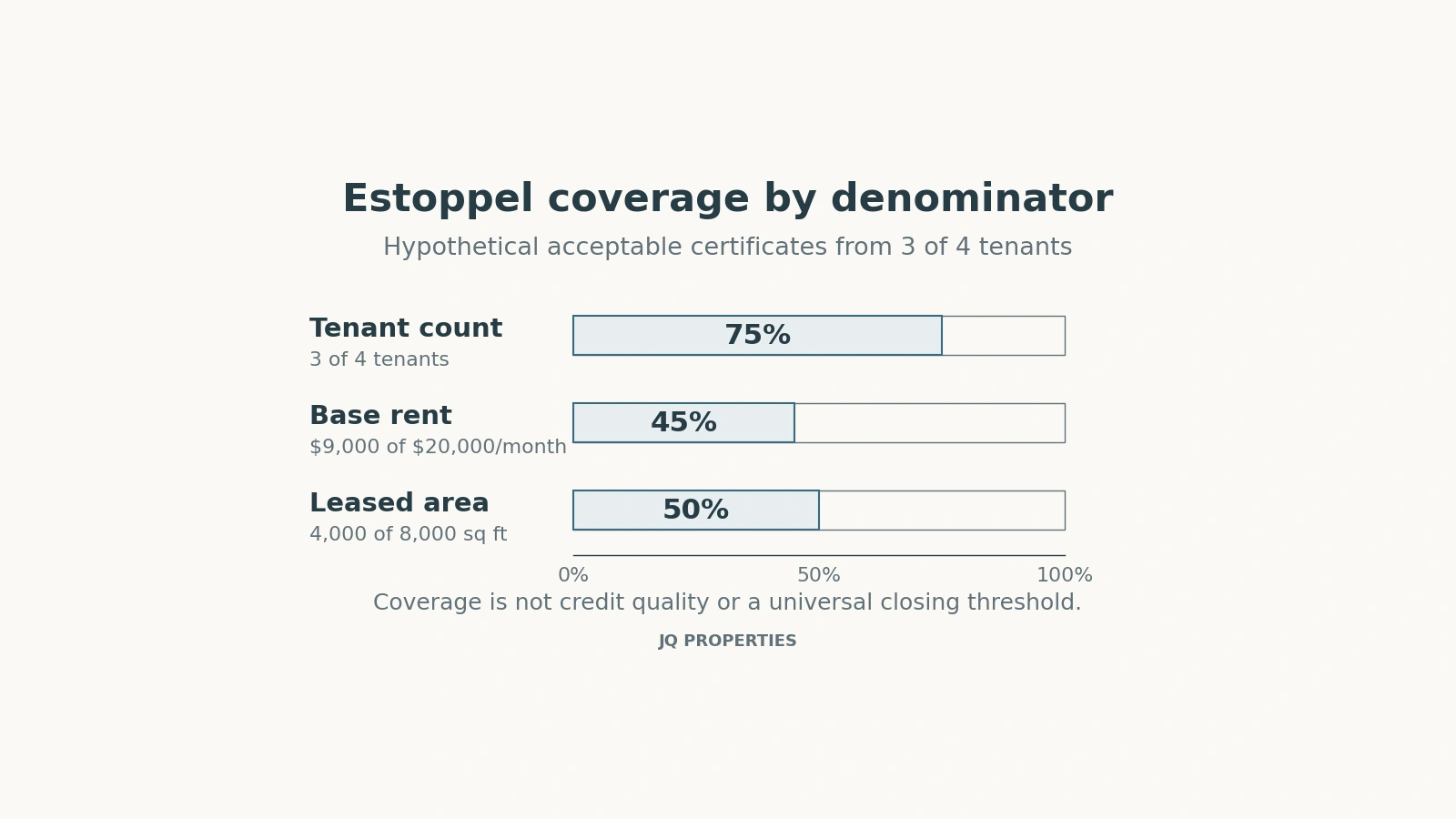
In a separate hypothetical four-tenant building, three tenants each pay $3,000 monthly base rent and the fourth pays $11,000. Suppose only the first three have supplied acceptable certificates for this exercise. That is 75% of tenants but only $9,000 of the $20,000 monthly scheduled base rent, or 45%. The unconfirmed tenant represents 55% of that rent.
If those three tenants occupy 4,000 of 8,000 leased square feet, area coverage is 50%, not 45% or 75%. Each percentage answers a different question. These figures describe coverage, not a recommended contractual threshold, credit quality or a conclusion that closing conditions have been met.
Close the gap between confirmation and closing
Certificates describe a position at a date. Check what changes before closing: a rent step, new amendment, payment, default notice, repair settlement or exercised option. Reconcile the final rent roll and adjustments with those events and obtain the updates required by the transaction. Ask the lender whether it needs direct reliance wording or further confirmation; do not assume buyer acceptance satisfies the lender.
If a tenant does not respond, record the request and follow-up history and establish why. Review the actual lease and purchase remedies rather than assuming silence confirms the landlord's version or automatically permits termination. A negotiated seller statement may address part of the purchase risk, but it is not the tenant's own confirmation.
Sellers can help by assembling signed documents and accurate account records before requests go out, identifying known disputes honestly and providing tenants enough context to respond. Buyers should turn each material discrepancy into a resolved fact, a documented allocation or an explicit remaining risk before the relevant contractual deadline. The aim is an explainable purchase decision, not a file full of signatures that contradict one another.
Sources checked September 8, 2026. Calculations are hypothetical. The effect of a certificate, qualification, non-response or purchase condition depends on the documents and applicable law.
An estoppel does not replace the separate transfer review. The commercial lease-assignment guide explains the landlord-consent questions when a business purchase includes taking over a lease.
When buying an income-producing property, JQ Properties can help organize the lease and rent-roll questions alongside the purchase timetable. Keep any disputed tenant statement and the legal decision it requires distinct from the income you hope to receive.
By Justin Qiao, Personal Real Estate Corporation, Justin Qiao Group | RE/MAX Crest Realty.
Sources checked September 10, 2026.