
Title Charges, Easements and Covenants: A BC Buyer’s Reading Guide
By Justin Qiao, Personal Real Estate Corporation, Justin Qiao Group | RE/MAX Crest Realty.
A BC title search tells you which registered interests to investigate. It does not, by itself, tell you the full terms of an easement, whether a covenant permits your renovation, or how a mortgage will be removed at completion. Read the title as the index to a property-specific legal review, then obtain the documents and plans behind the entries that matter.
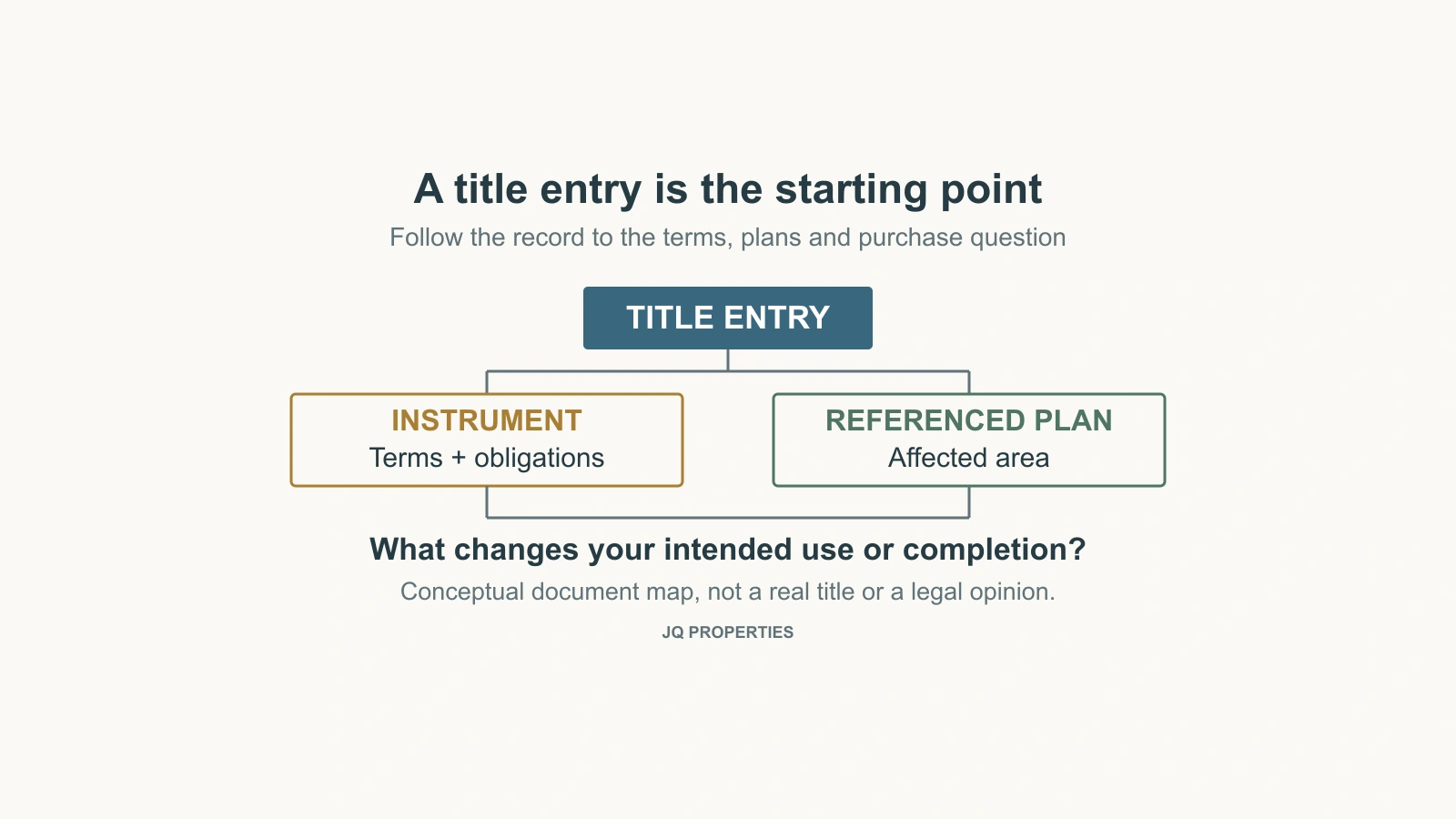
The aim is not a title with no unfamiliar words. It is an understood set of rights and obligations that works for the property you intend to buy. An access right may benefit you; a financial charge may be scheduled for discharge; a covenant may remain and constrain a project. Those are different questions, even when all three appear in one search package.
The fictional title-reading map and working record follows those distinctions. It contains no real title, owner information or surveyed boundaries. This guide uses LTSA information and BC legislation checked September 8, 2026; a lawyer or notary must interpret the actual transaction documents.
Start with the parcel and the date
Before interpreting charges, match the registered owner and legal description to the proposed purchase. Record the nine-digit parcel identifier, or PID, and the search date and time. LTSA describes a title search as a point-in-time record; an old copy is not a promise that nothing has since been registered. Its public search guidance recommends the PID and explains that a civic address is not itself a direct title-search key. LTSA: search for a title
Ask your legal adviser to reconcile the contract's legal description with the title package. If the deal includes more than one parcel, do not treat a search for one PID as coverage of them all. A mailing address, a listing label and a legal parcel description serve different purposes. Resolve a mismatch before deciding the wrong record is clean.
Also identify the kind of report you received. LTSA's title-view system can show current information alone or current and cancelled information. Read the status attached to an entry rather than assuming that every visible historical item remains active. Pending items and documents referenced in remarks also deserve attention; a short list headed “charges” may not be the whole package. LTSA: title view
Separate a benefit from a burden
An easement can give one parcel a limited right over another. In that arrangement, the land receiving the benefit is commonly called the dominant land and the land carrying the burden the servient land. For example, a right to use a neighbour's driveway may help the property you are buying; a neighbour's right to cross your driveway raises a different set of questions. LTSA's glossary explains these relationships and the role of legal notations. LTSA land-record glossary
Do not decide the direction of the right from the word “easement” alone. Ask which land benefits, which land is affected and how the purchased parcel fits. Then read the permitted purpose and any terms governing maintenance, access, cost sharing or interference. Their existence and wording depend on the actual instrument, not a standard assumption about shared driveways.
A statutory right of way is different from an ordinary easement between benefiting and burdened parcels. Section 218 of BC's Land Title Act permits qualifying holders, including specified public bodies and utilities, to hold registered rights without a dominant tenement. The right is still governed by its instrument. A utility label does not reveal the width, access terms or activities allowed on the affected land. Land Title Act, section 218
Order the instrument, not just its name
For an entry that may affect your use or financing, ask for the registered instrument, every referenced schedule or plan needed to understand it, and relevant amendments or releases. Record the document numbers so everyone is discussing the same material. A screenshot of the title is not the underlying agreement.
LTSA groups available records into title documents, legal notations, charges and other documents, including items referenced in remarks. Its help also explains that a document not available electronically may still exist and need retrieval from a land title office. An unsuccessful online result is therefore not a reason to treat the registered interest as imaginary. Ask the professional obtaining the records what is missing and how it will be located. LTSA document and plan ordering guidance
Read the instrument and plan together. One tells you the legal terms; the other may identify the affected area. Neither should be replaced by a listing sketch. LTSA expressly says ParcelMap BC is a graphical representation, not the authoritative source for the legal boundary; the survey plan or related registry information remains authoritative. LTSA: ParcelMap BC
If a fence, shed or proposed addition appears close to an affected area, ask whether a BC land surveyor is needed to establish its location. Do not measure an online map with a ruler and turn that into a legal clearance. The practical question is whether the actual improvement and the legal area have been reliably compared.
A covenant is not simply a line on a map
A covenant may affect what happens across an entire parcel, not only a narrow strip. Section 219 permits covenants concerning matters such as land or building use, construction, subdivision and preservation or maintenance of specified features. Such covenants may contain positive obligations as well as restrictions. That differs from assuming every covenant merely prohibits one activity. Land Title Act, section 219
Other restrictive covenants have their own legal framework. The Act also expressly cautions that registration under sections 219 and 221 does not determine enforceability. An old registration is not automatically irrelevant, but its appearance on title is not a complete legal opinion either. Ask your legal adviser what the instrument means, who can enforce it, and whether any proposed consent, modification or discharge is actually available. Land Title Act, sections 219 and 221
Describe your intended use concretely: “keep the existing house and add a rear workshop” is more useful than “renovate someday.” Counsel can then identify wording that needs attention, while the surveyor or designer can examine the physical proposal. Do not budget on a holder agreeing to change a restriction before that agreement exists.
For a commercial purchase or development plan, write down the proposed business and tenant uses, signage, parking, loading routes, access and utility needs. Have your legal adviser compare those needs with the actual title instruments and plans, including any environmental or servicing obligations. Separately check zoning and municipal permissions; a title review does not establish that the operation is approved. Use the commercial zoning due-diligence guide to organize that parallel use-and-approval review.
Follow one fictional purchase through the records
Imagine a buyer considering a house with a side driveway and hoping to add a small workshop. The fictional record in the companion asset has four entries. DOC-A is an access benefit over neighbouring land; DOC-B is a utility right burdening part of the purchased parcel; DOC-C is a covenant; DOC-D is the seller's mortgage. These labels are teaching devices, not LTSA registration numbers.
The buyer needs four different answers. For DOC-A, does the access right cover the route and use they are relying on? For DOC-B, where is the affected area and what does the instrument allow or prevent? For DOC-C, does the workshop conflict with an obligation or restriction? For DOC-D, what is the agreed completion treatment and how will discharge be confirmed?
Now suppose a contractor says the workshop physically fits beside the driveway. That answers none of the legal questions by itself. Conversely, a lawyer's reading of the covenant does not locate a fence on the ground. Keep the design, survey evidence and legal interpretation connected, without asking any one document to answer everything.
Paying a mortgage is not the same as removing it from title
FCAC explains that mortgage discharge involves removing the lender's registered rights, and that paying the balance does not complete the process automatically. Related products secured by the mortgage can also matter. For a purchase, have the legal professional identify which financial charges are to be discharged, what arrangements support that result and what evidence will confirm it. FCAC: discharging a mortgage
Do not classify every unfamiliar charge as a seller debt that will disappear. A lien or court-related registration may need a different process; an easement or covenant may remain after the sale. Ask for a specific completion treatment against each relevant entry, including any lender requirements. Do not infer legal priority simply by sorting registration numbers or dates yourself.
The search used for early due diligence and the searches needed for completion serve related but different moments. Ask your legal adviser when the record will be refreshed, how pending registrations are being addressed and which outstanding matters affect the transaction. There is no useful universal promise that a particular number of days makes a search current enough for every purchase.
Strata and building questions need additional records
For a strata purchase, include the common property record rather than reading only the individual lot's title. LTSA's electronic search guidance says the common property record accompanies a strata title search, and lists its own associated documents and plans. Confirm that your review package contains it. LTSA: common property search
Parking or storage descriptions should also be reconciled with the strata plan and relevant records, not inferred from the stall you saw at the showing. Our parking and storage guide covers that separate classification problem.
A title review is not a building-permit or zoning approval. If a municipal building notice appears, investigate the section 57 notice and its underlying file: what it records, what remains unresolved and what the municipality requires for removal. For a proposed suite or lane home, investigate municipal permissions and the building itself as well as registered restrictions. A quiet-looking title does not certify a rental unit's legality or approve future construction.
Bring your legal adviser the complete record package, your intended use and the offer's decision deadlines. Justin Qiao Group can help coordinate the property questions so the review addresses what you are actually buying. The goal is a clear account of what remains, what must be resolved and which plans still depend on evidence—not a reassuring summary of unread documents.