
Townhouse Snow Removal: Who Clears Your Steps Before the Contractor Arrives?
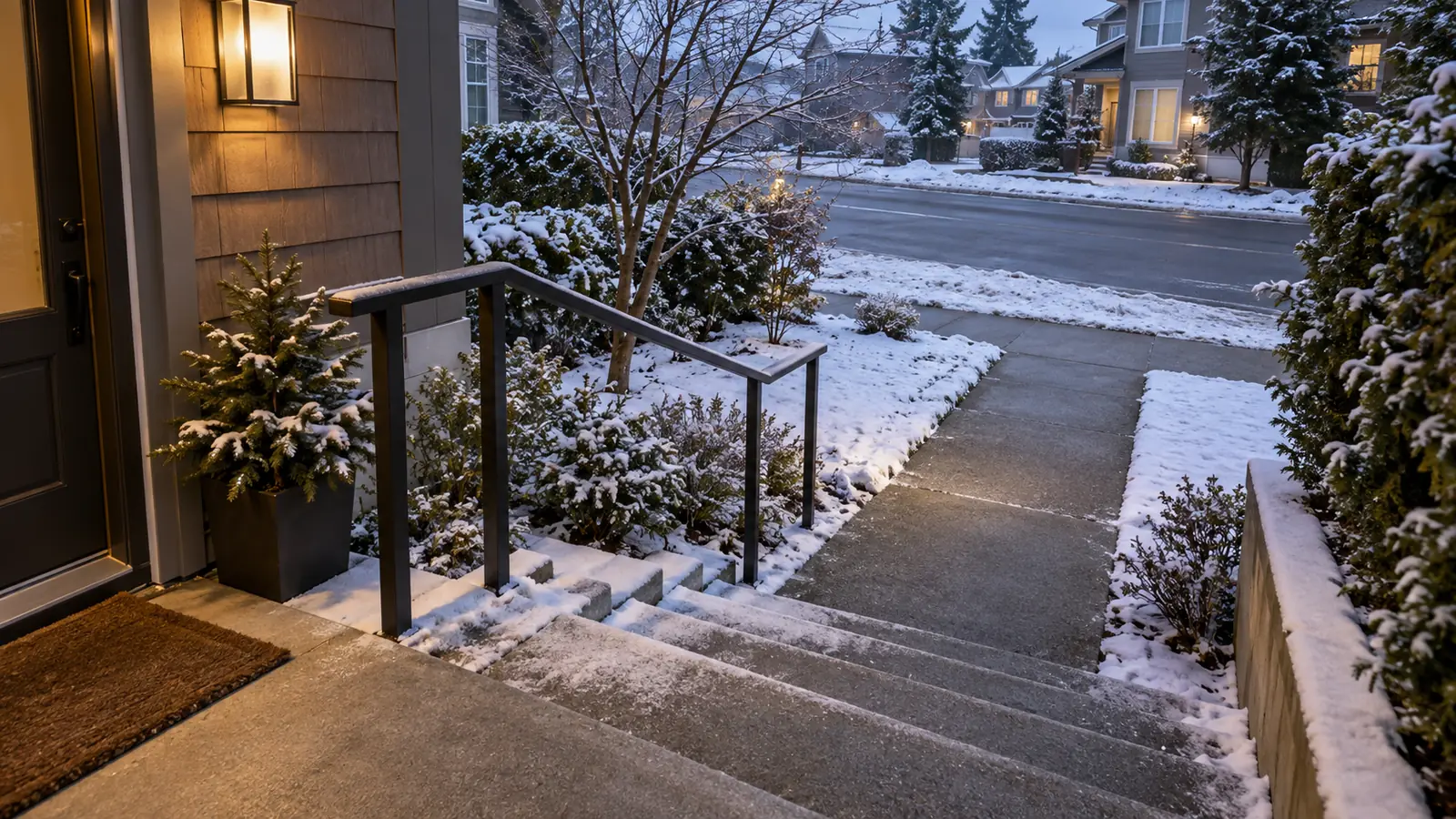
A townhouse can have a snow-removal contract and still leave its residents with an unanswered question at 6:30 in the morning: how do we get from the front door to a usable sidewalk? The answer depends on the particular steps and paths, the strata's current bylaws, the contractor's actual coverage, and the arrangements for the hours between visits. A line in the budget marked “snow removal” does not answer all of that.
For a buyer, this is part of deciding whether the property fits daily life. For an owner, it is a practical issue to resolve before winter. Start with the route you need, then establish who covers each part and when. Municipal sidewalk rules are a separate layer, not a promise that the entire trip will be ready before you leave.
Follow the route, not just the plow
Walk the route in dry weather and mark it on a simple sketch. A typical trip might cross an entrance landing, three steps, a short individual walk, a shared internal path and the public sidewalk. Someone driving may also need the driveway apron and access to the parked vehicle. Someone using a mobility aid may depend on a different, longer route without stairs.
Those are not interchangeable surfaces. A vehicle plow may clear the internal road without reaching a recessed landing. Hand clearing may be separately priced or excluded. A photograph of a cleared roadway says little about the narrow connection behind a snow pile.
Give each segment an unmistakable description, such as “bottom of unit entrance steps to the shared east path,” rather than “front area.” Note gates, grades, shaded corners and places where roof runoff or a snow pile could affect the route. These observations identify questions for the maintenance plan; they are not an inspection of drainage or a finding that a surface is safe.
For a purchase, ask for the current service scope and site diagram, not merely last winter's invoice. An invoice proves a service was billed. It may not identify the surfaces included, the conditions that triggered attendance, or what happens when residents need access earlier.
Your steps are not automatically your job
Do not decide responsibility from the fact that only one household uses an entrance. Check the strata plan and actual bylaws together. Under section 72 of the Strata Property Act, common-property maintenance starts with the strata corporation, with specified possibilities for bylaw allocation. The Act permits bylaws assigning maintenance of limited common property to the owner entitled to use it. That is not a general power to assign any shared path to whichever owner lives closest. Strata Property Act, section 72.
The Standard Bylaws also need careful reading. Bylaw 2 assigns certain owner maintenance, while bylaw 8 retains particular strata responsibilities, including exceptions concerning exterior stairs and other building components. It is therefore too simple to say that every frequent task on limited common property belongs to the owner. A strata may have different valid bylaws. Identify the provision being relied on for snow and ice at the exact location. BC Standard Bylaws, sections 2 and 8.
A useful written question is: “Which bylaw and service arrangement apply to the landing, these steps, and this connecting walk?” If the reply is that owners have always helped, ask whether that is a voluntary arrangement or an assigned obligation. A neighbour's past generosity is not dependable coverage when that neighbour travels or moves.
The strata-document guide can help assemble the broader package. For this decision, the important result is a location-specific answer, not a larger stack of documents.
The public sidewalk has its own deadline
In Burnaby, section 31 of the current consolidated Street and Traffic Bylaw requires owners or occupiers to remove accumulated snow or ice from sidewalks abutting the listed property types, including multi-family properties, by 10 a.m. each day, holidays included. The city's current resident guidance gives the same daily deadline. Burnaby Street and Traffic Bylaw, section 31, Burnaby sidewalk guidance.
That is a Burnaby example. Check the current rule for the municipality where the townhouse actually sits. Do not import Burnaby's deadline into Vancouver, Surrey or another community.
Also keep the surfaces straight. The public sidewalk beside the development is not the same thing as an internal strata walkway. Ask who has arranged the frontage work, including any side frontage of a corner property. Do not assume the city's road-clearing operation will clear either the frontage sidewalk or your private entrance.
Most importantly, a 10 a.m. deadline does not establish that your route will be available at 6:30 a.m. Nor does it settle what reasonable precautions are required in a particular situation or who would be liable for an accident. A compliance deadline and a household's access requirement answer different questions.
Read the service gap into the contract
“On call,” “automatic service” and “priority response” need an operational explanation. Ask what starts a visit: a stated accumulation, a weather forecast, an instruction from the manager, or another condition. If a snow-depth trigger is used, ask how ice without that depth is handled. A snowfall threshold alone cannot explain a refreeze response.
Then find out whether the promised time refers to dispatch, arrival or completion. “Crew dispatched by 7 a.m.” does not mean the steps are finished at 7 a.m. Ask how a prolonged storm affects repeat visits and what happens after an initial pass leaves an entrance connection blocked.
The missing piece is often the interval between visits. Identify the contact for reporting an icy patch, who can request extra service, and whether the contractor must receive instructions from management. An owner should not assume they can order work on the strata's account or obtain reimbursement by hiring another contractor themselves.
If the arrangement expects residents to help, establish what happens for a person unable to do that work. The useful answer may be an arranged additional service, an agreed assistance arrangement, or a different usable route. It should not depend on a resident undertaking strenuous or hazardous work. Keep emergency access needs separate from ordinary commuting arrangements.
A morning example: three surfaces, three different times
Consider a hypothetical household leaving at 6:30 a.m. Assume, solely to test the schedule, that clearing remains effective afterward and there is no new snowfall or refreezing:
| Required segment | Assumed service completion | Gap after the required departure |
|---|---|---|
| Entrance steps | 6:15 a.m., separately arranged | None |
| Internal shared path | 7:00 a.m. | 30 minutes |
| Frontage sidewalk | 9:00 a.m. | 150 minutes |
On these assumptions, the complete route is not available until 9 a.m. Clearing the steps early does not solve the two later connections. And completing the sidewalk before Burnaby's 10 a.m. deadline does not solve the early departure.
If additional service brings the internal path forward to 6:20 a.m., the sidewalk still controls the route. If all three segments are completed by 6:20 a.m., the schedule has ten minutes of margin before departure, but still needs a condition check; the timing calculation is not a safety certificate. If a completion time is unknown, leave the route unconfirmed instead of treating the blank as midnight or zero delay.
Use the winter route and service-gap sheet to repeat this exercise for your own entrance. It includes the example, a blank route strip and a separate return-trip check. Write only confirmed commitments as commitments; keep a contractor's estimate visibly labelled as an estimate.
Decide what must change before winter
A workable plan identifies the whole route at the time it is needed, including arrangements when the regular service does not cover that time or surface. It may reveal that the existing contract is adequate but the household needs a later departure. It may show that the strata needs to clarify one excluded connection. Or it may expose a recurring mismatch that matters to a buyer who cannot use stairs or adjust a work shift.
Bring that specific mismatch to the manager or council: the location, the required time and the unanswered service provision. Ask for the agreed arrangement and how residents will be told when it changes. Check the evening return as well as the morning exit; a clear route at breakfast does not establish its condition after sunset.
The aim is not to predict every storm. It is to avoid discovering, in the dark on the first icy morning, that everyone expected someone else to handle the same short stretch of path.
General BC property-planning information, checked September 8, 2026. Municipal rules and individual strata arrangements differ; this article does not determine accident liability.
If an early departure is essential to your home choice, contact JQ Properties with the entrance route and unresolved service gap so the next strata document request is specific.
By Justin Qiao, Personal Real Estate Corporation, Justin Qiao Group | RE/MAX Crest Realty.

