Home Insurance Before Closing: Get the Actual Property Accepted

By Justin Qiao, Personal Real Estate Corporation, Justin Qiao Group | RE/MAX Crest Realty.
A premium estimate is not the finish line for a home purchase. Before relying on insurance for closing, establish what property and use the insurer has accepted, what protection it is offering, when that protection starts, and whether the written evidence satisfies your lender's requirements. An attractive quote based on incomplete property facts can leave the real decision unresolved.
Start this work while you can still investigate the property and discuss contractual options. You do not need a fully issued annual policy before every showing. You do need to know whether the proposed purchase raises an insurance question that could change the offer, financing or cash plan.
This is a residential purchase guide using public guidance checked September 8, 2026.
For commercial premises or a business purchase, arrange a separate review with your insurance adviser against the actual use, lease and lender requirements. Ask which building, fire, environmental and claims records the insurer needs, and how property, business interruption, equipment and liability coverage should be addressed. Confirm the insured parties and effective coverage dates for possession or operational handover; do not assume residential insurance covers the operation. Use the commercial due-diligence checklist to coordinate those questions before removing conditions.
The property acceptance fact card provides a usable record for the insurance representative and closing professional without pretending to be an insurer's application.
Describe the house you are buying, not the seller's premium
Begin with the exact property, named purchasers and actual intended use. Is this your principal residence, a rental, a home with a rented suite, or a property where nobody will live immediately? Will a separate structure be used for storage, a workshop or a business? Describe the activity rather than deciding for yourself that it is too minor to mention.
Then gather the building facts that can affect the response: construction and renovation history, approximate building size, roof type and age, electrical service and wiring, plumbing, heating and any wood-burning appliance. Include relevant inspection findings, known damage and work still planned. IBC identifies building systems, replacement cost, unique uses, location and claims history among the factors insurers consider; it also says companies do not all use the same factors. These are prompts for accurate disclosure, not a universal rejection list. IBC's insurance rating factors
For every uncertain fact, identify the source. “Seller reports roof replaced in 2019; invoice not supplied” is more useful than turning a listing's “newer roof” into a confident date. “Panel replaced” does not answer whether all wiring was replaced. Ask the insurer what evidence is needed where your documents do not establish the answer.
Do not guess to get past an online form. If a question cannot be answered accurately, stop that field and contact the provider. A quote obtained by calling the property something it is not does not solve the purchase problem. Equally, an unanswered question is not proof the property is uninsurable; it is a request to obtain the right facts.
Separate price, acceptance and proof
Record the stage of each insurance conversation in ordinary language. A rough estimate helps with early budgeting. A quote based on submitted facts may still await an underwriting decision or additional documents. Once coverage is bound, obtain the written evidence and read it against the information you supplied.
Square One describes a binder as temporary proof of insurance while final policy documents are being prepared. It can identify the insured, property, coverage, limits, deductibles, endorsements and coverage dates. Its explanation also distinguishes a person having authority to bind coverage from a file awaiting further approval. Do not assume a saved quote screen is a binder. Square One's binder explanation
Ask a precise question: “On the facts we supplied, has coverage been bound from the stated date and time, and what conditions remain?” Keep the provider's answer and the actual confirmation. If it says a photograph, assessment or completed repair is still required, record whether that item is needed before coverage begins or by an accepted later deadline.
Payment and acceptance should not be confused either. A proposed instalment schedule tells you how premium payments would work. It does not, on its own, establish that every property fact has been accepted or that the policy meets the lender's requirements.
Compare protection before comparing premiums
Two annual premiums are not comparable until you know what each buys. IBC distinguishes comprehensive protection, named-perils protection and broad policies that treat the building and contents differently. “Comprehensive” still has exclusions; optional coverage may be needed for risks such as earthquake, flood or sewer backup. Read the offered policy, not only its product name. IBC's coverage types
Ask about the building settlement basis, contents, personal liability, additional living expenses, relevant water protection, exclusions and deductibles. Where there is a special limit, ask what item or event the limit applies to. A dollar amount without its definition is not enough to decide whether it addresses your concern.
For a detached house, the cost to rebuild is not simply the purchase price, which also reflects land and the transaction. IBC's homeowner guidance distinguishes replacement value from market value. Give accurate building details so the insurer can explain its valuation and settlement conditions. Do not lower the rebuilding figure to the mortgage amount merely because that number is easier to find. IBC's homeowner coverage explanation
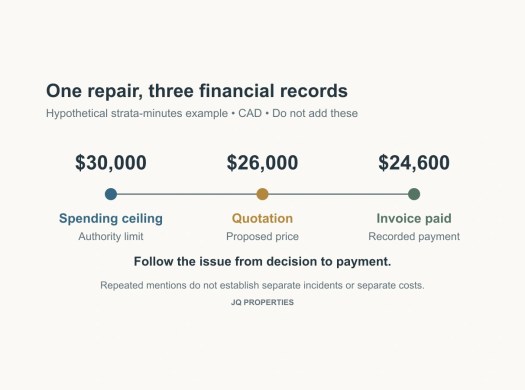
Consider an intentionally simplified comparison: Quote A costs $1,800 annually and Quote B $2,100. B costs $300 more per year, or $25 per month when averaged for budgeting. If A has a $5,000 deductible for the particular event being compared and B has $2,000, the deductible difference is $3,000. Those figures do not prove B is better: first confirm the same event is insured under both, along with limits and exclusions. These invented amounts are not Greater Vancouver price benchmarks.
A strata buyer needs the building information and a personal answer
The strata corporation's policy does not replace the owner's policy. BC advises owners to consider their own contents, liability, living expenses after an insured loss, improvements and possible responsibility for the strata deductible. Give your insurance representative the current corporation insurance summary and the actual unit-use and renovation details. BC strata owner insurance guidance
Do not substitute the seller's unit policy or an old building summary for the information that applies at your purchase. Ask whether the strata policy renews between your review and completion and obtain any updated terms. A building-level renewal can change the question your personal insurer needs to answer.
This guide does not calculate liability for a particular strata loss. Our condo insurance deductible guide owns that deeper review. Also identify whether a detached-looking property is bare land strata: BC says owners in that structure are responsible for insuring buildings on their own strata lots. Appearance alone does not establish which policy should insure the house.
Bring the lender and purchase contract into the same conversation
IBC says most mortgage lenders require home coverage, identification of the lender on the policy and proof of purchase. Obtain the lender's actual insurance instructions and send the requested evidence through the closing process. Ask the lawyer or notary to flag any mismatch in property address, purchaser names, lender name, coverage or effective date. Do not invent a standard insured amount for every loan. IBC's home insurance purchase guidance
Ask the closing professional when the actual contract puts the property at your risk. Reconcile that date and time with the insurance evidence, completion, possession and real move-in plan. Keys arriving later does not justify assuming insurance can begin later; the contract needs to be read. Conversely, this guide does not declare one universal risk-transfer hour for every BC purchase.
If the completion date changes, send the change to the insurance representative and obtain updated confirmation where required. If occupancy, rental use or renovations change, disclose that too. IBC specifically advises contacting the representative before renovations, home-based business activity or renting part of the property. A previous answer was given on previous facts.
Resolve a coverage condition as a purchase decision
Suppose an insurer asks for an electrical assessment before deciding whether to bind coverage. The seller's willingness to reduce the price does not provide that assessment. A contractor's availability after completion does not answer a requirement due before coverage begins. Identify the missing evidence, the person authorized to obtain it, the access required and the decision deadline.
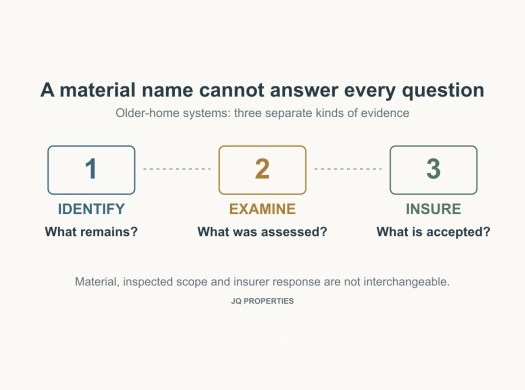
For older-system work, use the Poly-B and aluminum wiring guide for the specialist investigation. A known claim or an empty-house period likewise deserves its own focused review. Do not turn this general acceptance process into a diagnosis or presume every older component requires replacement.
Where suitable coverage cannot yet be confirmed, tell your representative and legal adviser before waiving relevant conditions. They can assess the contract and available options; the insurer decides coverage. A purchase extension, repair promise or holdback has to be documented for its own purpose and does not silently remove an insurance limitation.
Keep the completed fact card with the quote, bound-coverage evidence and outstanding conditions. Justin Qiao Group can help obtain relevant property information and coordinate the purchase dates. The useful outcome is a documented match among the real property, accepted coverage and closing requirements—not simply the lowest premium in an inbox.