
Commercial Lease Administration Fees: Check What the Percentage Applies To
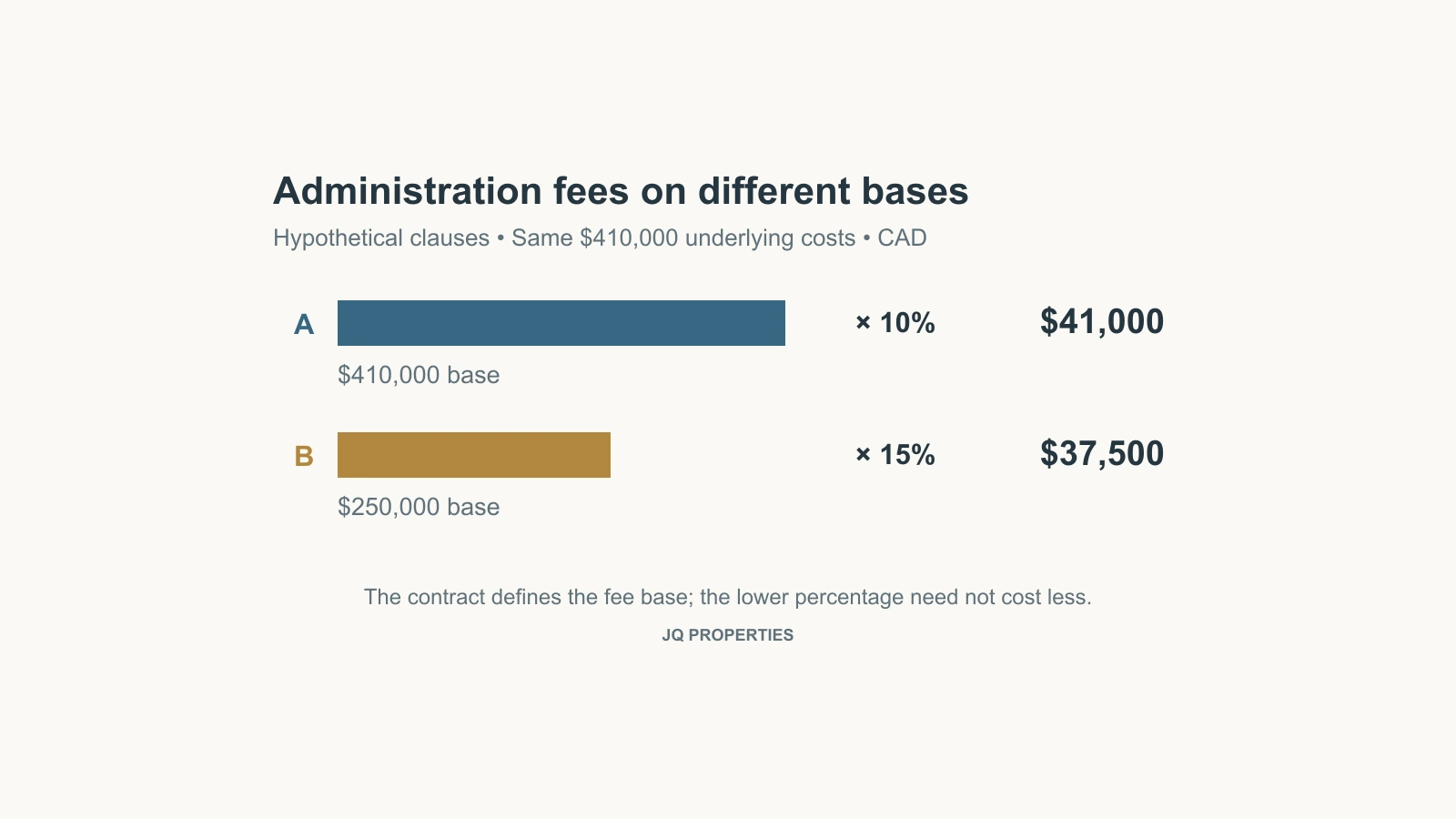
A 10% administration fee can cost more than a 15% fee. The difference is the amount underneath the percentage: property taxes, insurance, utilities, capital recoveries and other fees may be inside or outside the calculation, depending on the lease.
Before comparing rates, ask the landlord to show one complete calculation using the proposed lease wording and a recent year's accounts. You need the permitted cost base, the fee, and your allocated share as separate numbers. A statement headed “management fee” does not explain all three.
This is a method for reviewing a contractual charge, not a claim that any particular percentage is standard, reasonable or enforceable in British Columbia.
The label does not identify the formula
An operating-cost definition may include a fee based on building expenses. Another lease may use rent or building revenue. A third may permit the actual property manager's invoice, subject to limits. Before doing arithmetic, locate the definition and any amendment that changes it.
Publicly filed contracts illustrate the variation. A 2017 Birks lease in Quebec capped specified management/administration fees at 15% of building operating costs and excluded property taxes from that charge. A November 2016 Akamai lease in Massachusetts instead used 3% of defined gross receivable rents, with detailed inclusions and exclusions, including an exclusion of management fees from an operating-expense component of the base. Neither historical contract supplies a default rule for a BC tenant. Birks lease, section 6.1, Akamai lease, section 7.4(A)(8).
Read the noun after the percentage as carefully as the number. “Operating costs,” “gross rent” and “amounts paid by the landlord” are not synonyms. If the definition includes another defined term, follow that cross-reference before deciding which invoices belong in the base.
One set of accounts, two different fee clauses
Here is a fictional annual building statement in Canadian dollars. Assume both proposed leases allow recovery of all the listed net costs before the administration fee. The capital entry is an agreed $20,000 annual recovery, not the entire cost of a replacement project. There are no other management fees in these numbers. Sales taxes are excluded throughout.
| Building cost | Net amount recoverable before the fee | Clause A fee base | Clause B fee base |
|---|---|---|---|
| Maintenance and services: $200,000 less $10,000 supplier credit | $190,000 | $190,000 | $190,000 |
| Shared utilities | $60,000 | $60,000 | $60,000 |
| Property taxes | $100,000 | $100,000 | $0 |
| Building insurance | $40,000 | $40,000 | $0 |
| Permitted annual capital recovery | $20,000 | $20,000 | $0 |
| Total | $410,000 | $410,000 | $250,000 |
For this illustration, Clause A charges 10% of all five net categories, excluding the administration fee itself. Clause B charges 15% of maintenance/services and utilities only, excluding taxes, insurance, capital recovery and the fee itself. These are invented terms for comparison, not quotations from the filed leases.
Clause A produces $41,000: $410,000 × 10%. Clause B produces $37,500: $250,000 × 15%. The higher percentage is $3,500 cheaper at the building level because its base is narrower.
If your share is 10% under both clauses, your annual cost including the fee is $45,100 under A and $44,750 under B. The difference is $350 annually, or about $29.17 a month. That is the difference for this tenant—not the entire $3,500 building difference.
The $20,000 capital recovery appears in both underlying cost totals but only one fee base. This distinction matters: excluding an item from the fee calculation does not necessarily exclude the underlying item from additional rent. Conversely, if the lease excludes the underlying capital cost entirely, it should not enter either calculation merely because a fee clause mentions capital expenses.
Find the supplier credits before applying the markup
The maintenance row deliberately starts with a gross amount and subtracts a credit. Ask whether rebates, reimbursements, insurance recoveries or credits have been applied as the lease requires. Otherwise, a duplicated or unreduced underlying cost can also inflate the percentage fee.
For this example, failing to deduct the $10,000 supplier credit would overstate Clause A's fee by $1,000 and Clause B's fee by $1,500, in addition to overstating the recoverable cost itself. The right review is not just “does the multiplication work?” It is “does the base contain the right net costs?”
Keep the credit beside its originating invoice and accounting period. A refund posted in a later year may need an explanation of the lease's reconciliation treatment. Do not assume that every accounting adjustment is misconduct; ask for the bridge between the original charge and the final net amount.
Do not let the fee calculate itself twice
Suppose a separate simplified clause permits 10% of $250,000 in eligible costs and expressly excludes the administration fee from its own base. The fee is $25,000. A spreadsheet that first adds that fee to the base and then charges 10% on $275,000 produces $27,500—an extra $2,500 unsupported by those assumed terms. At a 10% tenant share, the overstatement would be $250.
Look for another kind of overlap too. Does the operating statement contain a property-management invoice while a separate percentage charge supposedly pays for the same service? Does a contractor invoice already include a project-administration charge that is then marked up again? Multiple fees are not automatically duplicates, but their different functions and contractual authority should be identifiable.
Ask the landlord to identify the service covered by each charge and whether the percentage base includes it. If the wording permits distinct charges, model both. If it excludes duplication, make sure the reconciliation applies that exclusion. Ambiguous drafting belongs with the lease lawyer, not in a spreadsheet assumption that quietly favours either party.
Reconcile the building calculation to your statement
Request a cost schedule that shows the source total, exclusions and credits, eligible fee base, percentage, calculated fee and tenant allocation. Then compare the resulting annual tenant amount with the estimated amounts already paid. A correct annual calculation can still produce an incorrect balance due if a payment or credit is missing.
Also check whether different cost pools use different shares. A building-wide management charge and a retail-only expense pool should not be combined under one convenient percentage unless the lease supports that allocation. This article's 10% share is intentionally constant; your statement may not be so simple.
BDC recommends reviewing incidentals and clearly specifying future cost increases during lease negotiations. A sample fee calculation makes that advice practical: it shows what the language would do to your business's bill before you sign. BDC: Negotiating a commercial lease.
When requesting clarification, use a specific question: “Please show which statement lines form the administration-fee base, which are excluded, whether another management fee is already included, and how the final amount is allocated to our premises.” This is more useful than arguing that the percentage seems high without checking what it applies to.
Keep the lease's review and objection deadlines in view. Requesting information does not necessarily extend them, and a disputed calculation is not an automatic right to withhold rent. Our guide to operating costs, additional rent and audit rights covers the broader document review.
JQ-Properties can help organize competing occupancy-cost schedules. Have your commercial lawyer confirm the contractual calculation and an accountant review the reconciliation where needed. Information checked September 8, 2026; examples are hypothetical and are not legal or accounting advice.
By Justin Qiao, Personal Real Estate Corporation, Justin Qiao Group | RE/MAX Crest Realty.

