
CAM and Additional Rent in a Commercial Lease: Check the Reconciliation
A commercial lease's monthly additional-rent estimate is not necessarily the final cost of occupying the space. The year-end reconciliation compares the charges allocated to you under the lease with the amounts already billed or paid on account. A balance owing can be legitimate, but the total should be explainable from the expense records, allocation rules and credits. A neatly printed statement does not establish that every item is recoverable.
For a BC tenant or business buyer, the useful question is therefore broader than “Did CAM go up?” Determine which costs belong in the calculation, how they reach your account, what has already been credited, and how to raise an unresolved item within the applicable process. That produces both an occupancy budget and a focused discussion about the bill.
Identify what the statement is reconciling
CAM usually refers to common area maintenance, but additional rent can cover more than shared cleaning or landscaping. Property taxes, insurance, management charges and other amounts may appear in separate schedules. Base rent is another obligation again. Do not combine a tax reconciliation with the CAM subtotal unless the statement and lease actually use that structure.
BDC's commercial-space budgeting guidance identifies these incidentals and recommends obtaining past bills when evaluating a lease. That is a useful starting point for a new location: request the current estimate and the prior reconciliations, rather than accepting a single advertised rate as the whole occupancy cost. BDC on budgeting for commercial space.
Write the reconciliation period at the top of your working page. Then separate the landlord's annual property costs, your allocated annual charges, and the payments on your tenant account. Those are three different sets of numbers. A property-wide insurance expense should not be entered as if it were your own bill, and an unpaid monthly instalment should not disappear just because it was included in the year's estimate.
Keep four statuses distinct: an estimate is a forecast; a billed amount is a demand on the account; an amount accepted or approved for your calculation has a stated supporting basis; a payment is cash actually remitted and credited. If a statement subtracts amounts billed rather than amounts paid, its reconciliation difference is not the complete account balance. Reconcile the unpaid instalments separately, and do not assume that paying a charge means its contractual treatment has been agreed.
Read the recovery clause beside the invoice categories
Start with the executed lease and amendments, including definitions that the operating-cost clause refers to elsewhere. A “net lease” label is useful shorthand, not a substitute for those provisions. BDC describes differences between gross, net and other lease structures; the particular costs and increases still require examination. BDC's commercial lease guidance.
For each material category, identify the inclusion language, any exclusion, the permitted allocation and the document supporting the cost. For example, an insurance refund might reduce a recoverable expense; a separately charged tenant service might already have been recovered elsewhere. Ask how the accounting handles those items rather than assuming every credit appears on the front page.
Capital expenditure needs a separate reading. A large replacement is not automatically recoverable in full in the current year, nor automatically excluded simply because it is capital. Look for eligible categories, amortization, interest, timing and caps. Repair clauses can also assign a dedicated system directly to a tenant while common mechanical costs pass through another schedule. Our commercial HVAC responsibility guide addresses that repair-versus-replacement question in more detail.
A publicly filed April 2015 Ottawa lease between Innovation Blvd II Limited and Ciena Canada illustrates the specificity involved. It separates operating costs, taxes and a property-management fee; its operating-cost definition addresses duplication and exclusions, while another provision governs eligible capital costs. This is a historical Ontario contract example, not a standard BC lease or a statement about your legal obligations. Filed lease, sections 4.2.2–4.2.6.
Rebuild a bill from expenses to the tenant balance
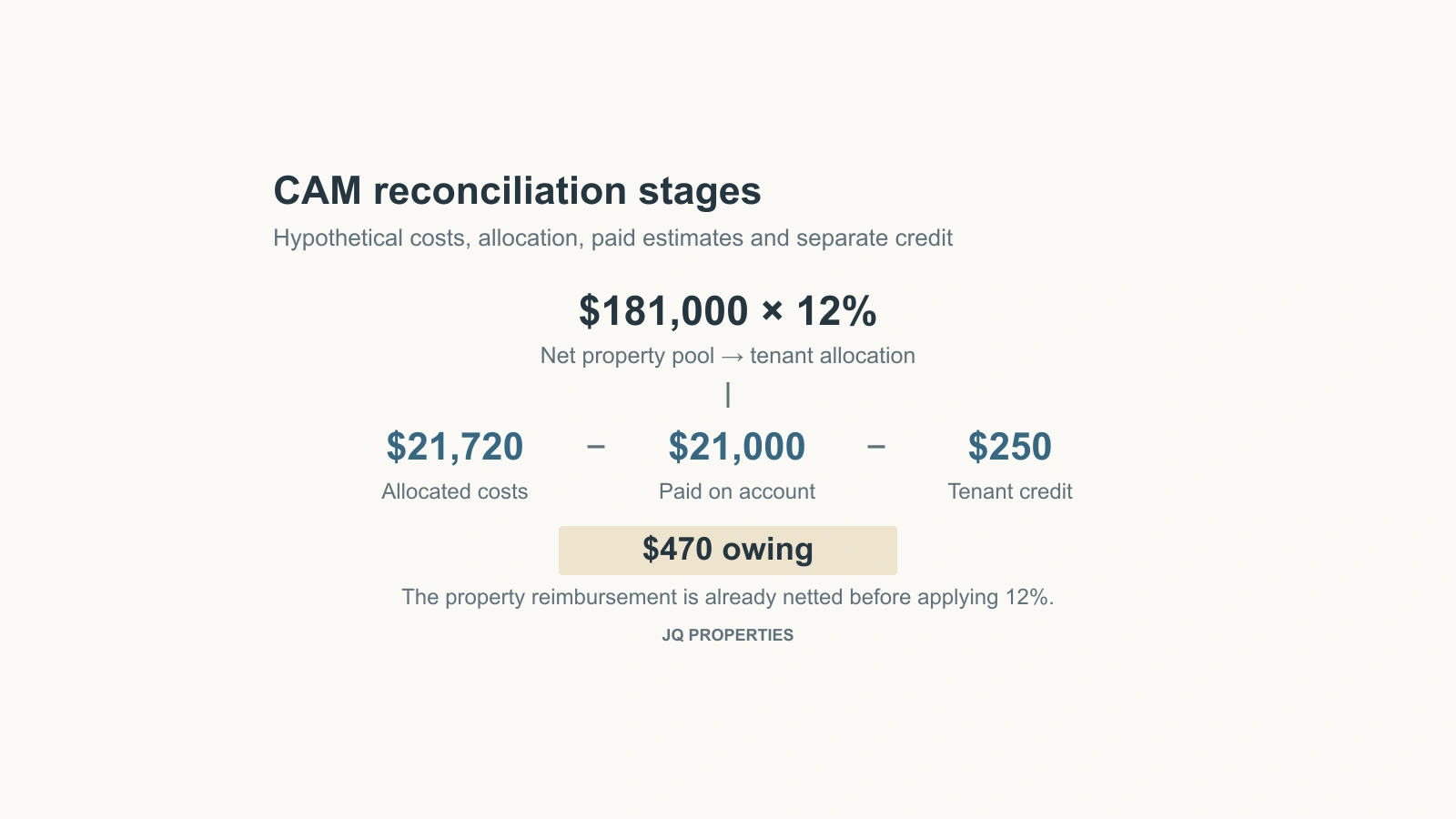
Consider a hypothetical full-year reconciliation in Canadian dollars, before sales taxes. The lease is assumed to allocate 12% of the following eligible property costs to the tenant. There is no gross-up, base-year subtraction, cap, partial-year period or changing allocation. Management is already included once in the expense total. These assumptions define the example; they are not proposed terms for every lease.
| Hypothetical property cost | Amount used |
|---|---|
| Property taxes | $100,000 |
| Insurance | $24,000 |
| Common cleaning and landscaping | $36,000 |
| Repairs before an insurer's reimbursement | $18,000 |
| Management charge, included once | $9,000 |
| Gross listed costs | $187,000 |
| Insurer reimbursement credited against those repairs | −$6,000 |
| Net eligible property-cost pool | $181,000 |
The tenant's allocation is $181,000 × 12% = $21,720. During the year, the tenant was billed and paid $1,750 a month on account, totalling $21,000. A separate $250 tenant-account credit is also assumed to apply to this same reconciliation and has not already reduced either amount. The resulting balance is:
$21,720 allocated actual costs − $21,000 paid on account − $250 separate credit = $470 owing.
The $6,000 property-level reimbursement and $250 tenant-level credit operate at different stages. Deducting the $6,000 directly from the tenant's bill would give this tenant the whole building's reimbursement. Deducting the $250 from the property pool would give it only 12% of its own credit. Keeping the stages separate prevents both errors.
Now suppose the initial statement failed to deduct the $6,000 reimbursement and added the $9,000 management amount a second time. Its pool would be $196,000, its tenant allocation $23,520 and its reconciliation balance $2,270. The difference from $470 is $1,800: $720 from the missed reimbursement and $1,080 from duplicate management. The numbers identify two questions to resolve; in a real file, the lease and underlying records must establish whether those adjustments are justified.
Check management charges without assuming every second fee is wrong
The example deliberately defines the second $9,000 as a duplicate. An actual statement may have a property manager's fee, on-site payroll, administration of recoveries and a construction-management charge that pay for different services. The existence of two labels does not prove overbilling. Conversely, changing a label does not make the same cost recoverable twice.
Ask what each charge covers and how it is calculated. If a percentage applies, identify its base: operating costs before management, rent collected, a selected expense subtotal or something else. Check whether the calculation is charging a fee on itself or on another fee, and whether the lease permits that treatment. Trace the expense back to its invoice or contractual entitlement rather than subtracting it merely because it looks unfamiliar.
Caps deserve similar care. Record which categories are controlled, which year supplies the baseline and whether the cap is cumulative, compounded or subject to exceptions. A restriction on selected controllable expenses need not limit taxes or insurance. Do not apply one percentage to the entire reconciliation because that is easier to calculate.
Confirm the share and the period before debating the total
Your allocation might use a fixed percentage, specified areas or separate cost centres. Check the denominator and the affected premises against the lease. A retail-only service in a mixed-use building may have a different allocation from a property-wide tax charge. Supporting documents should explain that distinction.
Vacancy adjustments and floor-area comparisons require their own inputs. For commercial lease gross-up clauses, establish which costs the clause allows to change with occupancy; for usable versus rentable area, reconcile the lease's numerator and denominator before applying a share. Do not add a vacancy multiplier to this article's 12% example: it expressly assumes none.
For a mid-year commencement, expansion or assignment, preserve the dated periods. Ask whether allocation follows actual expenses during each period, annual totals prorated under the lease, or another specified method. Six months in possession does not by itself establish the contractual calculation. Also keep arrears, interest and prior-year corrections separate from the current year's cost variance, so an unexplained opening balance does not masquerade as higher operating costs.
Use the reconciliation workpaper with your own statement
The CAM reconciliation workpaper includes the completed example, a blank expense record and the formulas for checking the tenant balance. Open or save it, copy the blank record into your preferred document, and use a calculator for the arithmetic. It is a working document, not an automated legal assessment.
Record property-wide costs and property-level credits first. Apply the supported tenant share, then deduct the applicable on-account amounts and separate tenant credits. Compare the result with the landlord's stated balance and explain each difference. Leave an unknown figure marked unknown; do not enter zero merely to finish the total. If different categories use different shares, calculate their allocations separately before adding them.
In the example, annual base rent of $42,000 plus $21,720 allocated actual costs less the $250 tenant credit produces $63,470 before sales taxes and other excluded charges. The monthly equivalent is $5,289.17. Actual cash timing was different: $5,250 monthly for base rent and estimates, followed by $470 at reconciliation. Use both views when budgeting; the annual average does not move the adjustment's payment date.
Raise a specific question before the response window closes
Review or audit rights must be checked, not assumed. Find the required notice, recipient, deadline, access conditions, permitted reviewer, cost allocation and dispute procedure. The historical Ottawa lease has separate objection and audit-completion windows and states that the audit does not suspend rent payments. Those are features of that contract, not default BC deadlines. Filed lease, section 4.2.7.
A focused request identifies the statement date, period, expense, amount and missing record: “Please show where the insurer's reimbursement was credited and whether the management amount is already included in the total.” Keep the original statement and the response. An informal email may not satisfy contractual notice requirements; an arithmetic disagreement alone is not a reason to assume you can withhold rent.
For a business purchase, obtain prior reconciliations, the current estimate, the tenant ledger and any unresolved notices before completing the lease-assignment review. Agree how an adjustment delivered after closing will be dealt with between buyer and seller, without assuming that their purchase agreement changes the landlord's rights. A clean handover should identify the open period and who retains the records needed to settle it.
The objective is a cost you can trace and budget. If the remaining uncertainty is an invoice, request the invoice. If it is the meaning of a clause, obtain advice on that clause and the response procedure. Keeping those questions distinct makes a reconciliation much easier to resolve.
By Justin Qiao, Personal Real Estate Corporation, Justin Qiao Group | RE/MAX Crest Realty. Commercial-leasing information checked September 8, 2026. All monetary examples are hypothetical and do not determine liability under an individual lease.