Daycare Operating Costs: Build a Monthly Cash Budget
By Justin Qiao, Personal Real Estate Corporation, Justin Qiao Group | RE/MAX Crest Realty.
A daycare's monthly budget should show the cash needed to deliver its actual program, including the work the owner performs, paid leave and relief coverage, premises costs, supplies, maintenance and obligations outside the profit statement. Then place each receipt and payment in the month it can really arrive or leave. A profitable year does not guarantee enough money for the next payroll.
This guide is for a BC operator or buyer building a forward operating budget. It is not a valuation or a claim that a particular number of licensed spaces will produce a particular income. Download the three-month daycare cash budget as a ZIP, extract it and open the included HTML file in your browser to test the complete cost picture. Calculation works offline; the included instructions explain input limits and printing. The example is hypothetical; public sources were checked September 8, 2026.
Start from the service you will actually deliver
Write down the program, age groups, opening hours, expected enrolled children and the rooms actually operating. These facts determine the work required. A fee multiplied by every licensed space is not a staffing plan or a collection forecast. Nor should a budget quietly assume a room will open before its required staff and approvals are in place.
BC's Child Care Licensing Regulation links supervision to qualified employees, children's needs and program-specific group and staffing rules. It also addresses absent employees and their replacement. A lower-enrolment scenario cannot simply reduce payroll by the same percentage if the proposed roster no longer meets the applicable requirements. Child Care Licensing Regulation, sections 34–39 and Schedule E
Build the roster first and price it second. Include opening and closing coverage, breaks, preparation, administration, training and foreseeable relief. Where a planned schedule depends on an owner being qualified and available, make that assumption visible. The budget should describe an operation you can actually run, not just a wage total you would like to pay.
Price all the labour, including the owner's job
Separate educator and assistant hours, management, administrative support and relief. Use the actual employment arrangements and current recruitment evidence for the required roles. Job Bank's regional wage statistics can provide context, but their reference period and occupational grouping matter; they are not quotations from people available to start at your centre. Job Bank regional wage information
If the seller handles management without a salary, determine who does it after the sale. A buyer who will perform the work personally should still compare the business after a reasonable labour charge. For the cash budget, show what will actually be paid and when; for the economic comparison, show the cost of replacing that labour. Do not combine the two views without labelling the difference. An owner-work payroll comparison should identify each duty, the coverage needed and the supported replacement cost separately from the cash you plan to draw.
Paid leave and relief are also different amounts. A salary may already cover pay during the assumed leave period, while someone else still needs to be paid to cover the duties. Adding the same employee's vacation pay twice overstates cost; leaving out relief understates the operating requirement. BC's vacation guidance distinguishes vacation time from vacation pay, so use the actual pay arrangement rather than treating a percentage allowance as a complete staffing answer. BC annual vacation guidance
Add employer contributions, assessments and benefits on the appropriate basis. CRA distinguishes amounts withheld from employees from the employer's own CPP and EI contributions; withheld amounts are not free working capital. If your cash schedule uses net employee payments plus remittances, do not also deduct the full gross payroll again. A monthly accrual budget and a payment-date forecast may place the same obligation in different periods. CRA payroll deductions and employer responsibilities
Give premises, program and maintenance costs their own space
Use the actual lease invoices and direct bills for occupancy, including charges not contained in the advertised base rent. Assign each utility, insurance policy, maintenance responsibility and recovery once. If a landlord's invoice includes a charge already budgeted as a direct expense, reconcile it rather than accepting both totals. Detailed lease-cost interpretation belongs with the lease review; this budget needs its resulting cash obligations.
Program spending should reflect what families are being offered. Food, cleaning, classroom materials, bedding, laundry and replacements can vary by program and enrolment. Software, bookkeeping, staff training and insurance may not fall in proportion to attendance. Keep the assumption behind each line so a quieter month does not automatically erase fixed commitments.
Separate recurring maintenance from capital replacements. A regular service invoice and the purchase of a replacement appliance are different payments. If the appliance is paid in one month, that month needs the cash even if the accounting expense is spread over years. An annual insurance premium can create a similar timing issue. Dividing every annual bill by twelve may help compare operating cost, but it is not the payment schedule.
An earmarked reserve is not a second supplier invoice. You can monitor cash above a chosen minimum balance without deducting that minimum as another expense. If money is genuinely restricted or unavailable, exclude it from available opening cash and explain why. Do not spend payroll deductions or other money held for an obligation simply because the bank screen shows a positive balance.
Bring receipts into the same months as payments
Separate parent cash, supported program receipts and other money. Reconcile the parent's reduced payment and any payment settling the rest of the same fee; do not add government fee payments on top of a gross fee amount that already includes them. A deposit or prepayment also needs its service period and refund obligations understood before it is treated as freely available operating cash.
The Province calculates operating funding using reported enrolment, approved rates and service details, not a simple multiplication of the licence's maximum capacity. Its current guidance distinguishes enrolment from attendance and prevents counting a drop-in child against a space already counted as enrolled. Use the applicable agreement, valid reporting and expected settlement rather than a generic “subsidy per space” assumption. BC monthly enrolment reporting
A supported receipt arriving late is different from eligibility being denied. The former changes timing; the latter changes the amount as well. Do not assume a sale leaves funding unchanged, or that a pending application is a receivable. A funding-continuity review must establish the entitled organization and conditions after the transaction; this operating budget takes only supported amounts and makes their cash dates visible.
A complete month can cost more than the operating statement suggests
Consider a hypothetical centre with $12,000 of available opening cash. Its monthly cash requirements are $32,000 for gross wages, including a paid manager and relief; $5,000 for the separately assumed employer costs and benefits; $9,000 for premises; $4,000 for program supplies and food; $3,000 for administration and insurance; and $2,000 for recurring maintenance. That is $55,000 of operating cash payments.
Assume a further $3,000 loan payment, including principal and interest, and a $1,000 capital purchase. Total cash leaving is $59,000. These are invented planning amounts, not local quotes, a compliant roster or statutory payroll rates. For simplicity, the example assumes gross-pay components and associated remittances are paid within the same modeled month. No further owner distributions, tax payments, borrowing or restricted balances are assumed.
In month one, parent receipts are $40,000 and valid program receipts $15,000: $55,000 comes in, leaving $8,000 at month-end. In each of months two and three, assume $42,000 from parents and $19,000 from programs, with the same $59,000 paid out. Month-end balances become $10,000 and $12,000. The quarter ends where it began, but the first month has consumed $4,000 of the opening cash.
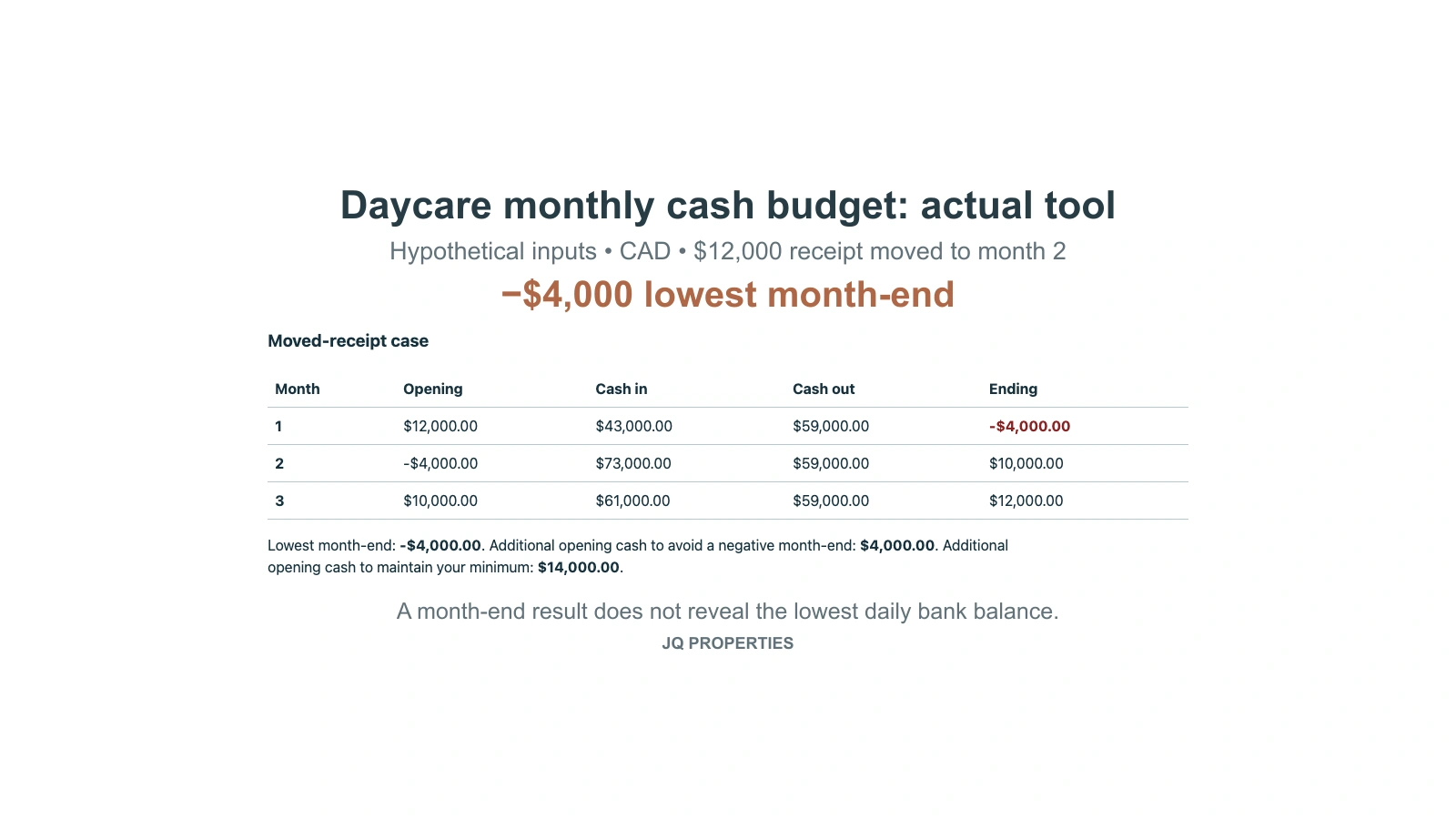
Now move $12,000 of the first month's supported program receipts into month two. Month one ends at negative $4,000; months two and three still finish at $10,000 and $12,000. The quarter's receipt total did not change. The business nevertheless needs at least $4,000 more cash to avoid a negative modeled month-end, or $14,000 more to maintain an assumed $10,000 floor throughout those month-ends. Neither figure is an approved credit facility.
The downloadable budget reproduces both cases and accepts your own monthly amounts. It reports the low month-end and the additional cash needed above zero or your selected floor. It does not test every payment day, calculate payroll deductions or determine funding eligibility. If rent and wages fall due before receipts within a month, the actual low point can be worse.
Use the shortfall to change a supported assumption
Trace the result back to an action: obtain better payment evidence, fund the initial reserve, reconsider optional capital purchases, or discuss genuinely available financing before it is needed. Do not solve the model by deleting required staff coverage, assuming an unapproved fee increase or delaying a contractual bill without agreement.
BDC recommends comparing forecasts with actual results and using a shorter rolling cash forecast for tighter visibility. Keep the monthly budget as the complete cost structure, then put near-term receipts and payments onto their actual dates. BDC cash-flow planning guidance
Contact JQ Properties with an anonymized cost summary and the premises obligations if you are assessing a daycare purchase. The useful question is not whether last year's profit looks attractive. It is whether the operation you will run has enough available cash when its real bills must be paid.
For historical earnings and the evidence behind them, the daycare financial-review guide covers revenue-to-cash reconciliation. This forward budget uses those records to test the costs and receipt dates of the operation you will run.
Sources checked September 9, 2026.