
Delivery Access for a Commercial Unit: Can Your Supplier Actually Unload?
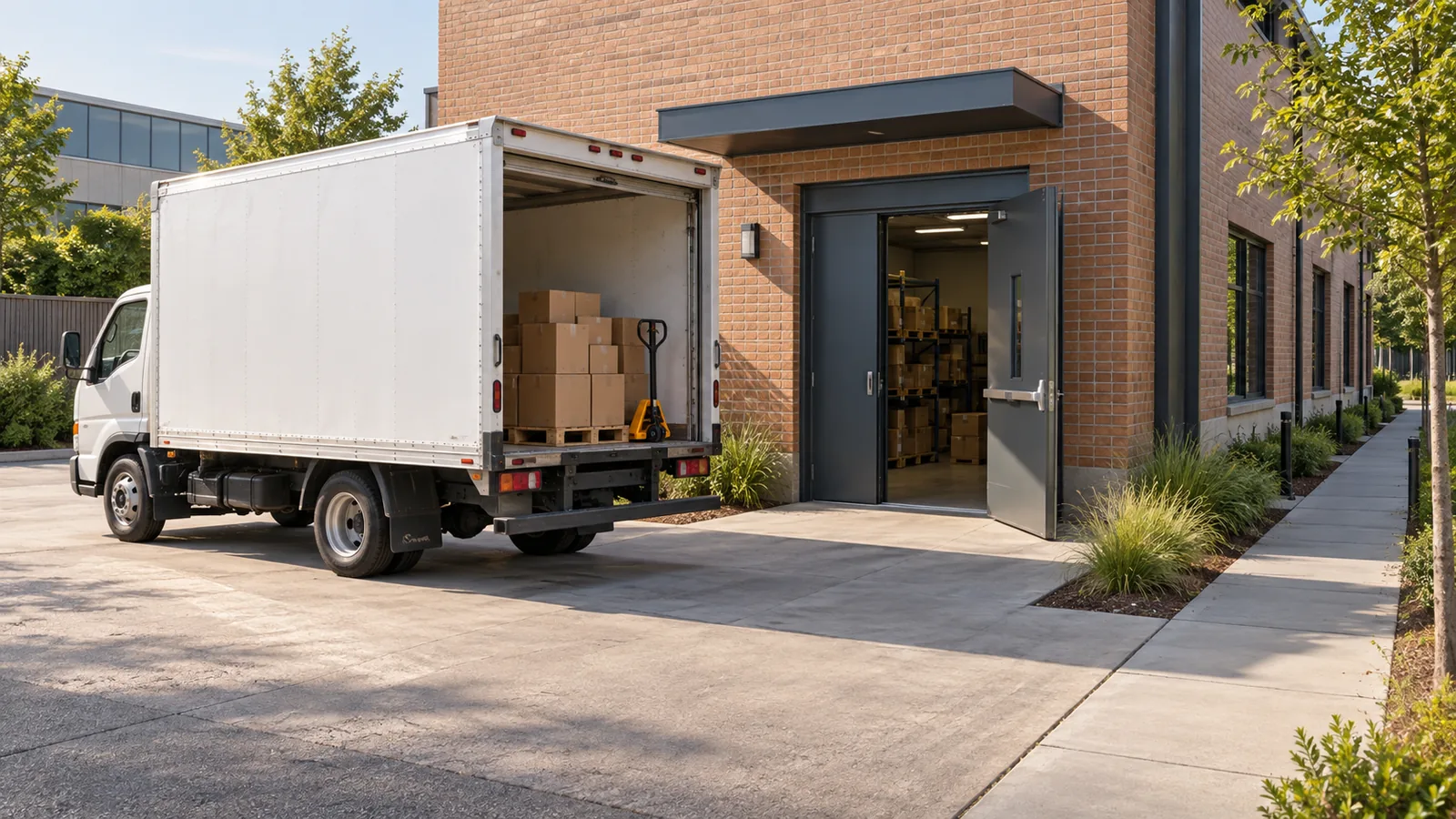
A commercial unit can have a loading bay and still be a poor fit for your deliveries. The supplier's truck may not clear the entrance, the shared bay may be unavailable during its route, or the goods may reach the dock but not the stockroom. Before committing to a lease, test the complete journey from the truck's approach to the place where the product will be stored.
This is an operating test, not just a measurement exercise. The route must work for the actual vehicle, load, people and delivery frequency your business expects. It also needs to be supported by the building's rules and the rights you are negotiating.
Start with the supplier's truck, not the unit's brochure
Ask each important supplier which vehicle normally serves the address and whether substitutions occur. Request overall dimensions and operating requirements, including any equipment that changes clearance or space needs. A truck described as “16-foot” does not mean its exterior is 16 feet long or that it fits a 16-foot space.
Penske's Canadian commercial-vehicle page, for example, lists cargo dimensions separately from clearance height, door opening and loading equipment. It also warns that specifications vary by make, model and year. Those categories are useful questions for your supplier, not measurements you can transplant to its truck. Penske Canadian vehicle specifications
Find out whether the load arrives loose, on pallets, in roll cages or in oversized pieces. Is the driver expected to unload, or does the receiving business provide staff and equipment? Does the truck need a raised dock, a liftgate or another agreed method? A building description of “grade loading” does not resolve every supplier's unloading arrangement.
Ask about exceptions as well as the routine delivery. A monthly bulk order, seasonal inventory arrival or replacement refrigerator may be the movement that determines whether the premises work.
Follow the route all the way to the shelf
Use this route card on a joint walkthrough with building management and the supplier or its transport contact. It is a sequence for recording evidence, not a scaled turning plan or permission to attempt a manoeuvre.
Approved street approach → vehicle entrance and turning area → assigned unloading position → goods entrance → freight lift or internal passage → stockroom door → storage position
At each arrow, record the limiting condition rather than only the generous dimension immediately before it:
| Transition | What to confirm for the actual delivery |
|---|---|
| Street to entrance | Permitted truck approach, restrictions, entry direction, overhead obstructions and driver confirmation |
| Entrance to unloading position | Clearances, turning and reversing arrangements, obstructions and availability of the position |
| Truck to goods entrance | Dock or ground-level compatibility, unloading equipment, weather exposure and authorised staging |
| Goods entrance to lift or passage | Clear door opening, corners, thresholds, access control and any shared-use restriction |
| Lift or passage to stockroom | Applicable capacity and size limits, booking, staffing and the largest packaged item |
| Stockroom to storage position | Space to handle the load safely without blocking exits or other required routes |
Write “not measured” where a dimension is unknown. Ask the appropriate building or transport professional to assess turning, clearances and safe handling; an approximate phone photograph is not an engineering check. Do not send an oversized truck into the site merely to see whether it gets through.
The Vancouver Convention Centre's published operating guidance illustrates the principle well: it gives separate information for truck routes, loading facilities, entrances and move-in arrangements. A venue is not a model commercial lease, but its distinctions show why one loading-bay measurement cannot describe an entire delivery path. Vancouver Convention Centre operating guidelines
Public curb access is not a private loading entitlement
For a Vancouver site, check the current truck-route requirements with the carrier. The City publishes route rules and cautions that listed clearance heights are approximate and should be checked. A navigation app's suggested route is not evidence that the actual commercial vehicle can legally and physically use it. Vancouver truck routes and regulations
The City's commercial-loading guidance describes privileges for vehicles displaying the required valid commercial decal and licence plate, including loading materials for up to 30 minutes, subject to the applicable rules. That is not a reserved curb space, permission to ignore signs, or a right to occupy a private building's dock. Confirm the specific location and vehicle requirements rather than assuming every supplier is eligible. Vancouver commercial loading zones and lanes
An operation dependent on finding an unreserved curb position has a different level of reliability from one with a usable booked dock. Ask what happens when the expected position is occupied: wait, return later, redirect or refuse delivery? Get the supplier's answer and the associated charges. Do not build the business plan around unloading in a prohibited location when the preferred one is busy.
Test the busiest realistic delivery window
“Access during business hours” can hide a mismatch between the supplier's route and the building's rules. Ask for the written loading and freight-lift procedures, including booking, maximum occupation, security arrangements, staffing and any restricted times. Then compare them with the supplier's realistic arrival window, not an exact time it cannot promise.
Consider a fictional delivery needing 6 minutes to check in and position, six pallet movements taking 4 minutes each, and 4 minutes for final paperwork and departure. Total occupation is 34 minutes. It does not fit a hypothetical private bay's 20-minute allocation. The calculation identifies a scheduling problem; it is not an invitation to speed up handling or leave goods in an unauthorised corridor.
Possible solutions might include a longer booking, an approved staging arrangement or a supplier's different vehicle and delivery method. Each changes something that must be confirmed. A smaller truck may mean more trips. More receiving staff may not solve a freight-lift bottleneck. A different delivery time may need paid staffing before the shop opens.
Even a modest recurring delay deserves a budget line. If three weekly deliveries each require an additional 20 minutes of employee time, that is one extra hour a week, or 52 hours over 52 operating weeks. At an assumed $35 an hour, the annual labour cost is $1,820. This fictional calculation excludes supplier detention, redelivery, overtime and business interruption; use your actual operating weeks and staffing cost. It also does not prove the route is acceptable simply because the labour cost is affordable.
Put the dependency into the lease discussion
Once the route works operationally, ask your lawyer to connect that reliance to the proposed documents. Is the loading arrangement an express lease right, a revocable practice, or a facility subject to changing rules? What can management change? Who pays booking or staffing charges? What happens during repairs, construction or temporary closure? Can the landlord relocate storage, alter the goods entrance or restrict delivery hours?
Keep the supplier's confirmation, measured route information, management's rules and any agreed lease language together. A verbal assurance that “other tenants receive deliveries” is weaker than evidence that your recurring load can reach your specific unit under the agreed conditions.
If you are comparing industrial premises more broadly, our guide to power, loading and ceiling height covers the larger property review. For this decision, take the route card to the next viewing and ask JQ Properties to help coordinate the information requests. The useful unit is the one your business can receive goods into reliably—not simply the one with a loading symbol on the floor plan.
By Justin Qiao, Personal Real Estate Corporation, Justin Qiao Group | RE/MAX Crest Realty.
Sources checked September 9, 2026.

