
Mortgage Default Insurance Premiums: How the Down Payment Changes the Math
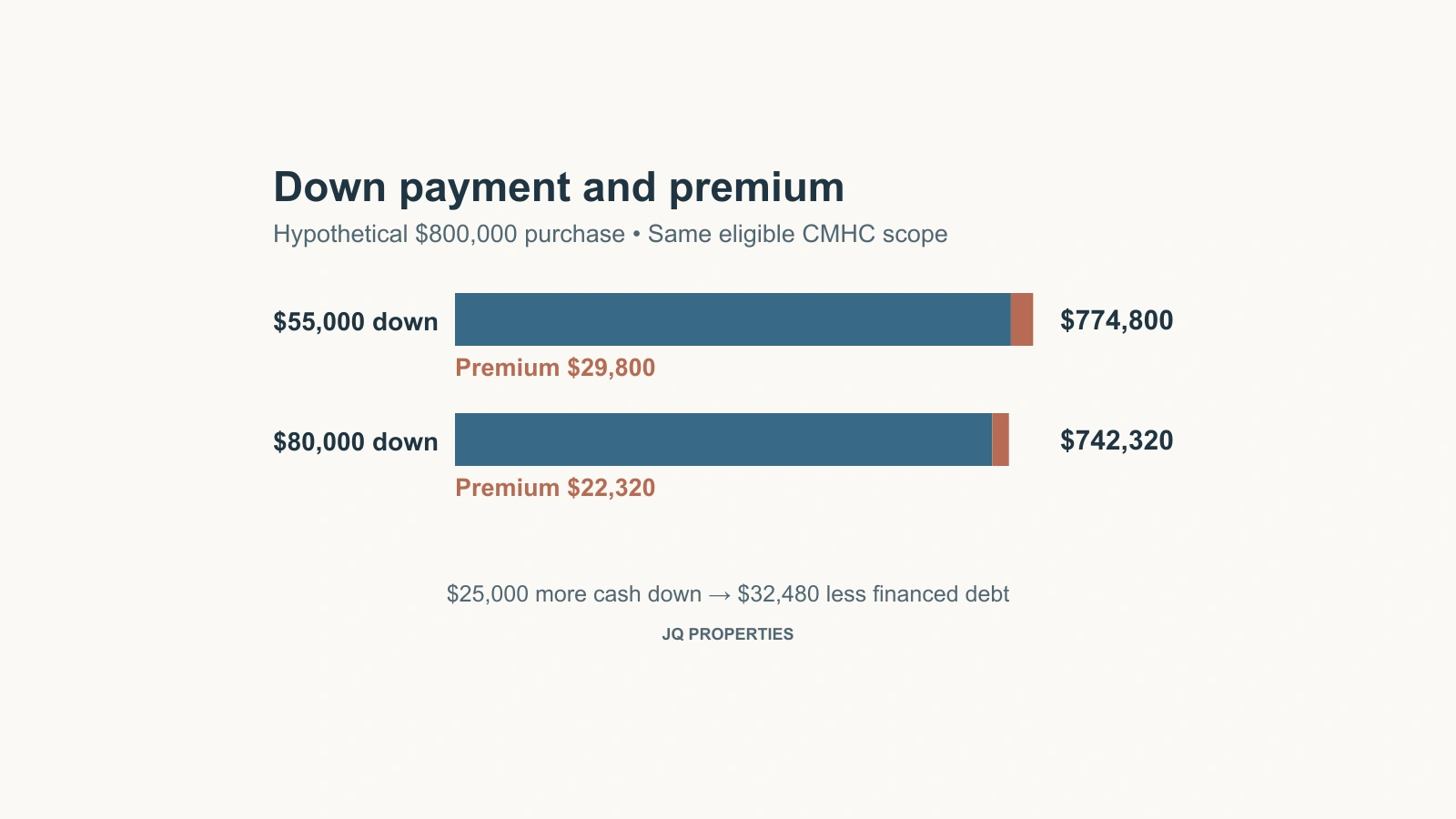
Increasing a down payment can reduce the mortgage in two ways: you borrow less of the purchase price, and you may cross into a lower mortgage-default-insurance premium band. That makes a comparison near a threshold more useful than a simple “another dollar down means another dollar less borrowed” calculation. But the lowest mortgage balance is not automatically the best cash plan. You still need closing costs, a usable reserve and a mortgage the lender will actually approve.
The examples below use CMHC’s published premium schedule for a standard purchase with a traditional down payment and a twenty-five-year amortization. They assume the lender accepts the purchase price as the lending value. They are not quotes, and they do not determine eligibility for a particular home or borrower.
Separate the purchase loan from the premium
Start with three amounts: purchase price, down payment and base loan. Subtract the down payment from the price to obtain the base loan. Divide that loan by the accepted lending value to find the loan-to-value ratio, usually shortened to LTV. Apply the relevant premium rate to the base loan, not to the purchase price.
If the premium is financed, add it to the base loan once. If it is paid up front, it increases the cash required instead. FCAC explains that a financed premium accrues interest at the mortgage rate. Mortgage default insurance protects the lender if the borrower cannot make the payments; it is different from home insurance and from optional insurance on the borrower’s life or disability. FCAC: Down payments and mortgage loan insurance.
For these standard CMHC purchase examples, the published premium rates are 4.00% for 90.01%–95% LTV, 3.10% for 85.01%–90%, and 2.80% for 80.01%–85%. Keep the precise inputs when comparing a loan near a boundary, and ask the lender to confirm how the insurer treats any fractional ratio between the schedule’s displayed bands. CMHC’s mortgage loan insurance cost schedule.
Compare an $800,000 purchase four ways
Assume a qualifying owner-occupied home with one or two units, a traditional down payment and no appraisal shortfall. CMHC’s current purchase requirements use 5% of the first $500,000 of lending value and 10% of the remainder for the minimum equity in this category. On $800,000, that is $25,000 plus $30,000, or $55,000. CMHC Purchase requirements.
The following table assumes the applicable premium is added to the mortgage. The last row is a separate conventional-loan assumption with no borrower-paid default-insurance premium, not a claim that every loan with 20% down is uninsured.
| Down payment | Base loan | Premium rate | Premium | Mortgage after financed premium |
|---|---|---|---|---|
| $55,000 | $745,000 | 4.00% | $29,800 | $774,800 |
| $80,000 | $720,000 | 3.10% | $22,320 | $742,320 |
| $120,000 | $680,000 | 2.80% | $19,040 | $699,040 |
| $160,000 | $640,000 | None assumed | $0 | $640,000 |
Moving from $55,000 to $80,000 down uses another $25,000 of cash but reduces the financed mortgage by $32,480. The extra $7,480 reduction is the difference between the two premiums. That is a real difference in this model, though it is not cash paid back into the buyer’s bank account.
Moving from $80,000 to $120,000 down uses $40,000 more cash and reduces the financed balance by $43,280. These comparisons should not be described as investment returns. You are choosing between liquidity and a different debt structure, with a change in a transaction cost.
A small top-up at a band boundary can matter
Now compare down payments of $79,900 and $80,000 on the same $800,000 purchase. At $79,900, the base loan is $720,100: 90.0125% LTV. At a 4% premium, the charge is $28,804 and the financed balance is $748,904. At $80,000 down, the base loan is exactly 90% LTV; the 3.10% rate gives a $22,320 premium and a $742,320 financed balance.
In that tightly controlled example, another $100 of down payment reduces the financed balance by $6,584. Most of that change comes from applying the lower premium rate to the whole base loan. The example is deliberately close to a boundary to show why approximate inputs can produce a misleading answer. The tool flags ratios in the tiny gaps between the published bands instead of inventing the insurer’s rounding policy.
Do not try to exploit the threshold using an estimated purchase amount, an unconfirmed lending value or cash that has not arrived. A changed price, a different appraisal basis or a lender adjustment can change the ratio. Ask the mortgage professional to confirm the exact accepted equity and premium before treating the saving as settled.
Download the ZIP, extract it and open the HTML file in a modern browser; no installation is required. The down-payment premium comparison tool reproduces these examples and lets you compare two amounts. It keeps its scope deliberately narrow: twenty-five-year amortization, traditional down payment, an eligible one- or two-unit owner-occupied purchase, and lending value equal to price. It does not quietly apply those assumptions to other mortgage products.
What the smaller payment does—and does not—tell you
When the interest rate and amortization are identical, a lower starting balance produces a lower payment. To isolate that effect, use an assumed nominal annual rate of 5%, compounded semi-annually, over twenty-five years with monthly payments. This is not a current rate quote.
The $774,800 financed balance produces a payment of approximately $4,506 a month. The $742,320 balance produces approximately $4,317. The difference is about $189 a month. These amounts include repayment of principal and interest only; property taxes, insurance, utilities and strata fees are not included.
Actual offers may not have the same rate or features. Compare the lender’s full proposal for each down payment, including the interest rate, term, prepayment privileges and fees. Otherwise you may attribute the whole payment difference to the insurance premium when part of it comes from a different product or amortization.
You should also compare the mortgage balance at a realistic future date, rather than assuming today’s rate lasts for twenty-five years. The premium is charged at the beginning in this model; the future interest paid on a financed premium depends on the mortgage’s changing rates and repayment path.
Keep eligibility and special products outside the shortcut
CMHC’s current homeowner purchase page states that the maximum purchase price or lending value must be below $1.5 million. It also distinguishes one- or two-unit purchases from three- or four-unit properties and traditional from non-traditional down payments. Those differences matter before selecting a premium band. CMHC Purchase eligibility and premium information.
Do not use this twenty-five-year illustration as a thirty-year quote. CMHC’s Home Start option has separate qualifications and premium treatment. Nor is this a portability calculation: CMHC’s published schedule has a separate column for premiums on an increase to an existing loan. A buyer moving from one insured home to another should ask whether that treatment applies instead of assuming a fresh full-loan premium. CMHC premium schedule.
Even at 20% down, confirm the actual insurance treatment with the lender. The comparison tool’s zero-premium row is an explicit conventional-financing scenario. It is not an instruction to remove a premium from a real commitment letter.
Choose the down payment with the rest of your cash still visible
Suppose the household has $100,000 available for the purchase, excluding a separately protected emergency reserve. Raising the down payment from $55,000 to $80,000 leaves $20,000 instead of $45,000 for other purchase costs. Whether that is workable depends on the actual tax treatment, legal costs, adjustments and other obligations—not on the premium saving alone.
Put those amounts beside the BC home-buying cash checklist and your property-specific estimates. A deposit already paid is part of the purchase funding, not an additional down payment to add a second time. Keep the money needed before mortgage funding separate from costs you plan to finance.
The next useful lender question is precise: “At each of these two down payments, what are my base loan, premium, financed balance, payment and remaining cash requirements?” If the answers use matching assumptions, you can choose the structure that fits both the purchase and life after closing.
General educational comparison, checked September 8, 2026. Insurer and lender approval, property value and the final mortgage terms determine the actual result.
By Justin Qiao, Personal Real Estate Corporation, Justin Qiao Group | RE/MAX Crest Realty.

