
Using an FHSA and RRSP for One Home Purchase: Keep the Rules Separate
By Justin Qiao, Personal Real Estate Corporation, Justin Qiao Group | RE/MAX Crest Realty.
You can use a qualifying FHSA withdrawal and an RRSP withdrawal under the Home Buyers' Plan for the same home. That does not mean eligibility for one proves eligibility for the other. There are three separate questions: were you eligible when you opened the FHSA, can you make a qualifying FHSA withdrawal now, and can you participate in the HBP now? CRA's current FHSA withdrawal form expressly permits combining the programs when their respective conditions are met.
The distinction matters particularly when a spouse already owns the home you live in, you have owned a home before, or your circumstances have changed since opening your accounts. A lender can see two healthy balances without those balances both being available through the tax treatment you planned.
This comparison uses federal rules checked September 8, 2026. It addresses an ordinary purchase for your own occupancy, not the special HBP provisions for disability or relationship breakdown.
“First-time buyer” is not one permanent status
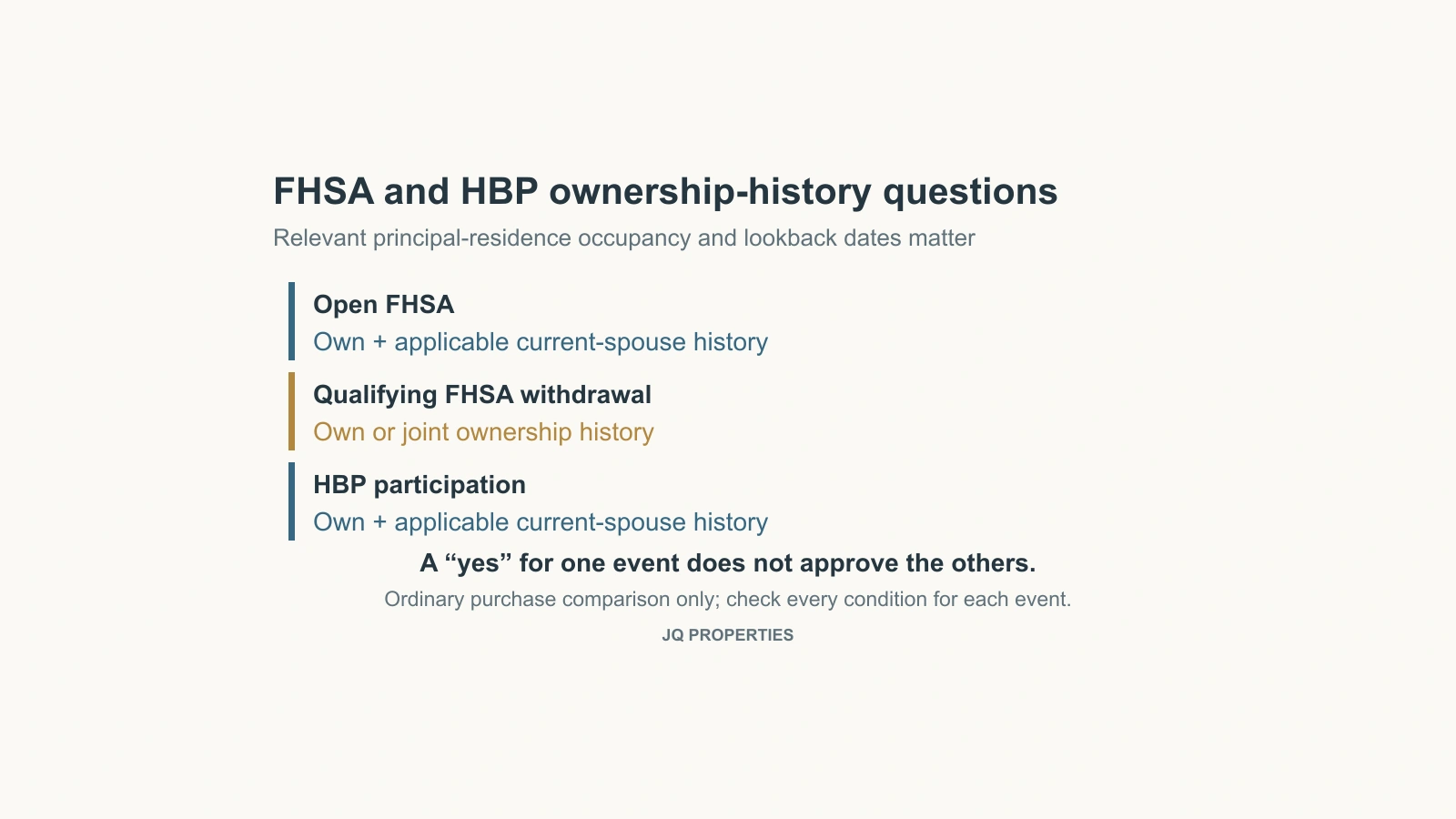
For FHSA opening, CRA considers whether, during the relevant current and preceding four calendar years, you lived in a principal residence owned by you or by your current spouse or common-law partner. Age, residency and other opening conditions also apply. Opening an account is therefore a historical eligibility event, not simply choosing a savings product at a bank. CRA's FHSA opening conditions.
For a qualifying FHSA withdrawal, the ownership part of the first-time-buyer test concerns a principal residence that you owned or jointly owned. The lookback covers the preceding four calendar years and the current year before withdrawal, excluding the immediately preceding 30 days. The current spouse's ownership alone is not the same barrier here. This difference appears in the separate definitions of a qualifying individual and a qualifying withdrawal in the Income Tax Act, section 146.6.
The ordinary HBP test again includes a principal residence owned by your current spouse or common-law partner that you lived in during its relevant lookback period. It also considers your own ownership. The important words are ownership, principal residence, relationship and dates—not just whose name appears on this month's mortgage statement. CRA's HBP eligibility conditions.
| Decision being made | Ownership history that needs attention | What a “yes” does not prove |
|---|---|---|
| Open an FHSA | Your history and the applicable history involving your current spouse or partner | That a future withdrawal qualifies |
| Make a qualifying FHSA withdrawal | Your own or joint ownership of a principal residence in the withdrawal lookback | That you also qualify for HBP |
| Withdraw RRSP funds under HBP | Your history and the applicable history involving your current spouse or partner | That an FHSA was validly opened |
These are comparison prompts, not a substitute for the full conditions. Someone who has never personally held title can still need to examine the spouse-related tests. Someone who once owned a home should not assume the word “first” necessarily means a lifetime prohibition either. The actual lookback and any applicable exceptions need to be checked.
A spouse's home can produce different answers
CRA illustrates the FHSA distinction through Joshua, who opened his account before marrying Lisa and moving into her condominium. He never owned that condominium. In CRA's example, he later qualifies for an FHSA withdrawal to purchase their new home even though they were living in Lisa's property. This is CRA's example, not a JQ client transaction. CRA's Joshua and Lisa example.
That result should not be copied into an HBP application. On an ordinary HBP analysis, living in the current spouse's owned principal residence during the relevant period matters. Nor does the example say a person already living in that situation can necessarily open a new FHSA now. The account-opening event came first, under different circumstances.
The useful response is to record what actually happened: account opening, relationship status, where you lived, and whether you owned an interest. Avoid resolving uncertainty by guessing that being absent from a mortgage means being absent from ownership. Where legal or beneficial ownership is unclear, take the documents to a qualified adviser before certifying a withdrawal form. Changing paperwork is not a substitute for accurately describing the facts.
Count eligible withdrawals, not just account balances
Consider a hypothetical buyer with a $26,000 FHSA balance and a $60,000 RRSP balance. Assume the FHSA was validly opened, contains no excess contribution amount, and the full $26,000 qualifies for withdrawal. The RRSP amount is an existing balance, not an instruction to make a new contribution.
If the buyer separately meets every HBP condition and the RRSP permits the withdrawal, the proposed combination is $26,000 + $60,000 = $86,000. CRA currently limits HBP withdrawals to $60,000 per participation period; having several RRSPs does not multiply that limit. Some locked-in or group arrangements do not permit HBP withdrawals. CRA's HBP participation guidance.
Now change one assumption: the buyer does not satisfy HBP eligibility. The amount identified through the two intended qualifying routes falls to $26,000, a $60,000 difference. Their RRSP has not vanished. But treating an ordinary RRSP withdrawal as if it were an eligible HBP withdrawal is not a neutral way to repair the budget. The tax treatment and usable proceeds need separate assessment.
If HBP eligibility is still unresolved, the honest planning entry is “$26,000 identified; $60,000 conditional,” not “$86,000 confirmed.” That wording distinguishes an unanswered question from a rejection without spending the uncertain amount twice. It also tells the mortgage adviser exactly which part of the down payment requires more work.
Use the FHSA and HBP eligibility record to make that distinction for each purchaser. It includes the worked amounts above and space for the evidence behind each account's status. It does not calculate tax or issue an eligibility decision.
The forms are separate, even if the home is the same
An FHSA qualifying withdrawal uses Form RC725. Its questionnaire asks about your own ownership history, residency, written purchase agreement, acquisition and occupancy. Complete a form for each qualifying withdrawal and give it to the FHSA issuer. An HBP withdrawal uses Form T1036 for each eligible withdrawal. Keeping both forms in one closing folder is helpful; substituting one for the other is not. CRA Form RC725, CRA Form T1036.
There are timing conditions beyond the first-time-buyer comparison. For example, the FHSA legislation requires a written agreement to acquire or build before October 1 of the following calendar year, and generally does not permit the qualifying home to have been acquired more than 30 days before withdrawal. Intended principal-residence occupancy also matters. Do not let a successful ownership-history check stand in for these remaining tests. Income Tax Act, qualifying withdrawal definition.
An eligibility answer is also different from a promise about when an institution will release cash. Once each route is established, confirm liquidation, processing and receipt arrangements against your contract obligations. A tax-eligible dollar that arrives after a payment deadline does not meet that earlier obligation.
For two purchasers, maintain two individual records. “We qualify” is too vague if one person has an established FHSA, the other has never opened one, or only one person satisfies the applicable HBP test. Do not assign the other purchaser's account balance to your own withdrawal application.
The obligations after withdrawal are not interchangeable
A qualifying FHSA withdrawal does not require repayment. HBP is different: it creates an HBP balance governed by its repayment and reporting rules. Money used for the same down payment can therefore leave different future obligations. Review the applicable CRA HBP statement and repayment requirements when planning the household's later savings. CRA's FHSA withdrawal guidance, CRA's HBP repayment guidance.
If the purchase falls apart, do not assume both transactions can simply be reversed. CRA's RC725 warns that a qualifying FHSA withdrawal cannot be cancelled. Paying it back into an FHSA is a new contribution, potentially creating or increasing an excess amount, and that new contribution is not deductible. This is a reason to examine the withdrawal before making it, not a reason to declare every failed purchase automatically taxable. RC725, Note 2.
HBP cancellation is available only in specified circumstances, including certain cases where a qualifying home or replacement property is not bought or built. CRA describes a repayment and reporting process; returning money alone is not the entire procedure. Identify which program supplied each amount before asking about cancellation, a replacement purchase or tax reporting. CRA's HBP cancellation guidance.
The practical goal is a purchase budget with two supported entries, not one optimistic total. For a broader view of programs that may apply, see our BC and Canadian first-time buyer program guide. When you discuss a home purchase with JQ Properties, bring the amount your issuer and tax adviser have helped you establish for each route; we can then keep the property search and contract timeline aligned with that funding plan.

