Deposit vs Down Payment in BC: Why Buyers Need Both
By Justin Qiao
Updated: May 8, 2026
Quick answer
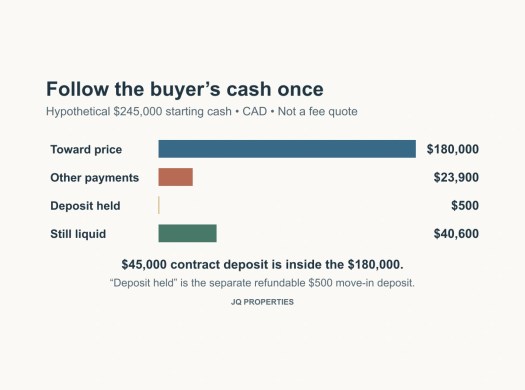
In a BC purchase, the deposit and down payment are related but not the same. The deposit is paid under the contract to show commitment and is usually credited toward the purchase price on completion. The down payment is the buyer’s total equity contribution required for financing and closing. Buyers need both a contract strategy for the deposit and a financing plan for the full cash required.
Who this is for
Buyers who are preparing to write offers and want to avoid confusing the deposit deadline with the total cash needed to close.
Deposit: a contract commitment
The deposit is normally negotiated in the offer. It may be due upon acceptance, after subject removal, or on another agreed timeline. It is usually held in trust and credited toward the purchase price if the deal completes. If the buyer defaults, deposit consequences can become serious and legal advice may be needed.
For practical planning, the deposit must be liquid and available on the contract timeline. Money trapped in investments, foreign transfers, pending gifts, or slow bank processes can create unnecessary risk.
Down payment: the financing requirement
The down payment is the buyer’s equity contribution for the mortgage approval and completion. A lender will review income, debt, credit, source of funds, property type, appraisal, insurer requirements if applicable, and other conditions. The final cash needed may also include taxes, legal charges, adjustments, insurance, and lender-related items.
A buyer can have enough for a deposit but still be short on total completion cash. That is the mismatch to avoid.
Document proof to request
Ask for bank statements showing liquid deposit funds, mortgage pre-approval or approval conditions, source-of-funds documentation for gifts or transfers, contract deposit clause, lawyer or notary closing estimate, and a written cash-to-close worksheet.
Offer strategy
A seller may view a larger or faster deposit as a sign of confidence, but the buyer should not use deposit size to compensate for weak due diligence. If financing, insurance, inspection, or document review is still uncertain, the offer structure should reflect that uncertainty. Deposit strategy is one part of risk allocation, not a substitute for a clean budget.
A good deposit decision answers three questions. Can the buyer deliver it on time without unusual friction? Is the amount appropriate for the property, market, and offer strategy? If the buyer cannot complete, does the buyer understand that deposit disputes and damages can become legal matters? If any answer is unclear, get advice before trying to look stronger on paper. ## Common mistakes
- Saying ‘I have my down payment’ when the deposit funds are not liquid.
- Forgetting the deposit is only one part of completion cash.
- Offering a deposit timeline that depends on a bank transfer arriving perfectly.
- Ignoring legal consequences if the buyer cannot complete.
- Removing financing subjects before the lender has cleared key conditions.
Practical sequence
Before offering, confirm where the deposit funds are held, how quickly they can move, who must authorize the transfer, and whether bank limits or foreign-transfer timelines apply. Then confirm the full down-payment and closing-cost plan with the lender and conveyancer. The two plans should connect, but they should not be confused.
When drafting the offer, align the deposit clause with the buyer’s liquidity and risk. A fast deposit can strengthen an offer, but only if the funds are genuinely ready. Before subject removal, confirm lender conditions, source-of-funds documents, appraisal status if relevant, insurance, and the cash-to-close estimate. For the wider budget, cross-check BC Home Buying Costs.
Decision memo summary
The memo should show deposit amount and deadline, source of deposit funds, total down-payment requirement, remaining closing costs, lender conditions, and reserve after completion. Mark any gift, investment sale, international transfer, or borrowed funds as timing-sensitive. The buyer should not remove subjects unless both the contract commitment and the financing plan are credible.
FAQ
Does the deposit count toward the down payment?
Usually yes, it is credited toward the purchase price on completion. But the timing is different, so the buyer still needs deposit liquidity when the contract requires it.
How much should my deposit be?
It depends on market practice, offer strength, property type, seller expectations, and buyer risk tolerance. Confirm strategy with your Realtor and legal implications with a lawyer if uncertain.
Can gifted funds be used?
Often they can be part of the plan, but lenders may require gift letters and proof. Timing and documentation should be checked early.
Greater Vancouver and BC context
In competitive Greater Vancouver situations, buyers can feel pressure to use deposit size or speed as a signal of strength. That can be appropriate when the funds are liquid and the buyer understands the risk. It is dangerous when the buyer is relying on a delayed transfer, unconfirmed gift, sale of securities, or lender condition that has not cleared.
Different property types also change the comfort level. A straightforward resale condo, an older building with insurance questions, a detached home needing inspection work, and a presale with staged deposits each require a different deposit conversation.
References
- Greater Vancouver REALTORS – Buying Costs: https://www.gvrealtors.ca/news-archive/buying-costs.html
- Bridgewell Group – Cost of Buying a House in BC: https://bridgewellgroup.ca/cost-of-buying-a-house-in-bc/
- BCFSA – Real estate consumer resources: https://www.bcfsa.ca/public-resources/real-estate
Disclaimer
This article is general information for BC real estate clients. It is not legal, tax, accounting, mortgage, insurance, strata, or financial advice. Rules, fees, market practice, and government programs change. Confirm current requirements with your lawyer or notary, accountant, lender, insurer, strata manager, municipality, and other qualified professionals before relying on a budget or signing documents.
Soft CTA
If you are preparing an offer, I can help separate the deposit plan from the full down-payment and closing-cost plan so the numbers stay clean.